


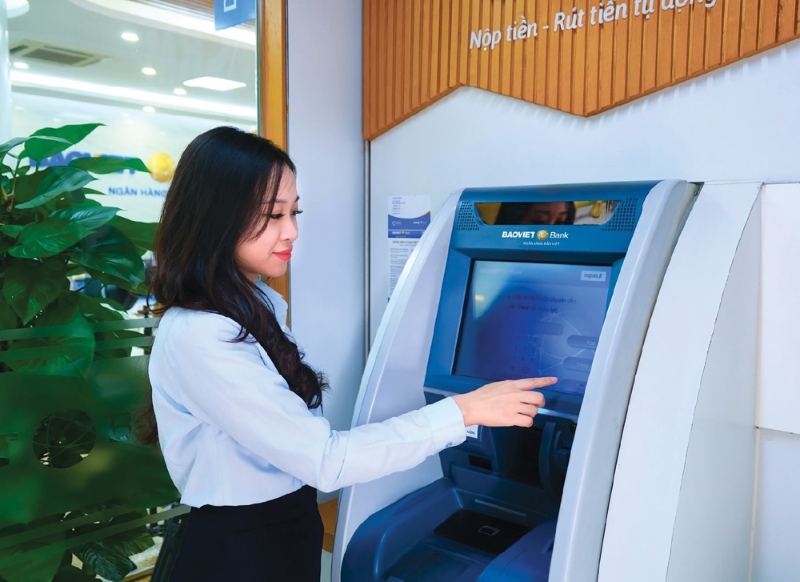
The fintech sector has grown rapidly and become a key pillar of the global financial system, encompassing services such as electronic payments, online lending, digital banking, and a wide range of technology-driven financial products.
In Vietnam, the rapid expansion of information technology, coupled with rising smartphone and internet penetration, has created a strong foundation for the sector’s development. Recent moves indicate that Vietnam is gradually positioning itself as an attractive destination on the global fintech map, not only in terms of market potential but also in its ability to connect with international financial institutions and technology partners.
Attracting international attention
In mid-April, the Vietnam International Financial Center in Ho Chi Minh City (VIFC), in collaboration with the London Stock Exchange and HD Bank, officially launched a Fintech Hub in the southern city. The Hub is expected to serve as a testing ground for new financial models under a regulatory sandbox framework, while also acting as a platform to connect banks, investors, and businesses. This milestone therefore represents not only a technical advancement but also a significant step forward in building Ho Chi Minh City’s financial-technology ecosystem, moving toward a development model driven by data, technology, and innovation.
Another notable development was the strategic partnership between the Saigon-Hanoi Commercial Joint Stock Bank (SHB) and China’s Huawei Technologies. The agreement focuses on digital transformation, the development of technology architecture, and the strengthening of system capabilities that are core elements in the banking sector’s digitalization journey.
As competition intensifies and customer expectations continue to rise, such collaborative endeavors between domestic banks and global technology firms are becoming essential, helping to drive meaningful fintech development in Vietnam. Moreover, as the global financial landscape undergoes significant transformation, the ability to effectively connect capital flows, technology, and policy will determine the position of emerging financial centers.
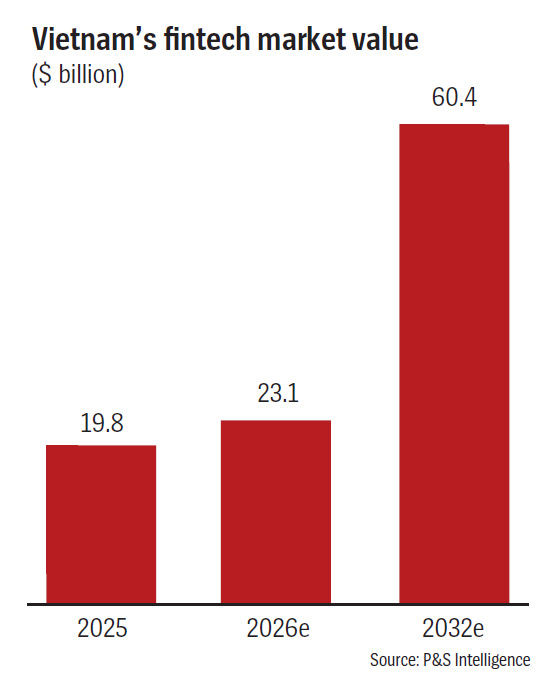
According to research from P&S Intelligence, Vietnam’s fintech market in 2025 was valued at $19.8 billion and is projected to grow at a compound annual growth rate (CAGR) of 17.3 per cent during 2026-2032, reaching $60.4 billion by 2032.
The market’s growth trajectory reflects Vietnam’s accelerating digital transformation and the increasing adoption of technology-driven financial services across all segments of the population. The convergence of favorable demographics, rising smartphone penetration, and supportive government policies has positioned Vietnam as one of the most promising fintech markets in Southeast Asia.
This growth is being driven by multiple reinforcing factors: rising smartphone and internet penetration, an expanding digital consumer base, and supportive government policies. At the same time, a large proportion of the population remains unbanked, creating strong demand for digital financial solutions. Meanwhile, e-commerce continues to expand, digital infrastructure is improving, and emerging technologies such as blockchain, AI, and digital payments are gaining traction. Together, these elements are creating a compelling convergence point for global investors and fintech partners.
In this context, expanding international cooperation is not just a strategic choice but a key lever for enhancing the quality of Vietnam’s development. Through such partnerships, Vietnam can access global capital, learn from international best practices, improve transparency, and gradually align with global standards.
A case in point is the UK, which has successfully built one of the world’s leading fintech ecosystems. With London at its core, which is home to a dense network of banks, investment funds, and tech startups, the UK has not only attracted substantial global capital but has also pioneered models such as regulatory sandboxes and open banking. In this context, strengthening cooperation with the UK is seen as a well-aligned and promising direction for Vietnam, offering opportunities to learn from regulatory frameworks, foster innovation ecosystems, and attract high-quality resources to modernize its financial sector.
According to Dame Julia Hoggett, CEO of the London Stock Exchange, Vietnam is emerging as one of Asia’s most dynamic economies, with growing potential to attract global capital. “In particular, progress in upgrading the stock market and improving the investment environment has sent positive signals to international investors, opening up opportunities to attract long-term capital inflows,” she said.
Australia is also emerging as a promising partner in fintech. The country ranks among the world’s leading fintech ecosystems, at sixth globally and second in the Asia-Pacific region, with nearly 900 active fintech companies. Its strong alignment of technology, policy, and innovation makes Australia a suitable partner for Vietnam as it builds a modern and globally-integrated fintech ecosystem.
Ms. Emma McDonald, Senior Trade and Investment Commissioner of the Australian Government to Vietnam and Cambodia, underlined that bilateral programs in fintech and compliance are aimed at fostering direct engagement between businesses in both countries. “We believe these initiatives will create more commercial partnerships between Australia and Vietnam, contributing to the development of a robust, trustworthy, and globally-connected financial ecosystem, one that blends Vietnam’s unique characteristics with Australia’s technological solutions,” she emphasized.
Readiness for collaboration
As financial digitalization accelerates worldwide, proactively preparing for international fintech cooperation is no longer optional but has become a necessity for Vietnam. To achieve this, the country needs to fully leverage its existing advantages while pursuing a well-structured, clearly defined, and consistent fintech development strategy. This involves not only fostering domestic innovation, but also building an attractive environment capable of drawing in global partners, from major technology corporations to international investors and fintech startups.
We believe these initiatives will create more commercial partnerships between Australia and Vietnam, contributing to the development of a robust, trustworthy, and globally-connected financial ecosystem, one that blends Vietnam’s unique characteristics with Australia’s technological solutions.
By combining domestic market potential with international expertise, Vietnam can shape a sustainable, transparent, and competitive fintech ecosystem. Ms. McDonald noted that fundamental strengths such as a young population, a stable socio-economic environment, and strong GDP growth continue to reinforce Vietnam’s position as a potential digital hub in the region.
Notably, recent government initiatives, including plans to develop international financial centers and implement regulatory sandboxes in areas such as credit scoring, peer-to-peer lending, and digital assets, are laying critical institutional foundations. These are the “building blocks” that will enable Vietnam not only to keep pace but also to participate more deeply in the global fintech value chain.
“The development of the VIFC clearly reflects the country’s ambition to become a globally-connected financial hub,” Ms. McDonald said. “However, the core of a financial center lies not only in capital or infrastructure but in the ability to build a trusted, data-driven, and inclusive financial ecosystem.”
At the same time, readiness in terms of legal framework, technological infrastructure, and governance capacity will be crucial in building confidence among international partners. A transparent and flexible legal system, while maintaining safety and stability, will enable fintech firms to innovate and scale with confidence. Meanwhile, digital infrastructure, including data systems, payment connectivity, and cybersecurity, must be developed in a synchronized manner to meet global standards.
According to Mr. Rich McClellan, CEO of the VIFC, international investors are shifting their focus. Whereas rapid economic growth was once the primary draw, they are now placing greater emphasis on infrastructure readiness, the reliability of the legal framework, and the ability to ensure smooth and secure capital flows.
This shift implies that Vietnam must move from “potential advantages” to “real, tangible strengths” by enhancing institutional quality and market operations. Once these elements are in place, Vietnam will not only become an attractive destination for capital and technology but also be in a position to help shape fintech standards in the region.







 Google translate