


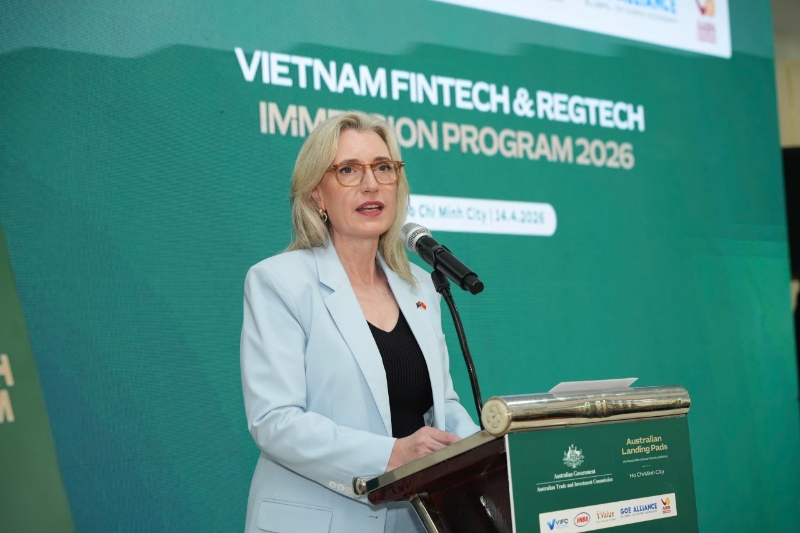
The Australian Trade and Investment Commission (Austrade) has led a delegation of nine Australian fintech and regtech companies to Vietnam under the Landing Pad Vietnam Fintech and Regtech Immersion Program 2026.
The programme connects Australian solution providers with Vietnamese banks and financial institutions to support the development of secure, inclusive, and modern financial services, in line with Vietnam’s digital transformation agenda. It also builds on the Memorandum of Understanding signed in June 2025 between Austrade and the Vietnam Banks Association, reaffirming Australia’s long-term commitment to Vietnam’s financial sector.
Running from April 14 to 16, the programme was launched in Ho Chi Minh City and will conclude in Hanoi, offering the delegation insights into Vietnam’s banking trends, regulatory priorities, and market opportunities, while fostering potential partnerships.
Speaking at the event, Ms. Emma McDonald, Senior Trade and Investment Commissioner of the Australian Government to Vietnam and Cambodia, said the programme is designed to foster direct, in-market exchanges. “We are confident this engagement will generate additional Australia–Vietnam commercial partnerships, contributing to a financial ecosystem that is resilient, trusted and globally connected, combining Vietnam’s characteristics with Australia’s technological solutions,” she said.
Vietnam is not only accelerating digital transformation across its banking sector but also laying the foundation for a broader strategy. The development of its International Financial Centre in Ho Chi Minh City reflects a clear ambition to position Vietnam as a globally connected financial hub.
Increasingly, what defines a successful financial centre is not just capital or infrastructure, but the ability to build trusted, data-driven and inclusive financial ecosystems where risks can be effectively managed and cross-border activities can take place with confidence.
Vietnam’s strong fundamentals, including a young population, macroeconomic stability, and sustained GDP and foreign direct investment growth, position it as a potential digital hub in the region. Government initiatives are reinforcing this momentum, notably the establishment of Vietnam's International Financial Centre in Ho Chi Minh City and Da Nang and the rollout of regulatory sandbox mechanisms for areas such as credit scoring, open API-based data sharing, peer-to-peer lending, and digital assets.
Australia, in turn, brings a mature fintech ecosystem ranked sixth globally and second in the Asia-Pacific, with nearly 900 active firms. Australian companies have developed strong capabilities in regulatory technology, cybersecurity, data governance, payments infrastructure, and digital assets within a highly regulated and trusted financial environment.
During the programme, participating firms showcased solutions spanning digital assets, fraud prevention, scam detection, and cybersecurity. Beyond providing technologies, these firms are also shaping how modern financial systems operate, particularly in risk management, compliance, and data governance - areas that are increasingly central to building investor confidence.
A seminar held in collaboration with Vietnam's International Financial Center in Ho Chi Minh City focused on advancing the next phase of Vietnam’s banking transformation and identifying international partnership opportunities. Discussions covered both policy frameworks and technical requirements, including cybersecurity, anti-money laundering, identity verification, risk management, payments infrastructure, and digital assets.
According to Mr. Rich McClellan, CEO of Vietnam's International Finacial Centre in Ho Chi Minh City, the development of the centre follows a three-phase roadmap: legal framework development, institutional setup, and market expansion. While 2025 is expected to complete the legal foundation, 2026 marks the institutional activation phase, with full market operations anticipated in 2027.
Vietnam has moved from a Politburo resolution to an operational institutional framework in less than 18 months, a pace considered rapid by international standards. However, the current focus remains on building and testing core systems rather than pursuing rapid expansion.
The development of an international financial centre requires globally aligned compliance and supervisory frameworks. New institutions, including regulatory bodies and specialised courts, must be equipped with advanced technological systems from the outset. This creates strong demand for international expertise, with Australia seen as a suitable partner given its experience in a transparent and tightly regulated financial system.
Vietnam's stock market will be upgraded from a frontier market to a secondary emerging market in September this year, following the latest mid-cycle review released by global index provider FTSE Russell on April 8. Its secondary emerging market could attract significant inflows from global investment funds and heighten international interest in the country’s financial infrastructure. This further underscores the importance of establishing a solid regulatory and technological foundation.
While the programme is not aimed at immediate deal-making, it is intended to help Australian firms better understand Vietnam’s development trajectory and position themselves for future opportunities. Looking ahead, continued efforts to refine the legal framework, strengthen institutional capacity, and enhance data governance will be essential.
In the longer term, deeper Vietnam - Australia collaboration in fintech and regtech is expected to improve the efficiency and resilience of Vietnam’s financial system, while supporting innovation and sustainable development as the country integrates more deeply into global financial markets.




 Google translate