


According to the United Nations World Tourism Organization, Vietnam currently stands among the world’s fastest-growing tourism markets, posting growth of some 21 per cent in 2025; far exceeding the global average of 5 per cent and the Asia-Pacific average of 8 per cent.
At the World Travel Awards (WTA) 2025 ceremony on December 6, meanwhile, Vietnam was honored in 16 global categories. Notably, this marked the sixth time it was named “World’s Leading Heritage Destination,” recognizing sustained efforts to preserve and promote heritage in line with a sustainable tourism development strategy.
Boost for rural economies
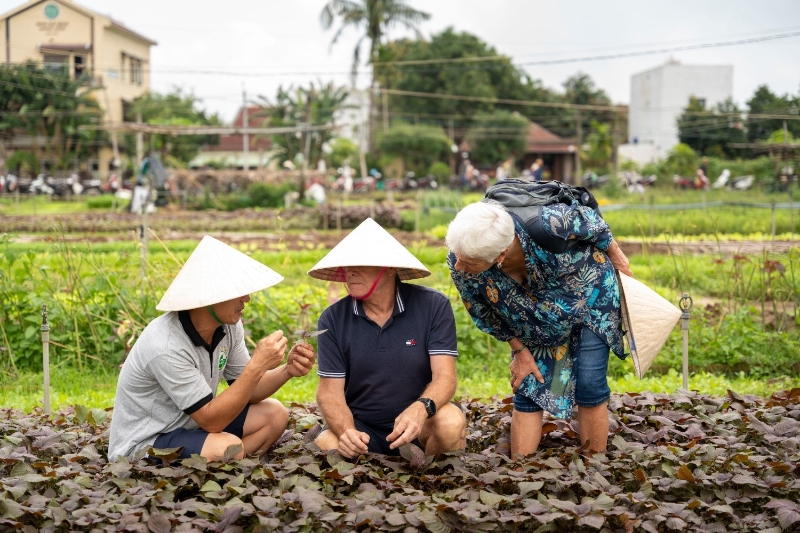
As demand for deeper, more meaningful travel experiences continues to rise, community-based tourism is emerging as a highly-promising direction for Vietnam’s tourism sector, with tangible and intangible cultural heritage becoming a glittering “treasure trove” that captivates international visitors.
One day in late November, at My Tho Marina in the Mekong Delta’s Dong Thap province, the exhibition space of the Xuan Ron Cacao Co. attracted large numbers of domestic and international visitors. In a small glass house overlooking the Tien River, visitors were able to create a complete chocolate bar themselves, from roasting cocoa beans and grinding them into paste to mixing and molding.
“This is the first time I’ve made a chocolate bar,” said Charlotte, a 38-year-old tourist from France. “The aroma of the cocoa feels stronger and deeper. I think this will be the most memorable experience of my Mekong Delta trip.”
Meanwhile, from a once-poor village in Vietnam’s northern reaches, Lo Lo Chai in Tuyen Quang province has risen to become one of the world’s Best Tourism Villages. Guided by the belief that “to go far, you must go together,” more than 100 households in Lo Lo Chai reached consensus to cooperate, share the benefits, and jointly shoulder the responsibilities of growing the local tourism industry. Each household plays a specific role: operating homestays, cooking food, performing traditional music and dance, serving as local guides, or producing handicrafts and agricultural products. This flexible division of labor has helped curb unhealthy competition.
In Hanoi in recent years, experiential tourism at traditional craft villages has also gained in popularity, offering authentic insights into local life. In Uoc Le, a village famous for its traditional pork sausage (gio cha), Mr. Vu Van Linh, a local resident, said: “When we first became familiar with social media platforms, our initial goal was simply to preserve the hand-pounded sausage-making technique. Later, through social media, many domestic and international tourists found their way here, gradually forming a community-based tourism trend.”
To accommodate visitors, wooden pestles and mortars - tools used for generations in Uoc Le - are displayed in many households’ courtyards. “For visitors to really experience it, we need three to five mortars at a time,” said Mr. Nguyen Viet Minh, another resident. “Usually, we prepare five to seven kilograms of meat, depending on how many guests want to try pounding the sausage themselves.” The joy of visitors has become the joy of local families, creating a unique connection that drives tourism development along a distinctive and effective path.
In practice, by directly leveraging natural and indigenous cultural values, community-based tourism is a model initiated, managed, and benefited from by local people themselves. In Vietnam, it is increasingly seen as a vital catalyst for remote and disadvantaged areas, while also reviving many traditional handicraft techniques.
In northern Ninh Binh province, Ms. Trinh Thi Ly from the Sinh Duoc Cooperative said many local producers have joined the “race” to develop experiential activities for international tourists over the past two years. “Visitors can make herbal soap with their own hands,” she explained. “We also organize tours where guests wear traditional Vietnamese attire, or wellness tours using ancient remedies. These activities both meet international tourists’ demand for deep experiences and align with green, healing, and sustainable values.”
Elsewhere in Ninh Binh, artisan Dao Xuan Ngoc helps visitors make decorative motifs from Vietnam’s Dinh and Le Dynasties on traditional “do” paper, the Bo Bat Pottery Cooperative offers hands-on pottery experiences in Hoa Lu ancient town, and Hoang Thanh Phuong, owner of the Bo De Tay Phuong gallery, organizes calligraphy writing on bodhi leaves. What these models share is the creation of spaces for encounters and storytelling, retelling the country’s cultural identity through fresh perspectives while maintaining deep respect for its heritage.
Sharing and spreading values
The 21st century has witnessed profound shifts in the global economy, with creativity and experience emerging as new engines of growth. In the Asia-Pacific region, the rise of creative hubs such as Seoul, Singapore, Tokyo, Busan, Chiang Mai, and Bangkok shows that creativity is not merely an artistic field but a catalyst linking heritage, technology, design, media, education, the digital economy, and experiential tourism.
These “cultural ecosystem” and “creative destination” models are opening up new approaches to development, grounded in community, identity, and the capacity to generate value from cultural, artistic, and indigenous knowledge assets. Vietnam is emerging as a bright spot, with numerous models in various provinces expanding the country’s “creative map” across heritage, handicrafts, music, film, design, and marine culture.
At a workshop on “Developing sustainable community tourism in ethnic minority and mountainous areas,” Associate Professor Pham Hong Long from the University of Social Sciences and Humanities at Vietnam National University, Hanoi, noted that community-based tourism is not merely about providing accommodation and food and must also integrate indigenous cultural activities. “Leveraging culture does not mean ‘selling’ culture, but sharing and spreading values,” he explained. :The driving force of this process must be the local community. When people are empowered to take ownership and receive fair benefits, community-based tourism can truly take off.”
“The effective development of community-based tourism requires that localities promote the ethnic cultural identity in order to build distinctive tourism products suited to each region,” Dr. Tran Huu Son, Director of the Institute of Applied Folklore Studies, added. “This process demands systematic research to create attractive product systems tailored to different visitor segments. Each product needs clear positioning and a unique identity based on the specific resources of each locality.”
From a business perspective, Ms. Ly said community-based tourism is a journey that requires balance, between tradition and innovation and between preserving core values and meeting the changing demands of modern travelers. “We need to develop tourism based on genuine indigenous values,” she believes. “At the same time, we must creatively ‘stage’ these cultural values so that they retain their traditional essence while also being entertaining and appealing to visitors.”
Crucially, education and communication within local communities are key. Local residents are the central guardians of culture, and need to be equipped with knowledge and skills to tell the stories of their homeland’s unique cultural values with pride and inspiration. Each individual must understand that preserving culture means activating internal resources to create value, ensuring that heritage exploitation is directly and fairly linked to community benefits.








 Google translate