


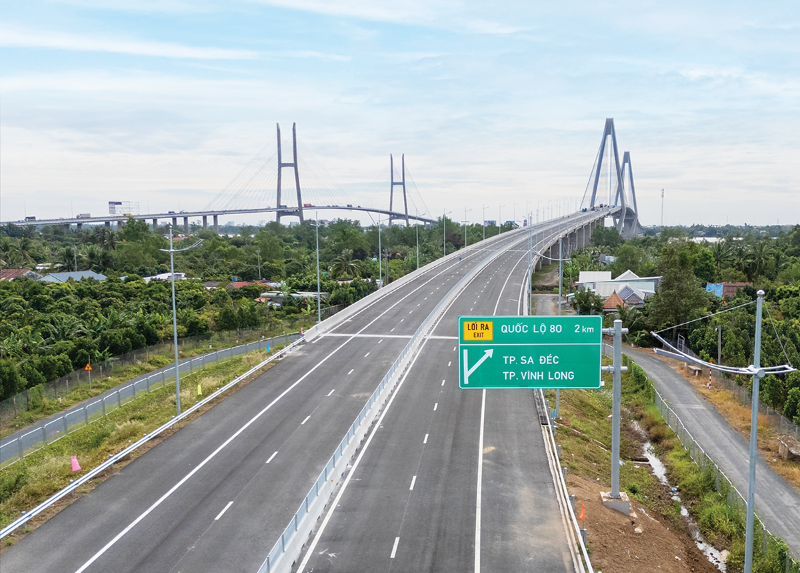
The Mekong Delta has taken another step forward over the past year on its difficult path of transformation. Beneath its seemingly tranquil surface, profound shifts are underway as the region recalibrates how it survives and grows in a rapidly-changing context. In response, green growth and the broader concept of a green economy have gradually emerged as a central axis of thinking, guiding efforts to restructure the region’s development model.
The Mekong Delta is increasingly forced to redefine its development trajectory. Lessons drawn from floods, landslides, saltwater intrusion, and resource depletion have compelled local authorities to reassess decades of growth strategies. A new mindset is taking shape: development can no longer come at the expense of the environment and must be built upon the Delta’s own ecological foundations.
Towards a green economy
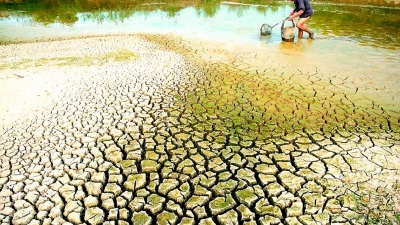
For many years, the region’s interaction with nature was largely shaped by a control-oriented approach - building higher dikes, enclosing waterways, and expanding production at all costs. Over time, however, the consequences of this strategy have become more apparent. Land subsidence, riverbank erosion, declining freshwater reserves, and ecological imbalances have exposed the limits of attempting to dominate natural systems.
A notable shift in awareness began to crystallize in 2025. Instead of “resisting” nature, many localities started to prioritize adaptation and coexistence. Water is no longer viewed solely as a threat but as an integral component of the ecosystem, requiring flexible, seasonal, and location-specific management. Flood retention areas, ecological lowlands, and natural drainage corridors are being re-evaluated for their critical role in reducing disaster risks.
At the same time, the exploitation of water resources is being adjusted towards sustainability. Groundwater extraction, which has contributed significantly to subsidence, is gradually being brought under control and increasingly replaced by surface water storage solutions, water-saving practices, and water reuse in production. These changes are neither abrupt nor uniform, but collectively lay the groundwork for a new approach, one that recognizes natural resources as finite limits to be respected rather than inexhaustible assets.
Within this broader picture, the green economy is emerging as a unifying current that runs through multiple sectors. It is no longer a slogan, but a practical framework that is increasingly shaping development choices. Agriculture, the traditional backbone of the Mekong Delta, offers the clearest illustration of this shift.
Instead of chasing output volumes, many localities are moving towards higher value through adaptive farming models that reduce emissions and protect ecosystems. Rice-shrimp systems, shrimp-mangrove models, organic agriculture, and circular farming practices not only ease environmental pressure but also open new pathways in terms of markets, quality, and value added. Farmers are no longer merely producers; they are becoming active links within green value chains.
A defining feature of this transition is the move from a “high volume” mindset to a “high value” orientation. Nature-adaptive farming models, once considered niche or experimental, are now being scaled up. Alongside agriculture, the marine economy is emerging as a highly-promising development space.
Stretching from the coastline of Tien Giang province (now part of Dong Thap province) to Ca Mau province, the Delta’s long shoreline and favorable wind conditions give it a distinct advantage in renewable energy development, particularly onshore and offshore wind power. At the same time, sustainable aquaculture, marine ecotourism, and mangrove conservation are gradually forming new value chains that both support livelihoods and protect coastal ecosystems.
Notably, the current approach to the marine economy does not separate growth from conservation. Mangrove forests in Ca Mau, for instance, are increasingly viewed as “green infrastructure” that protects coastlines, absorbs carbon, and supports long-term livelihoods. This perspective helps reduce conflicts between economic objectives and environmental protection, steering development towards long-term balance.
From a broader standpoint, a green marine economy also opens new opportunities for regional connectivity, linking inland areas with marine spaces and creating more open, flexible value chains compared with the closed development models of the past.
New regional driver
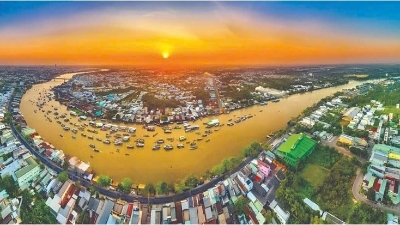
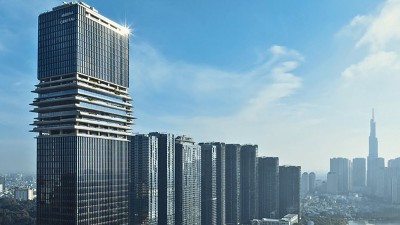
Beyond agriculture and the marine economy, urban areas in the Mekong Delta are gradually assuming a leading role in the green transition. Rather than expanding outward, many cities are pursuing more compact development models that emphasize green spaces, drainage infrastructure, and climate resilience.
New urban projects are paying closer attention to environmental considerations, from architectural design and energy use to waste and wastewater management. Public spaces, water bodies, and greenery are increasingly treated as essential components of urban systems rather than decorative additions. More importantly, cities are becoming hubs for spreading new values related to green lifestyles and sustainable governance.
From these urban centers, circular economy models, responsible consumption, and innovation are beginning to diffuse into rural areas, strengthening connections between different development spaces across the region. In this way, cities are not only beneficiaries of the green transition but also catalysts that help align rural and urban trajectories.
Looking back over the past year, the Mekong Delta appears to be passing through a pivotal phase. Mounting environmental challenges have made it impossible to maintain old development patterns, forcing localities to restructure how resources are used and how economic and social spaces are organized.
This transition is neither quick nor easy. It demands persistence, consensus, and long-term vision. Yet within this gradual process, a new identity for the Delta is taking shape, one that seeks growth by working with nature rather than against it, and by leveraging ecological advantages instead of pushing beyond environmental limits.
Green growth, therefore, is no longer a distant aspiration; it is increasingly visible in development decisions, production models, and living spaces across the region. It offers a pathway for the Mekong Delta to adapt to climate change while preserving its role as a pillar of national economic development, ecological stability, and food security.
As a new year dawns, these shifts may not have produced dramatic breakthroughs but clearly signal a new direction: the region is learning to slow down in order to go further. In that slower, more deliberate rhythm, the green economy is no longer simply an option, it is becoming the foundation of the Mekong Delta’s future.




 Google translate