



National budget disbursement for science, technology, innovation, and digital transformation reached VND21.69 trillion ($855.7 million) as of October 26, fulfilling 41.18 percent of the annual estimate, according to the Ministry of Science and Technology (MoST) at a national conference.
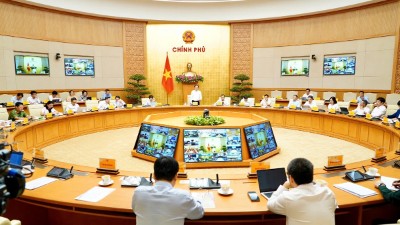
Speaking at a national teleconference with local Departments of Science and Technology on October 26, Director General of the ministry’s Department of Planning and Finance Hoang Thi Phuong Luu stated that total allocated funds nationwide stand at VND52.68 trillion ($2.08 billion) for 2026.
At the local level, total allocated estimates reached VND28.03 trillion ($1.1 billion), of which VND10.78 trillion ($425.6 million) has been disbursed, achieving 38.49 percent. Localities have been required to intensify efforts for full disbursement of the remaining amount of VND17.24 trillion ($680.2 million) through the end of the year.
By sector, local disbursement rates stood at 47.15 percent for science and technology, 27.54 percent for innovation, and 30.23 percent for digital transformation. By funding source, capital expenditure disbursement reached 43.78 percent, while recurrent expenditure recorded 37.18 percent.
Seven localities achieved disbursement rates of 50 percent or higher, led by central Hue city, at 65.21 percent, and northern Tuyen Quang province, at 65.17 percent, alongside Thai Nguyen, Can Tho, Quang Tri, Khanh Hoa, and Da Nang.
In absolute terms, the top 10 localities accounted for VND7.77 trillion ($306.8 million), or 72.1 percent of total local disbursement. Ho Chi Minh City led with VND2.71 trillion ($106.9 million), followed by Hanoi with VND2.03 trillion ($80.2 million), and Da Nang with VND697.7 billion ($27.5 million). Ho Chi Minh City and Hanoi combined represented 44 percent of total local disbursement.
Ministry officials emphasized that disbursement speed must be balanced with efficiency. Under the Law on Science, Technology and Innovation, state budget allocations must focus on targeted, key tasks tied directly to output quality. Unit heads must evaluate and report performance on the National Digital Platform for Science, Technology and Innovation Management.
The 2026 disbursement results and corresponding outputs will serve as the basis for budget allocations in subsequent years.
Clarifying regulatory hurdles during the conference, Director General of the Department of Engineering and Technological Science Nguyen Phu Hung noted that Decree No. 267/2025/ND-CP limits the timeframe for signing task delivery contracts to a maximum of 120 days from the application deadline.
Furthermore, under the Law on Science, Technology and Innovation No. 93/2025/QH15, host organizations are automatically granted management, usage, and ownership rights over task results funded by the state budget, eliminating secondary transfer procedures and reimbursement requirements.
Regarding digital transformation, Deputy Director General of the National Digital Transformation Authority Le Anh Tuan highlighted that Decree No. 224/2026/ND-CP relieves investors of liability if suppliers violate rules on public price quotes, provided transparent collection procedures were conducted.
To achieve 2026 targets, the Ministry of Science and Technology urged localities to review disbursement delays, issue management regulations under provincial jurisdiction, and update weekly disbursement figures with the State Treasury.
Localities were also advised to propose returning central budget allocations that cannot be absorbed in 2026 to allow reallocation to higher-capacity tasks.






 Google translate