


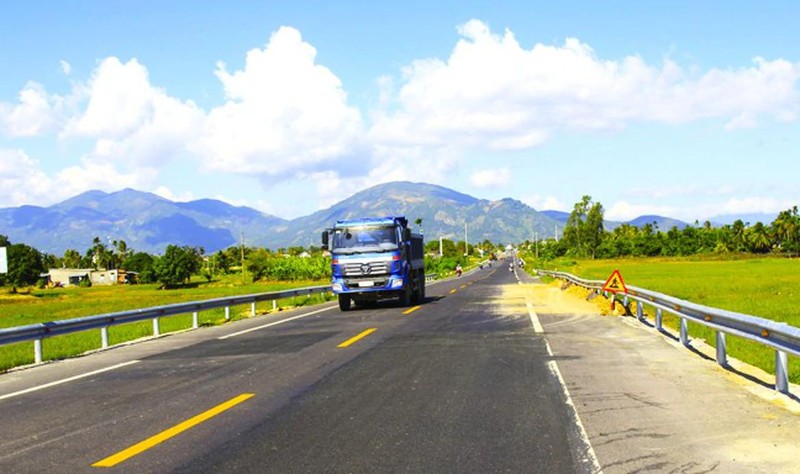
The Department for Roads of Vietnam (DRVN) has submitted a proposal to the Ministry of Construction, seeking approval for upgrading and expanding several sections of National Highway 1 (NH1) passing through various localities from central Da Nang city to the Mekong Delta province of Vinh Long, according to a report by the Government News.
NH1 is a vital artery of the North-South transport axis, connecting four major growth poles—Hanoi, Da Nang, Ho Chi Minh City, and Can Tho—as well as five dynamic economic regions across the country.
According to the proposal, several bypasses along NH1 in Da Nang and the provinces of Quang Ngai, Gia Lai, Dak Lak, Tay Ninh, Dong Thap, and Vinh Long currently consist of only two motor lanes. Furthermore, several key intersections in Dong Thap and Tay Ninh have become inadequate for modern traffic demands.
The rapid increase in vehicle volume, coupled with intensive urbanization and industrialization, has led to road degradation and localized congestion. These bottlenecks have resulted in longer travel times and increased risks of traffic accidents, ultimately hindering transport quality and the regional investment environment.
Furthermore, the provincial master plans for these localities for the 2021-2030 period, with a vision toward 2050, all identify the economic corridor along NH 1 as a top priority for development.
The DRVN has proposed an investment project to upgrade and expand 70.79 km of these sections, with a preliminary total investment of approximately VND10.653 trillion (approx. $405 million).
The project is expected to be funded by the State budget as part of the medium-term investment plan for the 2026-2030 period. Project preparations are scheduled for 2026-2027, with construction slated to begin in the third quarter of 2027 and reach completion by early 2030.








 Google translate