



At 9pm, after finishing work at her day job in Hanoi, in her small apartment that doubles as a film studio, with a tripod by the desk and skincare products on the shelf, 25-year-old Ms. Lan Nguyen reviews her affiliate sales. A year ago, her product reviews earned little more than pocket money. Now, it provides her with a second source of income. She began with products she had already used, learning to make short videos and track which ones converted views into purchases. Progress was gradual, but she discovered that relevant recommendations and audience trust mattered more than posting frequently.
Her experience captures the appeal of affiliate marketing in Vietnam, where creators can reach consumers with modest upfront investment and brands gain another sales channel. Yet sustainable earnings depend on more than visibility: content quality, credibility, and the ability to turn engagement into sales are increasingly critical.
As social commerce expands, creators have more opportunities to reach consumers and generate sales, but competition for attention is intensifying. According to affiliate network Rentracks, AI, increasingly-complex purchasing journeys, and the growing importance of consumer trust are reshaping the industry, forcing both advertisers and publishers to rethink how they attract audiences and generate revenue.
Reshaping marketing
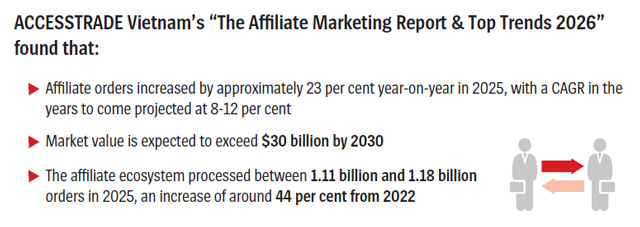
Affiliate marketing has traditionally served as a supplementary sales channel, allowing brands to pay commissions to content creators and influencers who generate purchases. However, the market has now become a more integral part of Vietnam’s e-commerce ecosystem. According to ACCESSTRADE Vietnam’s “The Affiliate Marketing Report & Top Trends 2026”, affiliate orders increased by approximately 23 per cent year-on-year in 2025, while the market is projected to grow at a compound annual growth rate (CAGR) of 8-12 per cent in the years to come.
Affiliate marketing contributed an average of 15-20 per cent of Vietnam’s total e-commerce gross merchandise value (GMV) in 2025. On major platforms such as Shopee and TikTok Shop, affiliate sales accounted for 30-35 per cent of GMV, rising to as much as 45 per cent during major shopping events such as September 9 and November 11. These figures reflect a shift from affiliate marketing as a final-stage sales tool to a model operating throughout the customer journey. Social media content, search engine optimization, short-form videos, livestreams, and creator networks increasingly connect product discovery with purchasing decisions.
According to the ACCESSTRADE Vietnam report, seven in ten consumers trust livestream hosts more than conventional advertising, while limited-time promotions and “fear of missing out” (FOMO) contribute to impulse purchases. The report indicates that 73 per cent of purchasing decisions in this context are impulsive.
Rentracks identifies seven developments that advertisers and publishers need to prepare for as consumer behavior and digital marketing technology evolve.
First, AI is becoming an operational tool. AI is moving beyond content production, such as writing articles, developing scripts, and creating images, into performance analysis and campaign management. Advertisers and affiliate networks are increasingly using it to assess traffic quality, detect fraud, classify partners, and forecast conversions.
Second, AI search is changing how publishers attract traffic. Consumers increasingly use generative AI to research products and narrow their choices before visiting marketplaces or watching creator videos. According to “E-commerce Influencer and Affiliate Marketing in Southeast Asia 2026”, a study by impact.com, Cube, and Dentsu, 34 per cent of Vietnamese consumers use generative AI to discover products.
Third, creator affiliates are shifting from awareness to performance. Influencers are increasingly expected to contribute directly to sales rather than simply promote brand awareness. The impact.com, Cube, and Dentsu study found that 49 per cent of affiliate transactions in Southeast Asia originated from trust and validation, compared to 28 per cent from convenience. This reinforces the importance of credible product recommendations as consumers navigate multiple sources before purchasing.
Fourth, owned media is reducing their dependence on algorithms. Relying exclusively on TikTok, Google organic search, or Facebook exposes publishers to algorithm changes and rising advertising costs. Rentracks recommends developing owned channels, including email newsletters, community groups, and independent content platforms, to build more direct relationships with audiences and reduce dependence on third-party traffic.
Fifth, multi-touch attribution is becoming more important. The traditional customer journey of content, click, landing page, and conversion is giving way to a more complex sequence involving AI search, creator content, marketplaces, reviews, and brand websites. Last-click attribution can overlook partners that generated initial interest or influenced consideration.
Sixth, advertisers are prioritizing partner quality over quantity. Recruiting more publishers does not necessarily translate into higher sales. Rentracks recommends focusing resources on high-performing partners and strategically-developing emerging publishers, niche content providers, and creators.
Seventh, localization is becoming essential in Southeast Asia. The region is not a single, uniform market. Vietnam, Indonesia, Thailand, the Philippines, and Singapore differ in consumer behavior, preferred platforms, shopping periods, and payment methods. Rentracks, citing Sensor Tower’s “Southeast Asia State of Digital Advertising 2026” report, identifies scale, localization, and precision as key factors shaping digital advertising.
These trends are unfolding as competition for digital visibility intensifies. According to Sensor Tower, Southeast Asia’s digital advertising market is expected to generate 3.6 trillion ad impressions and more than $3 billion in spending in 2026, with the fourth quarter accounting for more than 1 trillion impressions. Major shopping events, including September 9, October 10, November 11, December 12 and Black Friday, further intensify competition for traffic and conversions.
For advertisers, the challenge is no longer simply to increase commissions or recruit more publishers. They must identify effective partners, coordinate campaigns ahead of peak shopping periods, and measure performance across the customer journey. For publishers, the implications are equally significant. Success increasingly depends on producing relevant content, developing loyal audiences, and diversifying traffic sources. AI can improve efficiency, but content quality and consumer trust remain central to turning attention into purchases.
Tax matters
As affiliate marketing expands, tax documentation is an additional operational requirement for businesses working with individual service providers and business households. The Department of Taxation addresses the tax liabilities of individuals providing digital information content products and services, including affiliate marketing services in e-commerce, in Official Dispatch No. 7403/CT-TMDT, issued on October 6. Under this guidance, enterprise expenses may qualify as deductible expenses for corporate income tax purposes if they satisfy the applicable conditions under the Law on Corporate Income Tax 2025 and Decree No. 320/2025/ND-CP.
Business households and individuals with annual revenue exceeding VND1 billion ($38,462) must register to use invoices. Enterprises engaging their services must retain invoices as supporting documents for deductible expenses. Where purchases are made from business households or individuals whose revenue falls below the VAT-taxable threshold, the supporting documentation must include proof of payment and a list of purchased goods or services signed by the enterprise’s legal representative or an authorized person.
The guidance also requires cashless payment when purchases from an individual or business household reach VND5 million ($192) or more on a single day. For transactions conducted through e-commerce platforms, sellers may request buyer and transaction information, delivery times, and order completion status to prepare electronic invoices, while platform operators must provide the relevant information under the cited regulations.
These requirements add to the need for accurate records and effective management of affiliate partnerships as businesses expand their activities. For creators such as Ms. Lan, the challenge is to turn content into a trusted route to purchase rather than simply chase views. For advertisers, the priority is to build effective partnerships, measure their contributions accurately, and adapt campaigns to local consumer behavior. As affiliate marketing becomes more deeply-integrated into e-commerce, sustainable growth will depend on combining reach with trust and measurable commercial value.







 Google translate