


Vietnam’s economy continued its positive recovery throughout the first half of 2026, and alongside it consumer behavior and digital adoption shifted noticeably. E-commerce continued to confirm its role as a core distribution channel for modern retail, but the numbers behind that growth tell a more interesting story than the headline figure alone suggests.
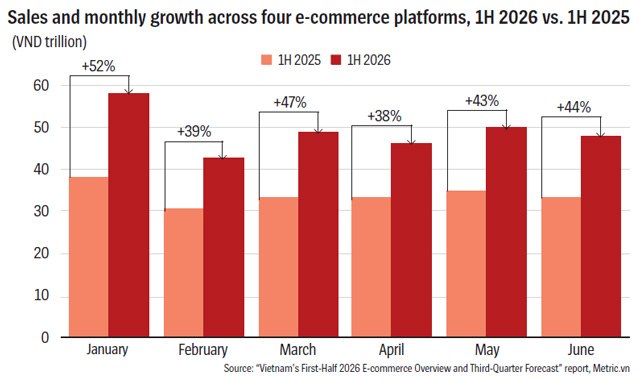
According to Metric.vn’s “Vietnam’s First-Half 2026 E-commerce Overview and Third-Quarter Forecast” report, Vietnam’s online retail market kept expanding through the first half of 2026. Combined sales across Shopee, TikTok Shop, Lazada, and Tiki reached VND291.6 trillion ($11 billion), up 44.11 per cent year-on-year, with the market expected to keep growing into the third quarter, when sales are forecast to reach VND146.3 trillion ($5.5 billion).
Transaction volume also grew, reaching 2.19 billion products sold, up 13.67 per cent, while the number of active shops rose to 613,800, up 14.11 per cent year-on-year. In the second quarter alone, sales stood at VND143 trillion ($5.4 billion), up 41.62 per cent.
Sales outpacing volume
The more revealing number, though, is the gap between the two growth rates: revenue rose 44.11 per cent, while volume increased only 13.67 per cent. When sales grow more than three-times faster than the number of items sold, it means the average value of each transaction is climbing. Consumers aren’t just buying more; they’re spending more on each purchase. This suggests that Vietnam’s e-commerce sector has moved past its bulk-discount, race-to-the-bottom phase and is entering a period of deeper, quality-driven growth.
Every one of the four platforms posted year-on-year growth in every month of the first half, with monthly growth ranging from 38 to 52 per cent. January posted the strongest growth, at 52 per cent, followed by March at 47 per cent, February 39 per cent, April 38 per cent, and May and June 43 and 44 per cent, respectively. Shopee and TikTok Shop continued to lead the pack, with combined sales exceeding VND280 trillion ($10.6 billion) across the first two quarters, reinforcing how concentrated Vietnam’s e-commerce traffic has become around a small number of dominant platforms.
Trust is the real currency
The clearest evidence of that shift toward quality over price shows up in how revenue is distributed among sellers. Official “Mall” storefronts - verified, brand-authorized shops - made up just 2.79 per cent of all shops across Shopee, Lazada, and TikTok Shop in the first half of the year, yet accounted for 34.2 per cent of total sales. That’s a striking concentration: fewer than 3 in 100 shops are generating more than a third of all revenue on these platforms.
What makes that figure even more telling is its direction of travel. According to Metric.vn’s report, compared to the same period last year, the number of authorized Mall shops actually fell 6 per cent, while sales from that same shrinking group rose 54 per cent, pushing average revenue per Mall shop up by roughly 63.8 per cent. In other words, fewer official stores are doing significantly more business each. That’s not simply growth; it’s consolidation. Revenue is increasingly flowing toward a smaller pool of higher-performing, verified sellers, even as the broader market keeps expanding.
That pattern reflects a deeper shift in digital trust. In a marketplace flooded with unverified, low-quality, or outright counterfeit listings, price is being pushed down the list of purchase criteria, replaced by authenticity and the assurance of consistent quality. Consumers appear willing to pay more, and buy from fewer, more trusted sources, rather than hunting endlessly for the cheapest listing.
The shift in price tiers backs this up. The cheapest segments - items under VND100,000 ($3.80) and those priced between VND100,000 and VND200,000 ($3.80 and $7.60) - lost 4.2 and 3.4 percentage points of sales share, respectively. Meanwhile, the premium segment, priced above VND1 million ($38), gained 3.1 percentage points, bringing its total contribution to 18.2 per cent of the market’s overall sales share.
“The data shows sales are becoming increasingly concentrated among a smaller group of sellers,” said Ms. Nho Dinh, COO of Metric.vn, in describing the shift. “Buyers’ money isn’t leaving the platforms - it keeps growing. It’s not just total sales that are rising; spending patterns are shifting too. The VND100,000-200,000 ($3.80-$7.60) segment is still the largest, but its share has fallen from 26.3 per cent to 22.9 per cent.”
Metric forecasts combined sales across the four platforms will reach VND146.3 trillion ($5.5 billion) in the third quarter of 2026, with 1.084 billion products sold, up 2.31 per cent and 3.45 per cent, respectively, from the second quarter. That pace is gentler than the explosive growth seen earlier in the year, but the third quarter is likely to be the hinge point that determines how strong the second half of the year turns out to be, particularly if the pattern of rising average order values continues to hold.
The “buy now” click
While the first half of the year showed what’s changing in Vietnam’s e-commerce market, the answer to why this is the case increasingly points to content, not discounts.
According to the Ministry of Industry and Trade, the country’s e-commerce market had reached roughly $31 billion as of the end of 2025, up 25.5 per cent year-on-year. Notably, 76 per cent of consumers searched for, clicked on, or added a product to their cart after encountering authentic content on digital platforms. Industry experts point to social media as a key driver behind that behavior: Vietnam now has around 70 million TikTok users and 85 million Facebook users, and livestreaming, short-form video, and product-experience content are exerting real influence over purchase decisions.
That influence has changed what “selling well” actually means on these platforms. Businesses and sellers that have made the most of livestream features on TikTok Shop, Shopee Live, and LazLive have turned them into a new playbook for success - one built on making customers fall in love with a product before they ever reach the checkout button.
Amid the sheer volume of information flooding e-commerce platforms, Vietnamese consumers have grown more discerning. They’re no longer just buying a product - they’re choosing to trust a brand, and letting that trust guide the purchase decision.
Platforms have responded by building tools that help sellers and brands turn that trust and engagement into actual orders.
Overall, e-commerce platforms are consolidating revenue around trusted, verified sellers and higher-value purchases, and the tool driving that trust, more than any discount or promotion, is authentic content. Brands that invest in creative content from the earliest stage of the discovery journey aren’t just closing sales - they’re building genuine affinity. As that trust compounds through each video, each livestream, and the growing convenience of digital payment options, businesses are creating something more durable than a single transaction - they’re turning casual scrollers into the loyal customers of tomorrow.
According to the Ministry of Industry and Trade, the country’s e-commerce market had reached roughly $31 billion as of the end of 2025, up 25.5 per cent year-on-year. Notably, 76 per cent of consumers searched for, clicked on, or added a product to their cart after encountering authentic content on digital platforms.








 Google translate