


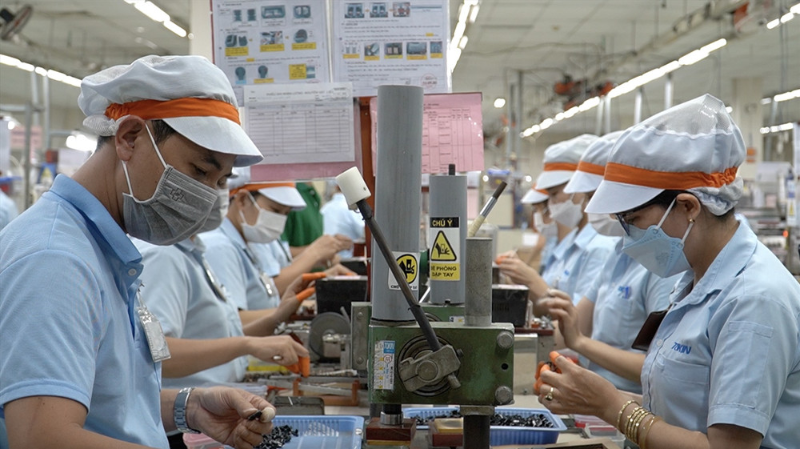
At the recent 10th session of the 15th National Assembly, lawmakers approved the resolution on the 2026 socio-economic development plan. The plan sets an ambitious target: GDP growth of at least 10 per cent and GDP per capita of $5,400-$5,500 in 2026.
2026 carries particular weight, marking the first year of both the 2026-2030 five-year socio-economic plan and the holding of the 16th National Assembly, during which key leadership positions from the central to local levels will be elected. Vietnam aims to become an upper-middle income country, which is defined as having an annual income per capita of $4,495 to $13,935 by 2030, and a high-income country by 2045 under World Bank classifications. With these targets, analysts believe the country is well-positioned to lift average incomes nationwide by 2030.
Experts widely believe Vietnam could reach upper-middle income status within the next one or two years. The 2026-2030 period has also been identified by the Party and the government as pivotal to meeting the more ambitious goals set for 2045.
A 40-year reflection
Over the past few decades, Vietnam has routinely been placed among the ranks of developing and emerging economies with strong growth potential. But data from nearly 40 years (1985-2024) tell a more tempered story: since Doi Moi (Economic Renewal) in 1986, Vietnam’s average GDP growth has been 6.38 per cent. Remarkably, the country has never recorded annual growth of 10 per cent or higher. Even if the Asian Financial Crisis (1998-1999) and the Covid-19 pandemic (2020-2021) are set aside, the average growth rate since 1992, with foreign investment surging following the near-normalization of Vietnam-US diplomatic ties in 1995, stands at only 7.09 per cent.
These numbers suggest that even under relatively favorable global and regional conditions, and despite major growth catalysts in recent decades, such as strong inflows of FDI, WTO accession in 2007, a series of bilateral and multilateral trade agreements signed, the introduction of the Law on Enterprises in 2005, and ongoing institutional and legal reforms to ease constraints on the private sector, a central question lingers: What is Vietnam’s real, self-sustaining growth capacity?
A recent study by researchers at the Federal Reserve Bank of St. Louis in US, using data from around 100 countries and territories across different income levels, highlighted an important conclusion about the catch-up potential of poorer nations. Between 1960 and 1999, rich countries grew faster than poor ones. But from 2000 to 2019, the trend reversed: poorer countries grew more quickly than wealthier economies. This suggests that income convergence has been entirely feasible in the early decades of the 21st century. The World Bank reached a similar conclusion in a 2023 study comparing the pace at which poorer countries are catching up with the US.
Though economic growth or steady increases in income per capita do not fully reflect a country’s overall development, living standards, or levels of well-being, there is a strong correlation between the two variables. Put simply, for Vietnam to escape the middle-income trap and reach high-income status by 2045, just 20 years from now, it must sustain rapid and continuous growth over this period.
According to the World Bank’s 2025 “Vietnam Rising: Pathways to a High-Income Future” report: “Centered around an export-driven growth model and strong participation in global value chains, the country has enjoyed average annual per capita GDP growth of 5.1 per cent over the past four decades. Reaching high-income country (HIC) status by 2045 would require an even faster growth rate over the next two decades, accelerating to a sustained 6.0 per cent. Moreover, completing the transition from middle-income to high-income would mean that Vietnam would have to succeed where few others have. Only 34 countries and territories have transitioned to HIC since 1990, most of them through EU accession or natural resource windfalls.”
The report also noted that Vietnam’s impressive economic growth in recent decades has relied heavily on capital accumulation, which accounts for as much as 70 per cent of total growth, while labor and productivity have played more modest roles. However, Vietnam’s population is expected to age rapidly beginning in the 2040s, causing labor’s contribution to economic growth to shift from positive to negative. This presents a major challenge: Vietnam must transition to a new, more efficient growth model by using production inputs more effectively in order to achieve high and sustainable growth.
Experts argue that the decisive drivers for Vietnam in the coming period will be capital accumulation and faster growth of Total Factor Productivity (TFP), which averaged 0.9 per cent in the country over the past decade. To reach high-income status by 2045, assuming the current investment-to-GDP ratio (gross fixed capital formation) of 37 per cent remains unchanged and if demographic pressures are taken into account, Vietnam would need to achieve average TFP growth of 2 per cent. This is an ambitious target. But looking at successful regional examples such as South Korea and Singapore, both economies achieved substantial gains through productivity: 2.3 per cent for South Korea from 1990 to 2010, and 3.3 per cent for Singapore from 1970 to 1980. In that context, a 2 per cent TFP growth rate for Vietnam is entirely within reach.
Shaping the next era
At a recent high-level workshop entitled “Policy and Strategy Capabilities for Vietnam’s New Era” held at the National Economics University in Hanoi and co-organized with the United Nations Development Programme (UNDP), Professor Kenichi Ohno from GRIPS in Japan and a veteran policy advisor to developing countries worldwide, presented a keynote address outlining a new policy approach for Vietnam. He detailed the challenges the country has faced and highlighted lessons drawn from the successes of East Asian economies. Professor Ohno stressed that policy quality is the critical factor Vietnam must strengthen to learn, adapt, and improve.
He argued that weak policy design is the underlying cause of long-term growth problems, including the risk of falling into the middle-income trap or stagnating even after reaching high-income status. In Vietnam’s case, he placed particular emphasis on the need for effective sector-based policy packages, historically known as industrial policy.
Vietnam, despite its many regional strengths, still faces fragile growth foundations. The country lacks high-quality human resources in science, innovation, and high-tech industries and services. Productivity levels remain low compared with major ASEAN peers, and heavy dependence on FDI continues to limit Vietnam’s deeper integration into global supply chains.
On the institutional front, the World Bank report outlines five policy packages Vietnam should prioritize during this pivotal period. Institutional modernization, which is already underway, is considered essential to ensuring effective implementation of broader efforts to strengthen the private sector, build resilient infrastructure, improve workforce skills and adaptability, and ensure that all citizens benefit from the transition to high-income status.
Vietnam is entering a defining period in which rapid and sustainable growth is not merely an economic objective but a crucial requirement for achieving high-income status by 2045.
(*)Ms. Le Minh Phuong is from VinUni and a Member of the Economic Policy Network at the Association of Vietnamese Scientists and Experts (AVSE Global)




 Google translate