


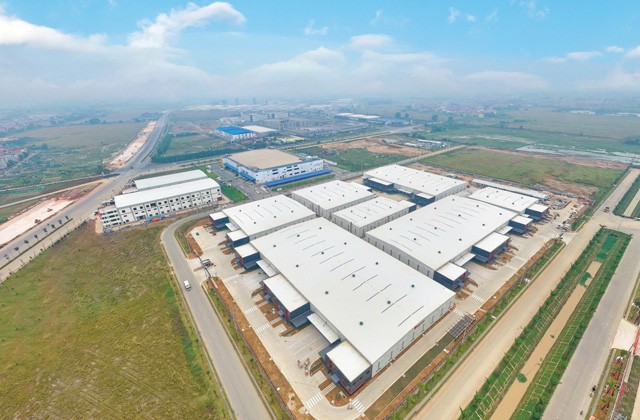
Vietnam’s industrial real estate market is entering a new phase. Manufacturing investment remains strong, but its profile is changing: fewer projects are attracting more capital, while electronics, semiconductors, and advanced manufacturing are becoming increasingly important. That shift is also changing what manufacturers want from industrial property. Instead of starting every project with industrial land and building from scratch, more investors are turning to ready-built factories (RBFs) to shorten the path from investment approval to production.
Expansion meets demand
The RBF market continues to expand in both the southern and northern regions, though market conditions differ between the two.
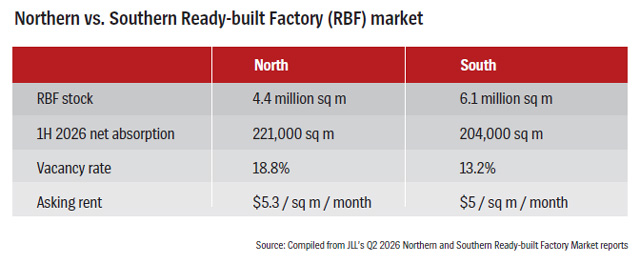
In the south, JLL’s Q2 2026 Ready-built Factory Market report recorded about 99,000 sq m of net absorption during the quarter, bringing first-half absorption to nearly 204,000 sq m. More than 95,000 sq m of new supply was completed, taking total RBF stock in the south to above 6.1 million sq m.
New supply has put some pressure on occupancy, which stood at 86.8 per cent in the second quarter. Still, demand remained supported by existing occupiers expanding their operations, particularly Chinese, Chinese-speaking, and Japanese manufacturers, according to JLL.
The north, meanwhile, saw an even stronger increase in quarterly demand. JLL recorded about 171,751 sq m of net absorption in the second quarter, or more than 3.5-times the first-quarter level. Meanwhile, 214,631 sq m of new leasable space entered the market, bringing total stock to about 4.4 million sq m.
JLL reported northern occupancy of 81.2 per cent, as newly-launched space took time to be absorbed. The tenant base remained diverse, including manufacturers from the US, Singapore, China, and Vietnam, with activities ranging from electronics components and metal products to semiconductors.
Rents have remained relatively firm despite the new supply. JLL recorded average asking rents of $5 per sq m per month in the south and $5.3 in the north in the second quarter. Northern rents rose 0.6 per cent quarter-on-quarter, while southern rents were unchanged.
The pipeline remains substantial. JLL expects about 1.7 million sq m of additional RBF supply in the south during the 2026-2028 period, while the north is expected to receive another 460,000 sq m in the second half of 2026.
With more space coming online, developers are likely to face greater competition over tenants. Location, building quality, and readiness could become as important as rental rates.
Bigger investments
The stronger case for RBFs becomes clearer when looking at where new manufacturing capital is going. Savills Vietnam found that computers, electronics, and optical products attracted more than $7.03 billion in newly-registered manufacturing capital in the first half of 2026, accounting for about 66 per cent of the total despite having only 65 projects. Several major investments were linked to semiconductor packaging, electronic components, precision engineering, and advanced manufacturing.
The shift from the previous year was particularly sharp. New electronics projects declined from 99 in the first half of 2025 to 65 in the first half of 2026, while the value of new electronics manufacturing capital jumped from about $984.5 million to $7.03 billion.
Mr. John Campbell, Head of Industrial Services at Savills Vietnam, described the trend as “fewer projects, much larger investments, driven by a semiconductor and electronics boom centered in northern Vietnam.”
The north has consequently taken a larger share of manufacturing investment. Savills recorded about $8.63 billion in newly-registered manufacturing FDI in the region in the first half of 2026. Thai Nguyen province attracted around $5.77 billion, with the port city of Hai Phong following, while Bac Ninh province posted the highest number of new manufacturing projects.
For industrial property, the change matters because advanced manufacturing can require more suitable buildings and infrastructure. As investment projects become larger and more specialized, manufacturers have greater incentives to find facilities that can support production without a lengthy development process.
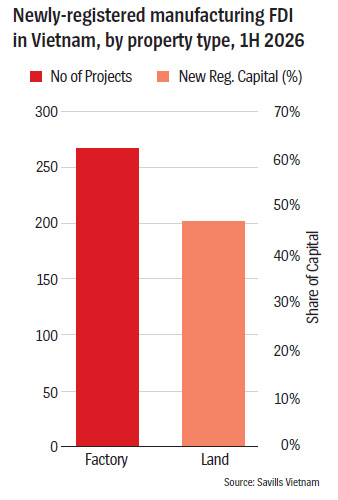
Savills Vietnam’s first-half 2026 analysis shows the growing importance of factory-based solutions. Of the 468 new manufacturing FDI projects, 266 were classified as factory deals, accounting for about $7.09 billion in investment.
The appeal is largely about speed. According to Savills Vietnam, the strength of factory deals reflects investors’ preference for “speed, flexibility, and faster operational setup.” Ready-built and operational facilities can shorten the period between licensing, fit-out, and production, particularly for electronics, components, light manufacturing, and supply chain businesses.
That advantage becomes more important as manufacturers compete for orders and seek to integrate quickly into regional supply chains. A completed factory allows companies to spend less time on development and focus sooner on equipment installation, hiring, and production.
Still, RBFs will not replace industrial land. Savills recorded 202 land deals worth about $3.62 billion in the first half of 2026, and noted that land remains important for large greenfield and expansion projects where manufacturers need greater control over facility design and long-term operations.
The two models are therefore likely to co-exist, serving different types of manufacturers. Large, customized projects may continue to favor land, while companies seeking faster entry or expansion can increasingly turn to ready-built facilities.
For developers, the challenge will be to make that ready-built space competitive as supply grows. JLL noted that southern landlords are already maintaining leasing incentives amid new supply, while higher-quality facilities have helped support rents.
Vietnam’s manufacturing base is becoming more capital-intensive and technology-focused, while its industrial property market is responding with more flexible ways for companies to establish operations. The next stage of the market may therefore be defined not simply by how much industrial space Vietnam can provide, but how quickly that space can help manufacturers start producing.






 Google translate