


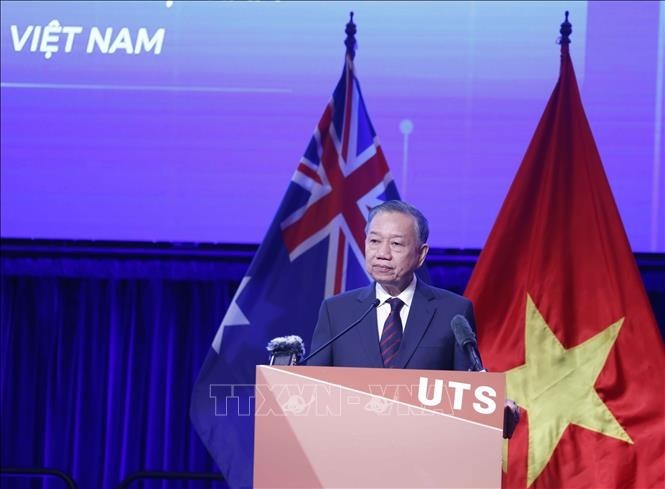
As part of his state visit to Australia, General Secretary of the Communist Party of Vietnam and State President To Lam on August 10 attended and addressed the Vietnam–Australia Techconnect Forum.
In his remarks, Vietnam’s top leader stressed that the forum holds special significance as the Vietnam-Australia Comprehensive Strategic Partnership continues to flourish—becoming deeper, more substantive, and more effective. This is particularly true in sectors that will determine the competitiveness and prosperity of both nations in the decades to come.
From cooperation to co-creation
Developing science, technology, innovation, and high-quality human resources is not merely a choice but has become an essential requirement for Vietnam to realize its aspiration of becoming a high-income developed nation by 2045, he said.
The Party and State of Vietnam have established a new development model in which knowledge, science, technology, innovation, digital transformation, and international integration serve as the primary drivers of growth. Concurrently, Vietnam continues to refine its institutions, empower the private sector, and effectively attract international resources.
The General Secretary and President stated that Vietnam is shifting strongly from the goal of attracting investment to "cooperation for mutual development"; from receiving technology to "co-creating technology"; and from participating in value chains to gradually securing positions with higher added value within global value chains.
Stressing that Australia is a partner with numerous strengths that Vietnam highly values and wishes to walk alongside, he shared a vision for a new type of partnership—stronger, deeper, and more strategic—in the fields of science, technology, innovation, and human resource development.
He urged the two countries to transition from cooperation to co-creation, from technology transfer to joint research and development, and from connecting individual organizations to linking their two entire innovation ecosystems. The goal is to build a regional innovation ecosystem where businesses, universities, research institutes, and investment funds can connect, innovate, and grow together.
The leader proposed that the two countries develop and implement a connectivity strategy for science, technology, and innovation with a long-term vision, establishing this as a new pillar of the Comprehensive Strategic Partnership.
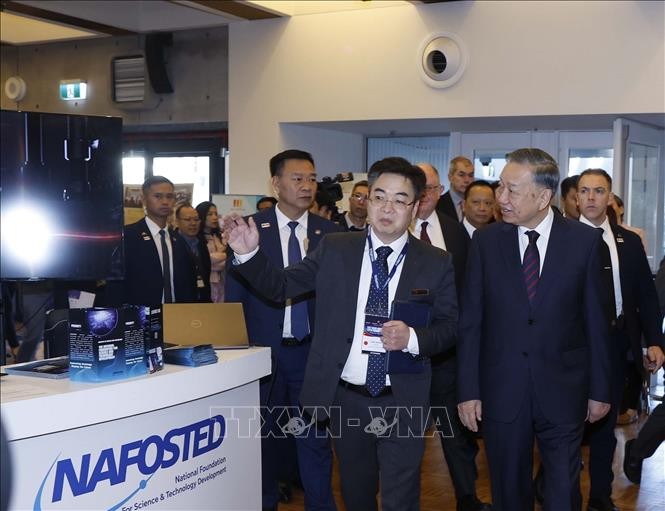
He emphasized that both sides need to expand joint research programs; strengthen connections between research centers, universities, businesses, and innovation investment funds; and form cooperation networks in priority fields such as artificial intelligence (AI), semiconductors, digital technology, biotechnology, quantum technology, clean energy, strategic minerals, and the maritime economy.
Furthermore, the two nations should promote two-way investment in high-tech industries; establish research and development (R&D) centers, joint laboratories, business incubation programs, and innovation projects with commercial potential; and build financial support mechanisms for joint research and risk-sharing, aiming toward co-development and co-investment.
Linking training and research with business needs
Vietnam encourages high-quality investment from Australia in the development of green financial products, digital infrastructure, data centers, and innovation hubs. Simultaneously, Vietnam seeks increased technical support and experience sharing regarding the development of the International Financial Center in the country.
The General Secretary and President proposed expanding cooperation in training high-quality human resources, particularly engineers, scientists, technology experts, and innovation managers, while encouraging the exchange of students, postgraduates, and experts between the two nations.
He noted that both sides need to closely align training and research with the actual needs of businesses. This includes promoting bilateral mechanisms and annual forums for policy dialogue, experience sharing, and fostering the "Triple Helix" model of collaboration between the State, academia, and industry.
The top leader of Vietnam expressed his confidence that with the determination of both governments and the support of the business community, universities, research institutes, and scientists, both sides will achieve new breakthroughs. This will help make the Vietnam–Australia relationship a model for cooperation in science, technology, innovation, and human resource development within the region and globally.
Speaking at the forum, Vietnamese Minister of Science and Technology Vu Hai Quan proposed that both sides concentrate resources on strategic sectors such as AI, semiconductors, cybersecurity, quantum technology, biology, clean energy, and maritime technology. He also suggested building a cooperation chain spanning from research and testing to commercialization, while connecting capital sources for innovation.
Addressing the event, Australian Assistant Minister for Foreign Affairs and Trade and Assistant Minister for Immigration Matt Thistlethwaite emphasized that science and technology lie at the heart of human progress, economic growth, and the improvement of quality of life. He also spoke highly of Vietnam’s Politburo Resolution No. 57-NQ/TW. Within the framework of the Comprehensive Strategic Partnership, both sides are seeking further ways to cooperate and invest in science, research, and innovation.
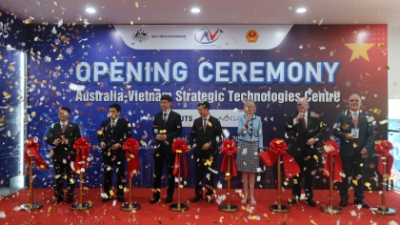
At the forum, businesses from both countries exchanged cooperation documents and announced new initiatives. On this occasion, Vietjet Aviation Joint Stock Company signed a cooperation agreement with Western Sydney International Airport, announcing the opening of a direct flight route from Ho Chi Minh City to Western Sydney International Airport starting in January 2027. This move is expected to boost the economy, investment, trade, tourism, and people-to-people exchanges between the two countries.
 Google translate