


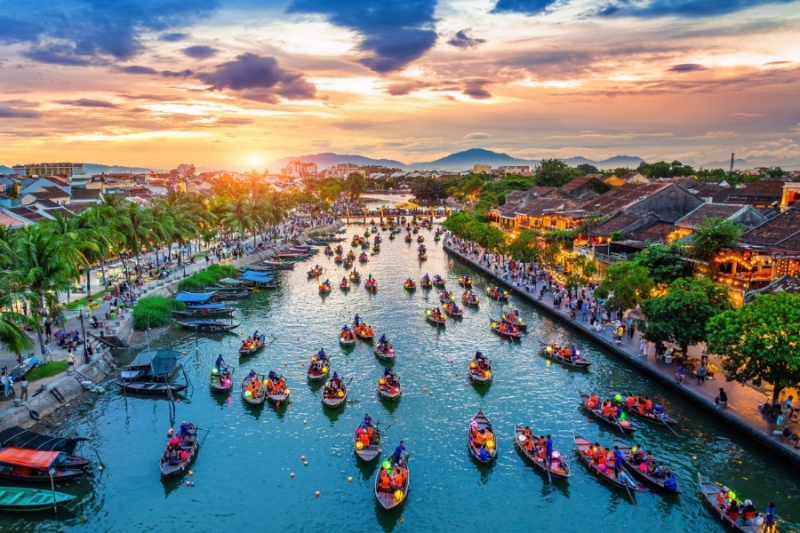
Vietnam’s tourism sector is pursuing an ambitious target in 2025 of welcoming 25 million international visitors, and is now stepping up efforts to draw in more travelers from now to the end of the year - traditionally the “golden season” for foreign arrivals.
Building momentum
According to the National Statistics Office at the Ministry of Finance, Vietnam welcomed 1.73 million international visitors in October, for an increase of 13.8 per cent compared to September and 22.1 per cent year-on-year. The country welcomed nearly 17.2 million international arrivals in the first ten months, marking a 21.5 per cent rise over the same period of 2024 and a strong indication of the sector’s ongoing recovery and growing appeal.
Revenue from accommodation and food services in the first ten months has been estimated at VND695.1 trillion ($26.4 billion), accounting for 12 per cent of total retail sales and consumer service revenue and marking an increase of 14.6 per cent compared to the same period last year. Meanwhile, travel and tourism services generated an estimated VND77.4 trillion ($2.94 billion), representing 1.4 per cent of total retail and service revenue and rising 19.8 per cent year-on-year.
Mr. Nguyen Trung Khanh, Chairman of the Vietnam National Authority of Tourism (VNAT) at the Ministry of Culture, Sports and Tourism, emphasized that the sharp increase in international visitors in recent months reflects the positive impact of the country’s visa-exemption policies and the effective implementation of tourism promotion and marketing programs in key source markets such as Russia, Japan, Italy, and South Korea. “These proactive efforts have significantly strengthened Vietnam’s position as a welcoming and attractive destination for global travelers,” he said.
In addition to the steady rise in international visitor numbers, Vietnam’s tourism sector has also achieved remarkable success in promotion and branding over the past year. At the World Travel Awards in October, Vietnam once again made an impression, winning two prestigious titles: “Asia’s Leading Destination” and “Asia’s Leading Heritage Destination 2025”. Several Vietnamese localities, including Ho Chi Minh City, Hanoi, and Hoi An ancient town in central Da Nang city, and tourism companies also received international recognition across multiple award categories, reaffirming the country’s growing reputation as one of Asia’s most captivating destinations.
As the year draws to a close, Vietnam’s tourism sector is witnessing robust momentum in international arrivals, coinciding with the peak travel season. The final months of the year promise to be vibrant and festive, filled with major events and celebrations such as Christmas, New Year’s Eve, and a wide range of cultural and entertainment activities around the country.
Ms. Nguyen Nguyet Van Khanh, Marketing Director at Vietravel, said the number of international travelers booking services for the year-end season has increased by 125 per cent compared to the same period last year. The strongest growth comes from markets such as China, Europe, English-speaking countries, and especially India, which is emerging as a key source of inbound tourists.
Similarly, Ms. Nguyen Hoai Thu, Director of Saigontourist Travel, Hanoi Branch, reported that during the summer season of 2025 alone the number of European tourists booking long-stay tours to Vietnam rose by over 25 per cent year-on-year. “We are developing more high-end tourism products that connect heritage sites, coastal and island destinations, and modern urban experiences,” Ms. Thu explained. “Our goal is to extend visitors’ length of stay and increase the likelihood that they will return to Vietnam in the future.”
Mr. Bui Thanh Tu, Marketing Director at BestPrice Travel, said his company has recorded 130 per cent growth compared to the same period of 2024 and is aiming to reach 150 per cent by the end of the year. “Travel preferences among visitors to Vietnam have become increasingly diverse: approximately half choose leisure and resort vacations, 20 per cent prefer exploration and adventure tours, another 20 per cent seek cultural and historical experiences, and the remaining 10 per cent are here for medical tourism or wellness retreats,” he noted.
He also emphasized that this diversity in demand presents both an opportunity and a challenge for Vietnamese tourism companies to continue innovating their products and improving service quality to meet the evolving expectations of international travelers.
Chasing goals
Though Vietnam’s tourism sector has been maintaining strong growth momentum, experts have emphasized that achieving the ambitious goal of welcoming 25 million international visitors this year will require even greater effort and coordination across the sector.
Mr. Vu Quoc Tri, Deputy Secretary-General of the Vietnam Tourism Association, noted that Vietnam must accelerate its growth pace to reach the target. “Welcoming around 10 million international visitors in the closing months of the year is no small challenge,” he said, pointing out that recent storms and natural disasters have severely affected several key local destinations. This calls for a comprehensive approach, combining promotion, infrastructure readiness, and close collaboration between local authorities, travel businesses, and service providers to maintain Vietnam’s attractiveness among international travelers.
Mr. Pham Van Thuy, Deputy Chairman of VNAT, acknowledged that the goal of welcoming 25 million international visitors this year remains a significant challenge but also expressed confidence that the target is attainable, provided that the sector accelerates its efforts and focuses on implementing key strategic solutions over the remaining months of the year. The top priority now is to develop distinctive tourism products that reflect Vietnam’s unique cultural identity while meeting the evolving preferences of modern travelers.
He also highlighted the importance of intensifying tourism promotion both domestically and internationally, particularly by leveraging digital technology and multimedia communication to amplify Vietnam’s image as a vibrant and welcoming destination. “At the same time, it is crucial to continue refining our mechanisms and policies, especially those related to visa facilitation, to make travel to Vietnam easier and more appealing for international tourists,” Mr. Thuy added.
Reports also show that local destinations around Vietnam are actively implementing initiatives to attract visitors during the year-end peak season. Ho Chi Minh City is focusing on expanding river tourism products, while northern Quang Ninh province, home of Ha Long Bay, is organizing a series of festivals and tourism stimulus packages to boost visitor numbers. Da Nang, meanwhile, has launched new direct flights to and from Singapore, which are expected to significantly enhance international arrivals to the central city.
From a business perspective, Ms. Thu said her company has set an ambitious goal of achieving at least 20 per cent annual growth in visitor numbers during the 2025-2026 period. “Our strategic focus is to develop a chain of high-quality, specialized tourism products that combine heritage, leisure, and cultural experiences,” she explained. “This approach aims to encourage travelers to extend their stays and explore Vietnam more deeply.”
As Vietnam’s tourism sector accelerates towards its ambitious goals, the roadmap ahead is defined by both opportunities and determination. With synchronized solutions spanning product innovation, connectivity, digital transformation, and policy support, Vietnam is not only recovering but also redefining its position as a leading tourism destination in Asia.






 Google translate