


Products from ethnic and mountainous regions continue to face significant market hurdles. These challenges stem from small-scale production, inconsistent quality and output, high logistics costs, limited market insight, and a lack of regular access to distribution networks.
These issues were the focus of a seminar titled "Tapping Domestic Demand, Expanding Outlets for Products from Ethnic Minority and Mountainous Regions," held on September 3.
According to Mr. Bui Nguyen Anh Tuan, Deputy Director of the Domestic Market Management and Development Department (Ministry of Industry and Trade), while these products have gained wider recognition, the metric for success needs to change. Instead of measuring how many products are on display, the focus should shift to customer retention—evidenced by stable sales and long-term trade partnerships.
Furthermore, a lack of transparency and proper documentation remains a barrier. Traceability, data verification, standardized packaging, and legal records are often incomplete, said Mr. Tuan. Additionally, the cultural value of these products has yet to be fully commercialized; while many items possess a unique local identity, they have not been crafted into compelling brand stories.
Logistics also pose a major hurdle. High transportation costs, combined with a shortage of local infrastructure for collection, preliminary processing, and warehousing, have driven up circulation expenses. Many producers also lack the marketing, operational, and digital skills required to participate effectively in modern distribution channels.
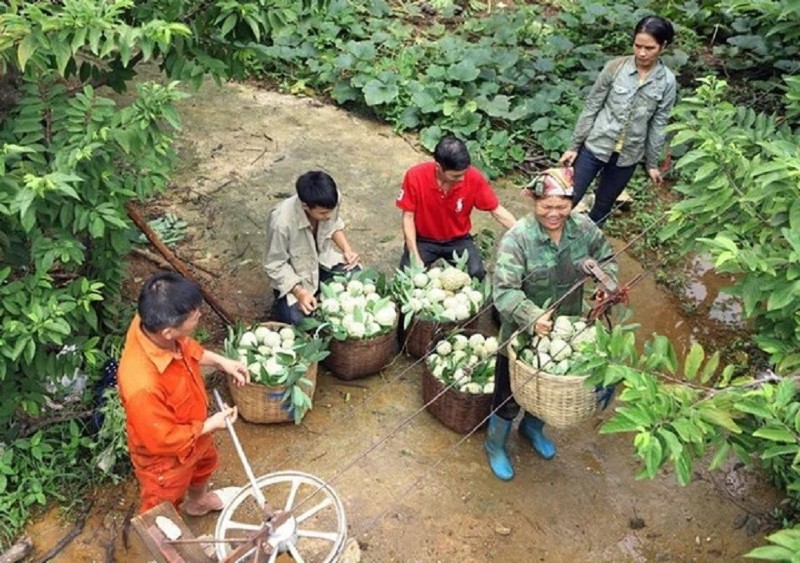
Providing a practical perspective, Mr. Le Duc Hai, Director of the Huu Lung Green Agricultural Cooperative (Lang Son Provinice), said that the cooperative specializes in specialty custard apples grown on limestone mountains. They use biological methods—"growing grass to nourish the soil"—to ensure high safety and quality standards.
Despite these efforts, the cooperative’s biggest challenge is still consumption, as they remain largely dependent on seasonal traders who buy directly from the orchards.
"Farmers spend half an hour climbing mountains to hand-pick each fruit, bringing them down using homemade pulley systems. It is exhausting work," said Mr. Hai.
"During peak season, a single household can harvest between 500kg and two tons of custard apples a day, but without a centralized collection point, traders have to enter individual yards to pack the goods. Furthermore, custard apples are fresh produce with a short shelf life of only about a week. Without a brand identity, QR codes, OCOP certification, and attractive packaging, it is very difficult to get these products into supermarkets or clean fruit chains in distant cities," he added.
Mr. Dao Duc Huan, a representative from the Ministry of Agriculture and Environment, asserted that the primary bottleneck is not the quality of raw materials but the organizational capacity and market mindset of the producers.
To secure legally binding contracts and achieve sustainable consumption, cooperatives must shift from the mindset of "producing first and waiting for buyers" to actively adapting to the strict requirements of each distribution channel. This requires a new generation of tech-savvy managers capable of organizing logistics and taking full responsibility for the end consumer.
To effectively tap into domestic demand, participants agreed on several key transitions: shifting from "production based on capacity" to "production driven by market demand"; moving from price-based competition to value-added competition based on quality, safety, and cultural identity; and transitioning from fragmented support activities to synchronized coordination along the entire value chain.










 Google translate