


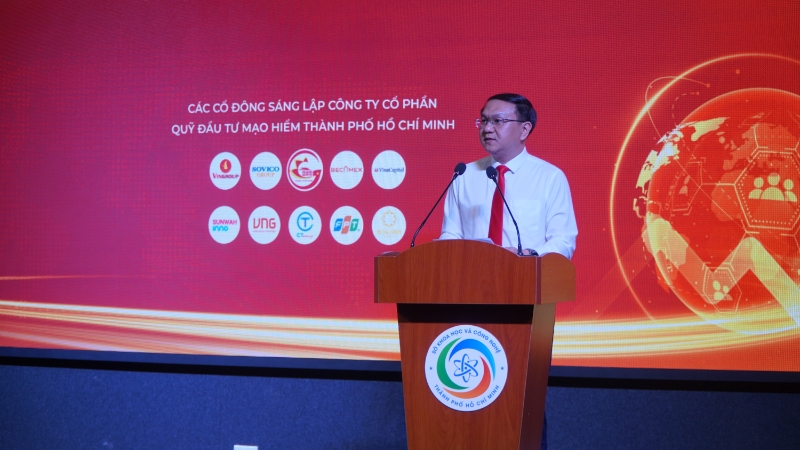
The Ho Chi Minh City Department of Science and Technology officially lauched the Ho Chi Minh City Venture Capital Fund on April 17.
Operated by Ho Chi Minh City Venture Capital Investment Fund Joint Stock Company (HCM VIF JSC), the fund is seen as a concrete step in implementing the city’s strategy to develop its innovation ecosystem, while opening up a new capital channel for technology enterprises.
At the launch, the fund has a charter capital of VND500 billion (nearly $19 million), structured under a public–private partnership model. The city budget contributes VND200 billion, equivalent to 40 per cent, while the remaining 60 per cent or VND300 billion has been successfully mobilised from the private sector. Specifically, within the private capital portion, Sovico contributed VND100 billion, Vingroup VND60 billion, Becamex VND50 billion, SunWah VND25 billion, and VinaCapital VND20 billion, while VNG, CT Group, Hoa Sen, and FPT each committed VND10 billion.
The participation of these private corporations is considered a key factor underpinning the fund’s foundation.
Looking ahead, Ho Chi Minh City aims to expand the fund’s total capital to at least VND5 trillion ($190 million) by 2035, with contributions from private sector accounting for no less than 60 per cent. The fund is expected to serve as a “launchpad” for innovation, supporting the development of a more dynamic and sustainable startup ecosystem.
Investment will focus on core technology sectors such as artificial intelligence, semiconductors, biotechnology, renewable energy, and automation, alongside digital economy and green transition solutions. The fund also aims to invest in between 50 and 150 startups, acting as “seed capital” to crowd in additional private investment.
According to Mr. Lam Dinh Thang, Director of the Ho Chi Minh City Department of Science and Technology, the project was implemented with a strong sense of urgency and determination. The municipal People’s Committee approved the establishment plan on March 4, 2026, after which relevant agencies swiftly completed legal procedures, capital allocation, and organisational arrangements.
“This is a concrete step to remove capital bottlenecks, unlock resources for innovation, and help position Ho Chi Minh City as a regional innovation hub,” Mr. Thang said.
A notable feature of the fund is its “controlled risk-taking” mechanism, allowing for a risk threshold of up to 50 per cent of state capital within an investment cycle, with performance assessed across the overall portfolio rather than on a project-by-project basis. In addition, a “liability waiver” mechanism has been introduced to protect fund managers who comply with established procedures, thereby encouraging more proactive investment decisions.
The fund’s structure is expected not only to strengthen financial capacity but also to build market confidence, with state capital playing a catalytic role in attracting private investment into innovation-driven ventures. In the context of intensifying competition for capital, the initiative is viewed as a strategic move to position Ho Chi Minh City as a leading startup and technology hub in the region.






 Google translate