


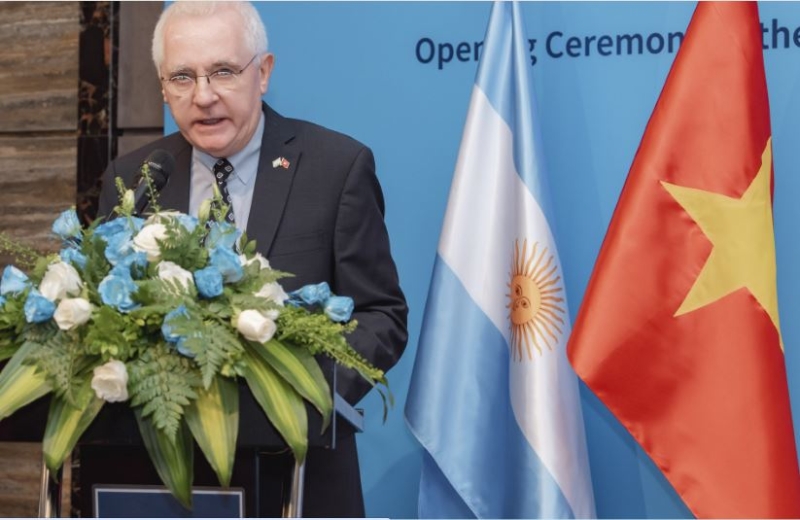
How would you evaluate the development of the relationship between Vietnam and Argentina in the 50 years since bilateral relations were established in 1973?
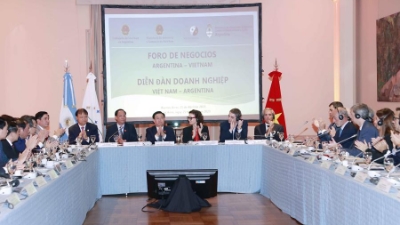
Bilateral trade has consistently grown robustly and steadily since Vietnam and Argentina established diplomatic ties. Within the Asian region alone, Vietnam is now Argentina’s third-largest trading partner and ranks eighth globally. This demonstrates that cooperation between the two countries has been continually strengthened and has come to play a strategically important role.
However, to fully unlock the cooperative potential, I believe Vietnam and Argentina need to make greater efforts in diversifying their export structures in each other’s markets. Argentina’s export structure to Vietnam remains relatively narrow, with more than 90 per cent consisting of animal feed products. Both sides therefore need to proactively identify sectors of high potential and explore more effective negotiation mechanisms to boost market access and facilitate the smoother entry of goods into one another’s markets.
In addition, one of the major challenges Argentine products face when entering the Vietnamese market is the relatively high import tariffs imposed compared to those on countries enjoying preferences under Vietnam’s free trade agreements (FTAs). For this reason, Vietnam and Argentina, along with other members of the Southern Common Market (MERCOSUR), are actively advancing negotiations towards reaching an FTA between Vietnam and the trade bloc. This would establish a more comprehensive cooperative framework, reduce trade barriers, and create new momentum for economic and commercial exchanges in the years ahead.
Vietnam is one of six countries selected by Argentina to host its Agro-Industrial Attaché Office. What policies or incentives is the Argentine Government offering to support Vietnamese enterprises in accessing the Argentine market?
Argentina officially inaugurated its Agro-Industrial Attaché Office in Vietnam on July 1 this year. This is one of six such Offices Argentina has established worldwide, reflecting the importance the country places on Vietnam within the bilateral relationship as well as Vietnam’s strategic role in the sector’s development.
When Argentina elected a new president in 2023, the Argentine Government introduced a series of new economic policies, including removing unreasonable requirements for businesses, opening its international trade market, stabilizing the macro-economy, and providing special incentives for many sectors, particularly agriculture.
In 2023, Argentina faced severe drought, which significantly affected agricultural production. However, the situation had improved by 2024; production had stabilized and output returned to levels comparable to pre-drought periods. Agricultural output is expected to continue rising strongly in 2025 and 2026, contributing to the sector’s sustainable development.
Previously, Argentina’s agricultural sector faced various restrictions, such as export limitations and mandatory domestic reserve requirements. With the new policies, many of these constraints have been considerably eased, and certain import-export bans have even been removed. This has created additional incentives and new opportunities for Argentine agricultural products, while expanding the potential for cooperation with Vietnamese enterprises in the Argentine market.
How do you view Argentina’s investment in Vietnam in recent years?
Overall, Argentina’s investment in Vietnam, as well as the presence of Argentine enterprises in the Vietnamese market, remains relatively limited and does not yet reflect the full potential of cooperation between the two countries. However, we are actively exploring economic sectors that can enhance the presence of Argentine businesses in Vietnam and promote bilateral economic cooperation in the coming period.
Specifically, at the 8th Meeting of the Vietnam-Argentina Intergovernmental Committee on Economic, Trade and Scientific-Technological Cooperation, held in October, both sides agreed to implement a series of pillars and priorities within the bilateral cooperation agenda. Within this framework, Argentina will continue to promote collaboration in several key sectors with Vietnam, particularly agricultural projects such as rice cultivation, increasing soybean production, and dairy processing.
In addition, the energy sector is considered a field with very high potential for cooperation between the two countries. Argentina is endowed with abundant energy resources, making this a priority and promising area for strategic cooperation in the near future. Furthermore, both countries are seeking to expand cooperation into other sectors of potential.
Argentina is currently negotiating a Double Taxation Avoidance Agreement with Vietnam. Once concluded, this agreement will facilitate smoother exchanges of goods and services between the two countries in the years to come.
Vietnam is actively advancing its national digital transformation, while Argentina possesses notable strengths in technology. Could this be a promising area for deeper bilateral cooperation between the two countries in the near future?
The potential for cooperation between Vietnam and Argentina in digital transformation is indeed significant. I have been closely monitoring Vietnam’s policies on digital transformation, and I must say that in Latin America, Argentina is one of the leading countries in this field.
Notably, at the 8th Meeting of the Vietnam-Argentina Intergovernmental Committee on Economic, Trade and Scientific-Technological Cooperation, we also proposed supporting Vietnam in implementing a digital plant quarantine certificate. This reflects practical experience from Argentina’s successful digital initiatives, which we are eager to share with Vietnam.
Moreover, Argentina is among countries with a high Human Development Index in Latin America and is seriously investing in training and developing a digital workforce. These foundations create favorable conditions for both countries to expand cooperation.
Therefore, I am confident that digital transformation can become an important area of bilateral cooperation. What is needed now is for both sides to identify specific, feasible, and suitable projects that can be implemented effectively and pragmatically in the near future.





 Google translate