


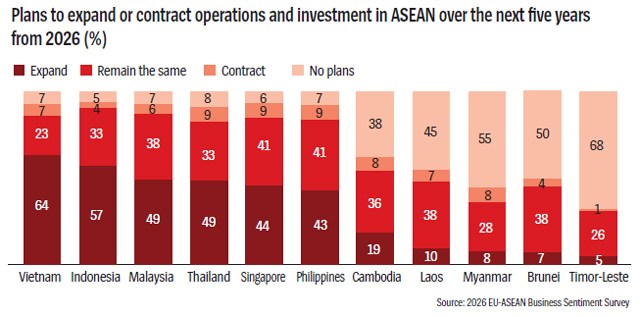
Vietnam has emerged as the most attractive ASEAN market for European businesses planning to expand over the next five years, according to the 2026 EU-ASEAN Business Sentiment Survey. The 12th annual edition of the EU-ASEAN Business Council’s business sentiment barometer, the survey found that 64 per cent of respondents plan to expand their operations or investments in Vietnam over the next five years - the highest percentage among all ASEAN markets. Indonesia followed at 57 per cent, while Malaysia and Thailand each posted 49 per cent.
The country’s leading position is notable not only because of the strength of expansion plans among companies already operating within its borders, but also because it is attracting interest from European businesses that have yet to establish a presence here.
Expansion momentum
The report describes Vietnam and Indonesia as the region’s clearest “dual-growth markets.” Both already have substantial European business communities, with more than 70 per cent of respondents active in each market, while simultaneously recording the strongest interest among companies that are not yet operating here.
Thirty-four per cent of respondents not currently operating in Vietnam are considering entering the market, compared to 32 per cent for Indonesia and 20 per cent for both Malaysia and Thailand.
The survey’s geographic data shows that 70 per cent of participating European businesses already have operations in Vietnam, making it the fifth-most common ASEAN location among respondents, behind Singapore, Malaysia, Indonesia, and Thailand.
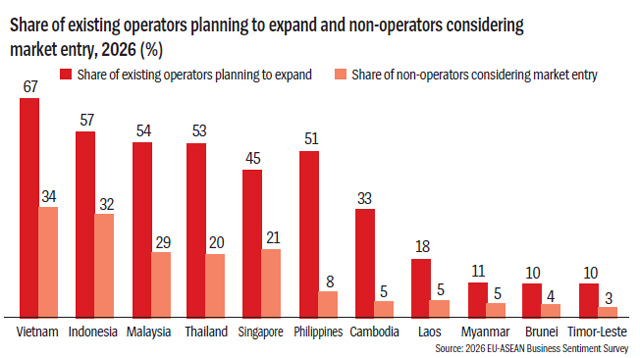
A combination of a large existing business presence and strong prospective market entry interest distinguishes Vietnam from smaller ASEAN economies, where European companies have a more limited footprint and expansion ambitions are correspondingly weaker.
The report therefore sees future European investment in ASEAN as largely reinforcing established commercial centers rather than producing a major redistribution toward smaller markets. Vietnam and Indonesia are the strongest examples of this trend.
Vietnam’s strong position comes against a broader recovery in European business sentiment toward ASEAN. Nearly three-quarters of survey respondents - 73 per cent - said ASEAN had become more important to their companies’ worldwide revenues over the past two years. Meanwhile, 61 per cent identified ASEAN as the region offering the best economic opportunities over the next five years, up from 56 per cent in 2025. A further 78 per cent expect their trade and investment in ASEAN to increase over the five-year period.
The survey suggests that businesses are primarily looking toward commercial opportunities when deciding where to expand rather than simply lower production costs. Economic recovery and growth opportunities were cited among the Top 3 reasons for expansion by 66 per cent of respondents. Adequate laws and regulations followed at 46 per cent, while diversification of the customer base was selected by 44 per cent.
Vietnam’s appeal within the survey is not presented simply as a cost-based manufacturing proposition. Rather, its position reflects the broader combination of market opportunity, an established European business ecosystem, and the potential to support regional growth.
The country’s investment momentum also comes as European companies rethink their supply chains amid geopolitical and trade disruption. Some 67 per cent of businesses that had already recalibrated or were planning to recalibrate their supply chains were considering ASEAN as a destination, well ahead of South Asia at 29 per cent, China at 24 per cent, and Europe at 22 per cent.
Two-thirds of respondents already use ASEAN regional supply chains. Among those companies, proximity to key markets and faster delivery times were the leading benefits, cited by 76 per cent, while 72 per cent pointed to the cost competitiveness of regional suppliers. More than half also saw opportunities to localize production and meet regional demand, while 47 per cent valued diversification away from excessive dependence on a single country.
That makes the region increasingly relevant not just as a collection of consumer markets, but as part of companies’ broader production, sourcing, and resilience strategies.
Headwinds to withstand
The positive outlook for Vietnam and ASEAN comes despite considerable pressure from global disruption. Eighty-one per cent of respondents said uncertainty surrounding US tariff policies had made them at least somewhat less confident about operating in ASEAN. At the same time, only 18 per cent had already recalibrated or relocated their supply chains in response, while another 19 per cent were planning to do so.
Such responses are characterized in the report as adaptation rather than broad withdrawal. Businesses are attempting to strengthen resilience while maintaining their commitment to ASEAN.
The conflict in the Middle East has added another layer of pressure: 64 per cent of respondents reported a high level of business impact, while 19 per cent said they had delayed or reduced ASEAN-related investment or expansion plans. Yet the survey found that companies were more commonly responding through measures such as supply chain diversification, changes to logistics routes, higher inventories, and increased regional sourcing.
For Vietnam, this global backdrop creates a mixed picture: international uncertainty may make companies more cautious, but the same disruptions are encouraging them to diversify and build more resilient regional operations.
Vietnam’s strong ranking does not mean that European businesses see ASEAN’s operating environment as frictionless. Across the region, 73 per cent of respondents believe there are too many barriers to the efficient use of regional supply chains. Regulatory complexity and inconsistent standards are the biggest pain points among supply chain users, cited by 67 per cent, followed by non-tariff barriers, customs requirements and cross-border delays at 55 per cent.
More broadly, growing non-tariff barriers were ranked as the biggest challenge to trade and investment in ASEAN, followed by regulatory unpredictability, rising protectionist sentiment, and geopolitical instability. Lack of harmonized standards and complex taxation and customs procedures also remain significant concerns.
The survey consequently presented a clear tension: European companies see substantial growth opportunities in ASEAN, but the regulatory environment can influence where that investment ultimately goes. Adequate laws and regulations are among the most important factors attracting expansion, while regulatory unpredictability is simultaneously one of the biggest constraints.
For ASEAN as a whole, businesses identify faster and more efficient customs procedures as the top priority for strengthening the region’s attractiveness as a supply chain and manufacturing base. Deeper regional economic integration, removal of import and export restrictions, and improved market access follow.
Promising position
Vietnam’s leading position in the 2026 survey is therefore best understood as a combination of strong existing European business presence and unusually high future expansion interest.
The country leads ASEAN with 64 per cent of respondents planning expansion, while 34 per cent of European businesses not currently operating there are considering market entry. This gives Vietnam the strongest combination of continued expansion by existing investors and potential entry by new ones in the survey.
At the same time, the report cautions against interpreting the findings as an unconditional vote of confidence. Across ASEAN, European investment is becoming more selective, favoring markets that combine strong growth prospects with predictable regulations, market access, and established business ecosystems.






 Google translate