


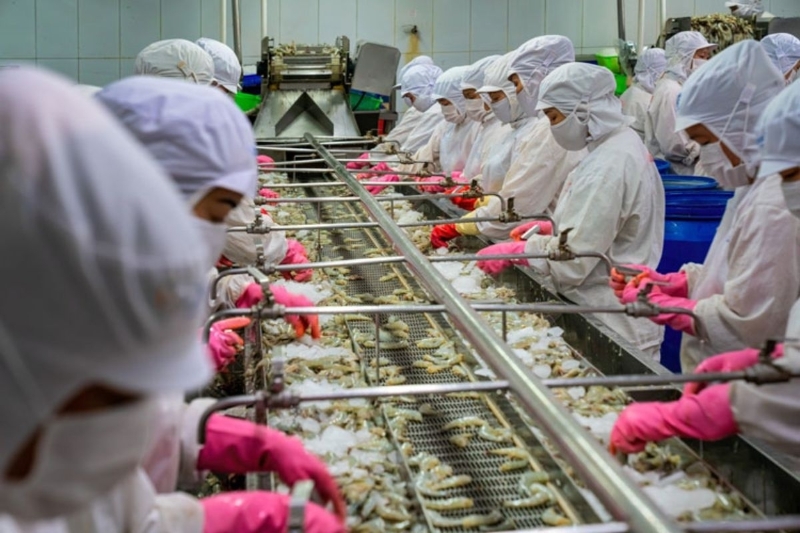
A report from the Ministry of Agriculture and Environment (MAE) puts Vietnam’s exports of agriculture, forestry, and fisheries products to the EU in 2025 at $9.24 billion, accounting for 13.2 per cent of the sector’s total export value.
Coffee posted the strongest growth among export items, with shipments exceeding 666,000 tons and export value reaching $3.63 billion, up 68.3 per cent in value. The EU accounted for 40.7 per cent of Vietnam’s total coffee export value, maintaining its position as the country’s largest export market for coffee. Notably, coffee exports to key markets such as Germany, Italy, Spain, and the Netherlands all posted impressive growth.
Rising standards
The European Union Deforestation Regulation (EUDR) is increasingly seen as a driver for Vietnam’s agriculture and forestry sectors to accelerate digital transformation, standardize data, and strengthen governance. Meeting EU standards not only helps overcome trade barriers but also creates favorable momentum for Vietnamese products to access other high-end markets more easily.
Exports of Vietnam’s agricultural and forestry products to the EU are expected to continue growing in the years to come. However, Dr. To Xuan Phuc, an expert at non-profit Forest Trends, said this growth trend is no longer simply about expanding market share but is accompanied by increasing pressure for comprehensive transformation in governance, transparency, and sustainable development.
Where businesses previously focused mainly on complying with domestic laws and basic trade regulations, they must now meet a broader set of criteria, including preventing deforestation, reducing carbon emissions, respecting the rights of indigenous communities, and ensuring equality and meaningful participation of smallholder farmers in supply chains. International trade, particularly in the EU, is shifting from price-based competition to standards-based competition.
According to Dr. Phuc, the EU-Vietnam Free Trade Agreement (EUVFTA) has created significant advantages for Vietnamese goods, as tariffs on many agricultural and wooden products have been reduced to zero, strengthening their competitiveness compared with countries that do not have trade agreements with the EU. However, as tariff barriers are gradually removed, technical barriers and compliance costs are becoming increasingly significant.
The EU is now widely viewed as a complex legal system with multiple overlapping regulations, including the EUDR, the EU Timber Regulation (EUTR), and the Registration, Evaluation, Authorization and Restriction of Chemicals (REACH) regulation. Among these, the EUDR is considered to have the most far-reaching impact on Vietnam’s coffee, rubber, timber, and wooden product sectors. In May 2025, the EU classified Vietnam as a “low-risk country” under the EUDR, meaning inspection rates of around 1 per cent and significantly simplified control procedures.
Traceability challenges
Mr. Truong Tat Do, an official from the Forestry and Forest Protection Department at the MAE, said there remains a misconception that Vietnamese companies must directly submit reports under the EUDR.
In reality, the legal obligation rests with importers in the EU. However, for partners to fulfill their due diligence responsibilities, Vietnamese businesses must provide complete and accurate information on product origin to EU importers. This means that although domestic companies do not directly submit documentation, they still face significant pressure to ensure transparency and the reliability of their data.
The EUDR sets out two core requirements. First, products must not be linked to deforestation or forest degradation after December 31, 2020. Second, production must comply with national laws, including regulations on land, environment, labor, and the rights of third parties. The regulation does not apply only to production areas but to the entire supply chain, from harvesting and transport to processing and export. If any stage involves legal violations or deforestation after the stated cut-off date, the product will not meet requirements.
Under the latest timeline, the EUDR will take effect on December 30, 2026, for large companies in the EU and on June 30, 2027 for small and medium-sized enterprises (SMEs). The preparation period is therefore limited, while the transformation required is both systemic and long term.
Dr. Phuc said Vietnam’s biggest challenge lies in the fragmented and small-scale nature of production. A farmer may own multiple plots of land, while raw materials can pass through six to seven intermediary layers before reaching processing factories. This structure makes traceability extremely complex, particularly when precise geolocation data must be provided for each shipment.
Another issue is the overlap of forestry land. In some localities, such as Son La in the north and parts of the central highlands, rising coffee prices led to expansion into areas designated as forestry land. Under Vietnamese law, some of these cases may not be fully compliant, while under the EUDR the risk of products failing to qualify for export is clear.
“Before discussing global standards, the most important requirement is compliance with Vietnamese law,” Dr. Phuc said. “There are still areas recorded as forestry land on paper where forests no longer exist in reality, and some forest allocation contracts from earlier programs remain legally valid, creating complications in management and accountability. If these issues are not addressed in a coordinated manner, adapting to the EUDR will face significant obstacles.”
Digital mapping
A major shift under the regulation is the requirement for geospatial data. Companies must provide precise geographic coordinates of production plots, and a closed polygon boundary must also be defined for areas of 4 ha or more. EU authorities will cross-check this data with satellite mapping systems as of December 31, 2020, to assess deforestation risks. This approach shows that the EUDR no longer relies solely on paper documentation but increasingly uses remote sensing technology and digital data for monitoring. Inaccurate or dishonest declarations can be quickly detected when compared with independent systems.
Mr. Pham Ngoc Hai, a remote sensing expert at the Forest Inventory and Planning Institute, said advances in remote sensing and digital transformation are fundamentally changing how information on forests and land use is accessed. Free satellite imagery from the US’s Landsat program has provided continuous data since 1972. While it previously took 16 days to obtain a new image, observation frequency is now significantly higher, enabling near-continuous monitoring.
“Just two or three overlapping satellite images can significantly improve observation capacity,” Mr. Hai said. “Observations generate data, and data produces information that objectively reflects conditions on the ground. For a specific forest plot, it is possible to trace land use history from the 1980s to the present, effectively ‘telling the story’ of how that area has changed over time.”
In practice, field inspections may show that an area has been planted with coffee, but it can be difficult to determine exactly when the crop was established. Satellite data allows analysts to trace backwards in time to determine whether the planting occurred before or after the 2020 cut-off date, and whether the land was previously farmland or forestry land. This capability helps clarify timing, a key factor under the EUDR.
According to Mr. Hai, Western partners do not necessarily require Vietnam to provide every piece of detailed information, as they can retrieve data from independent sources. Exporters only need to provide the coordinates of shipments, while importers can independently verify and cross-check the information. Multiple traceability systems are currently in use; beyond domestic platforms, international partners may build their own databases and compare data from various sources. There is no longer a single source of information.
In this context, data transparency has become essential. If reports differ between stages, external parties can verify the information using scientific data with a high degree of accuracy. Technology and data are reshaping how natural resources are managed and are setting higher transparency standards for the entire supply chain.
To help Vietnam’s agricultural and forestry products deepen their access to the EU market, experts recommend that during the 2025-2027 period the country should prioritize completing GPS mapping of raw material areas, building comprehensive traceability records, and strengthening data governance capacity.




 Google translate