


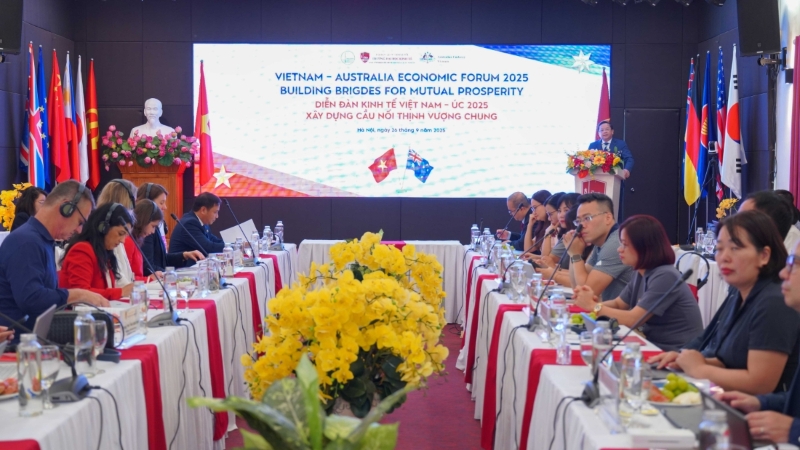
Ưithin the framework of the Comprehensive Strategic Partnership between Vietnam and Australia, one of the pillars established focuses on science, technology, innovation, and digital cooperation. In this context, closer collaboration between policymakers, universities, businesses, and investors is essential for translating scientific research into innovative and commercially-viable solutions for both countries.
In a cross-sector panel discussion at the Vietnam - Australia Alumni Business Forum on December 12 in Ho Chi Minh City, with the theme “From Science to Industry Solutions: Advancing Innovation through Cross-Sector Collaboration”, experts from government, academia, finance, and venture capital examined how Vietnam and Australia can strengthen cooperation to accelerate innovation and commercialization.
From lab to market
The challenge of converting scientific research into commercially-viable products continues to test Vietnam’s innovation ecosystem, particularly in terms of policy alignment, financing, and institutional collaboration.
According to Mr. Do Tien Thinh, Deputy Director of the National Innovation Center (NIC), Vietnam is entering a new era of innovation, driven by three key factors that can bring research from the laboratory to the market: legal frameworks and mechanisms, financial resources, and human capital.
On the legal and regulatory front, Vietnam has revised nearly 90 laws and issued around 40 National Assembly resolutions since last year. Ho Chi Minh City also recently updated Resolution No. 98/2023/QH15 on the pilot implementation of special mechanisms and policies for its development. For each law and mechanism, the focus is increasingly on enabling scientific research to become practical market solutions.
Under the new Law on Public Asset Management, nearly 300 public and national universities can now turn their assets into innovation hubs. Laboratories can be used for research and surveys, while existing buildings can host startups, fostering closer collaboration between universities and industry. Coupled with increased funding for science, technology, and innovation, as well as programs connecting with the overseas Vietnamese community through networks such as the Australian Alumni Business Network (AABN) and the Vietnam-Australia Scholars & Experts Association (VASEA) to address talent challenges, these reforms aim to accelerate innovation and turn scientific research into market-ready solutions.
“When mechanisms, resources, and talent come together, scientific ideas can be transformed into practical solutions that create real market value,” Mr. Thinh emphasized. “I hope that next year we will see tangible results from these policies.”
Associate Professor Ngo Duy Dong, Head of the Transportation Section at the Department of Civil and Environmental Engineering at Monash University in Melbourne, noted that moving from science to practice often focuses solely on scientific value, while many projects face budgetary or investment risks. “There is no simple solution,” he said. “Each case must be considered individually, balancing risk and value.”
Monash University prioritizes cross-border collaboration to keep pace with global trends and climate change. Within this framework, it provides both financial and administrative support to help researchers identify potential industry partners across countries. “For example, at Monash, we have specialized innovation and commercialization teams that support researchers with intellectual property, licensing, and Proof of Concept (POC) funding,” he said. “This allows scientists to focus on their work without worrying about IP or commercial agreements. This support is a key factor in translating science into practical solutions.”
In the financial sector, Mr. Phung Duy Khuong, Deputy CEO and Head of Retail Banking at VPBank, emphasized that a bank’s role goes beyond providing capital. It also involves creating an ecosystem that connects startups, researchers, and investors. “We have developed programs to support innovation and accelerate projects from research to practical application,” he noted. “The biggest challenge is that scientific projects are sometimes not yet market-ready, so they need support in funding, training, and market connections.”
From a venture capital perspective, Ms. Vu Anh Tuyet, Senior Advisor at Vertex Ventures and a member of the AABN Advisory Board, said her experience working with numerous startups from their inception confirmed the challenges of bringing technology to market. Even highly-skilled researchers and technologists can lack an understanding of real market needs, sales capabilities, and team-building skills. “It is essential to ‘pair’ commercially-minded founders with tech experts to develop products that truly address customer pain points,” she explained, while also observing that Vietnam’s innovation ecosystem has grown significantly in recent years and pledging to support early-stage founders in building the next generation of technology-driven, investment-ready companies.
Turning opportunities into impact
Panelists agreed that the Vietnam – Australia Comprehensive Strategic Partnership provides a solid foundation for deeper cooperation in innovation. Priority areas identified included the digital economy, education, agriculture and food, energy, and health.
Mr. Brett Lovegrove, Pro Vice-Chancellor for Global Partnerships at the University of Queensland, emphasized the importance of complementarity between the two countries. Australia offers strong research infrastructure and commercialization experience, while Vietnam provides a fast-growing market with high demand for applied innovation.
A practical example of this collaboration was shared by Associate Professor Dong, who cited AI-enabled traffic management solutions in Ho Chi Minh City. Co-developed by Australian and Vietnamese partners, the digital twin technology has been piloted on several major corridors and has reportedly reduced travel time by some 20 per cent.
Mr. Khuong emphasized that with Vietnam’s population of 100 million and Australia’s 28 million, there are vast opportunities for cross-sector collaboration. The banking sector plays a crucial role in supporting all industries. The Vietnam Bankers Association and its Australian partner have signed an MoU to promote financial cooperation and innovation, applying sandbox models to pilot initiatives on a small scale before broader implementation.
Experts stressed that turning innovation opportunities into real market impact requires coordinated action across government, academia, business, and investors. Flexible regulatory frameworks, sandbox mechanisms, sustained investment, and cross-border talent networks were cited as key enablers.
The panel also highlighted the role of people-to-people links, particularly the community of more than 160,000 Vietnamese alumni of Australian universities, in bridging research and commercial ecosystems in both countries. The discussion reinforced a shared message: only through integrated, cross-sector collaboration can Australia and Vietnam unlock the full potential of science, technology, and innovation for sustainable economic growth.
Broadening the partnership
Speaking with Vietnam Economic Times / VnEconomy, Ms. Sarah Hooper, Australian Consul General in Ho Chi Minh City, highlighted the evolving partnership between the two countries. Traditionally known for agricultural investment and cooperation, Australia has recently stepped up its engagement in innovation and technology as part of its Comprehensive Strategic Partnership with Vietnam.
“For Australia, this is not an either-or choice,” Ms. Hooper said. “Agriculture remains a critical sector, but we also have a dedicated pillar on science, technology, innovation, and digital cooperation. This partnership is built on equality, with shared opportunities and challenges. The prosperity of our nations and the stability of our region depend on securing our economic futures together.”
Digital transformation and sustainability, including the goal of net-zero emissions by 2050, form vital pillars of cooperation. “We understand that these challenges cannot be tackled alone,” she said. “Collaborative efforts will shape a prosperous, stable, and peaceful region.”
Regarding how Australia’s experience can help Vietnam accelerate technology and innovation, Ms. Hooper pointed to Vietnam’s clear digital transformation framework and the parallels in Australia’s journey. “We are learning to design effective regulations and pathways to turn research into scalable startups,” she explained. “The recent partnership between the Ho Chi Minh City Innovation and Startup Support Center (SIHUB) and Australian unicorn Canva is a good example.”
She also highlighted Australia’s bold global leadership, citing the world-first ban on social media for children under 16, introduced on December 10, as a measure reflecting careful attention to community concerns about unregulated platforms. “Both countries are on learning journeys, discovering the benefits and risks of new technologies,” she said. “In many areas, Vietnam leads, offering valuable lessons for Australia as well.”
On sustainable development, Ms. Hooper stressed the importance of inclusive transformation. “Governments alone cannot meet these enormous challenges,” she said. “Private sectors, communities, and international partners must collaborate to ensure the benefits of digital and green transformation reach all members of society while protecting the planet.”
She noted shared concerns over pollution and water scarcity as areas ripe for deeper cooperation. “Achieving net-zero by 2050 requires collective action beyond government regulation,” she believes. “Our joint efforts across the region will be essential to building a sustainable, inclusive, and prosperous future.”
Quote
Ms. Sarah Hooper, Australian Consul General in Ho Chi Minh City
“We understand that these challenges cannot be tackled alone. Collaborative efforts will shape a prosperous, stable, and peaceful region.”





 Google translate