


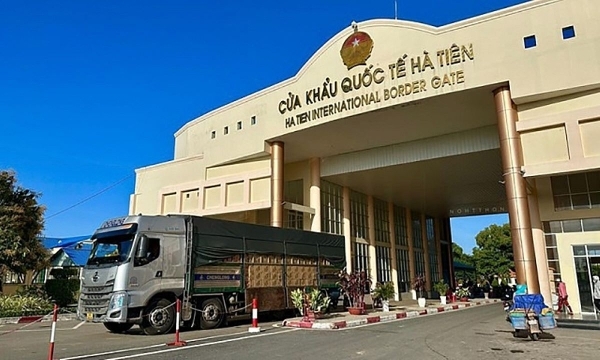
Minister of Agriculture and Environment Trinh Viet Hung held a working session with a delegation from the Cambodian Ministry of Agriculture, Forestry, and Fisheries, led by Minister Dith Tina on June 10.
Both sides discussed various cooperation initiatives aimed at fostering the development of agriculture, environment, forestry, and fisheries in the coming period, while agreeing on solutions to enhance the efficiency of bilateral cooperation.
The total agricultural trade turnover between Vietnam and Cambodia in 2025 reached $2.9 billion, accounting for nearly 23% of the total bilateral trade value between the two sides. From 2020 to 2024, agricultural trade between the two countries more than tripled, rising from $749 million to $2.7 billion.
Between 2020 and 2025, the value of Vietnam’s agricultural exports to Cambodia surged more than 6.5 times. Vietnam exports commodities such as rice, coffee, and fruits and vegetables to Cambodia; however, this export share still only accounts for about 3% of the total bilateral agricultural trade turnover. Conversely, Vietnam imports key items from Cambodia, including rubber, cashew nuts, soybeans, corn, and fruits and vegetables. The value of these imports increased 3.4-fold during the 2020–2025 period, currently making up 97% of the total bilateral agricultural trade.
Both sides noted that the significant trade imbalance reflects a new development trend in Vietnam’s agricultural processing industry. While agricultural trade was relatively balanced in 2015—with Vietnam even seeing a slight trade surplus—Vietnam has become a net importer in recent years. The primary reason is that Vietnamese enterprises are increasingly expanding deep-processing activities, thereby driving the demand for raw materials from neighboring countries to serve production and re-export to international markets.
During the meeting, the two ministers agreed on the goal of continuing to increase agricultural trade turnover in the future. To achieve this, both sides will conduct a comprehensive review of signed agreements and cooperation programs to assess their implementation efficiency, while researching amendments and supplements to align with new development requirements.
The review is scheduled for the third quarter of 2026, focusing on concretizing cooperation commitments, addressing bottlenecks in the implementation process, and expanding into sectors with high development potential.
In the agricultural sector, both sides noted the vibrant exchange of key commodities such as rubber, rice, and other agricultural products. The ministers emphasized the need to develop strategic production plans aimed at improving product quality, ensuring a stable supply, and maintaining reasonable price levels, thereby balancing the interests of both producers and consumers.
Quality and food safety were also identified as core pillars of bilateral cooperation. Both sides agreed to strengthen coordination in inspection and monitoring, and to develop programs ensuring that products meet international standards, which will facilitate trade and the expansion of export markets.




 Google translate