


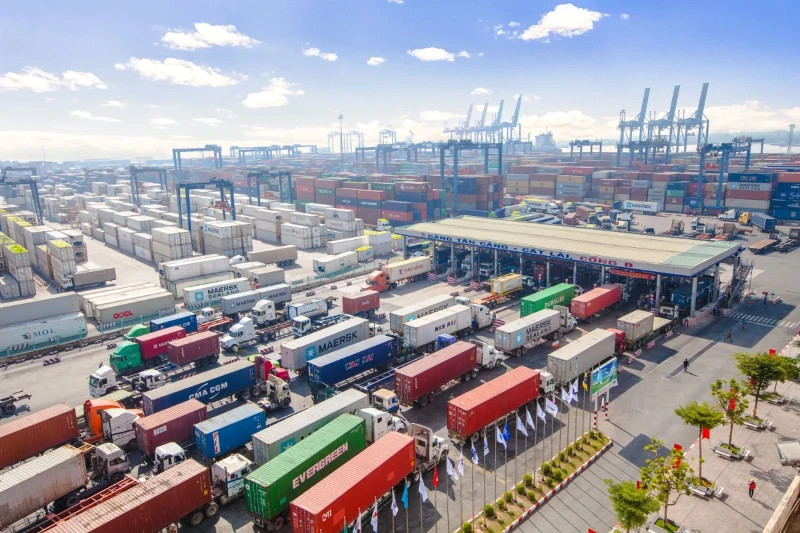
Signed on November 19, 2026, and taking effect on January 8, 2027, Circular No. 71/2026/TT-BCT of the Ministry of Industry and Trade establishes a transparent benchmark to address years of uncoordinated investment and weak regional connectivity.
Under the regulation, a logistics center is defined not merely as a storage facility, but as a geographically demarcated zone with integrated technical and technological infrastructure supporting end-to-end operations from storage, consolidation, and customs clearance to distribution and value-added services.
Based on scale and supply chain impact, Vietnam’s logistics centers are classified into three tiers.
Grade I centers serve as national and international hubs. They must span at least 20 hectares and handle a minimum annual throughput of 3 million tons, 200,000 TEUs, or 35 million orders. Internal infrastructure must include parking for at least 200 container trucks and two-lane internal roads at least 7 meters wide. Strategically located along expressways or national highways, Grade I hubs must integrate at least two transport modes among road, sea, inland waterway, rail, and air, and provide at least half of government-regulated logistics services.
Grade II centers act as regional connectors within the country's key economic zones, covering 10 to under 20 hectares with an annual capacity of 1 million to under 3 million tons. They must link directly to at least one transport mode and offer at least 30 percent of prescribed logistics services.
Grade III centers, spanning 3 to under 10 hectares with throughput under 1 million tons per year, handle intra-provincial and urban distribution, linking production zones with local consumer markets. In addition to this three-tier hierarchy, the circular defines five specialized logistics center categories, all requiring at least 3 hectares and three basic logistics services.
A standout feature of Circular 71 is the mandatory inclusion of digital transformation, cybersecurity, and green sustainability criteria.
Grade I centers must operate level-1 warehouse management systems, round-the-clock surveillance, smart-card access control, redundant telecom lines from at least two independent providers, and backup power capable of sustaining specialized warehouses, security, and last-mile traffic coordination for at least 24 hours.
Grade II and III centers must automate and electronically link at least 30 percent and 10 percent of core processes, respectively.
On sustainability, Grade I hubs are required to use renewable energy, while Grade II and III facilities must establish clear clean-energy transition roadmaps. All tiers must install standard-compliant wastewater treatment systems, packaging recycling processes, and electric vehicle charging stations.
Rather than adding administrative licensing hurdles, the circular introduces a self-assessment and self-declaration mechanism. Operators determine their own classification and publicly disclose infrastructure capacity, technical standards, and sustainability commitments on the national trade infrastructure database at TradeNode.vn.




 Google translate