


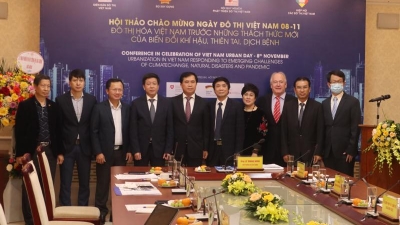
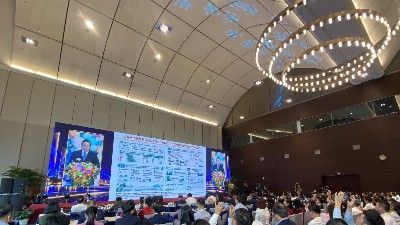
The Ministry of Construction organized the Vietnam Sustainable Urban Development Forum 2025 on November 5, discussing solutions for improving urban planning, management, and operation efficiency.
Participants also discussed ways to mobilize and allocate resources for green and smart urban development; policies for digital transformation in urban areas; modern urban development management models; climate change adaptation solutions, disaster prevention, and emission reduction; and linking urban development with rural construction.
In recent years, urban areas have increasingly played a pivotal role in driving the socio-economic development of regions and the entire country, contributing approximately 70% of the national GDP.
Speaking at the forum, Deputy Minister of Construction Nguyen Tuong Van highlighted that Vietnam's urban system has been a driving force in the country's development, contributing significantly not only to economic growth but also holding important political, cultural, social, and environmental roles.
However, alongside these achievements, Vietnam's urban system faces major challenges such as rapid but uneven urbanization; pressure on technical and social infrastructure, environment, and housing; the growing impact of climate change, natural disasters, and pandemics; and the need to shift development models based on innovation and digital data.
Addressing urban flooding, Pham Doan Khanh, Deputy Head of International Cooperation, Department of Dyke Management and Disaster Prevention (Ministry of Agriculture and Rural Development), suggested solutions such as upgrading drainage systems, increasing permeable surface areas, strictly managing land use, developing green spaces, enhancing early warning systems, and educating communities to improve response capacity.
From the perspective of planning and institutional experts, Antonie Mougenot from the French Development Agency (AFD) proposed mandatory hydrological-hydraulic simulations in planning, updating construction standards according to new climate scenarios, integrating land-water-infrastructure management, and establishing a unified data platform among ministries.
Focusing on climate finance, Mr. Steven Louis Rubinyi, Senior Disaster Risk Management Specialist at the World Bank, proposed expanding concessional funding, labeling climate budgets, and integrating disaster risk assessments into all public investment decisions.
At the forum, experts agreed that developing climate-resilient urban areas is a long-term and urgent task. Vietnam needs to improve institutions, ensure sustainable finance, enhance human resource capacity, and promote the application of science and technology. Particularly, there is a need for innovation in thinking, planning methods, governance, and urban development models to build a safer, greener, and more sustainable urban system in the future.

 Google translate