


The Nationally Determined Contribution (NDC) is one of the pillars of the Paris Agreement, outlining each country’s contribution to the global effort to curb temperature rise and move towards net-zero emissions. As of the end of October, nearly 70 nations had submitted their NDC 3.0 documents to the Secretariat of the United Nations Framework Convention on Climate Change (UNFCCC).
Vietnam is currently drafting its NDC 3.0 for the 2026-2035 period, marking its strongest commitment yet to the global climate response effort. The development and implementation of the NDC 3.0 will play a critical role in enabling Vietnam to reach its net-zero emissions by 2050 target.
Global progress
According to the latest UNFCCC report, total greenhouse gas (GHG) emissions under new NDCs are projected to reach about 13.0 Gt CO₂e in 2035 (excluding land use, land-use change and forestry, or LULUCF); a 17 per cent fall from 2019 levels.
If all new NDCs are fully implemented, including conditional commitments, total GHG emissions could fall to 12.3 Gt CO₂e by 2035, or 19-24 per cent lower than in 2019. Emissions for this group of NDCs are expected to peak before 2030 and then decline sharply through 2035.
The projected 2035 emissions level aligns broadly with a linear reduction pathway from the 2030 estimate towards a collective net-zero target. However, the anticipated reductions still fall short of what is needed to limit global warming to 1.5oC, a 60 per cent cut against 2019 levels.
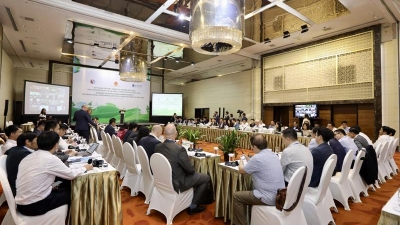
At a recent technical consultation on Vietnam’s NDC 3.0 report for 2026-2035, Mr. Luong Quang Huy, Head of the Greenhouse Gas Emissions Management and Ozone Layer Protection Division at the Department of Climate Change under the Ministry of Agriculture and Environment, noted a key trend: nearly 90 per cent of next-generation NDCs now integrate economic development goals, up from 81 per cent in earlier NDCs. This shift underscores the need to advance climate action alongside socio-economic development.
On adaptation, next-generation NDCs also indicate significant updates. About 73 per cent of parties have included adaptation measures, focusing on priority areas such as food and nutrition security, water resources, health, and ecosystems. Regarding loss and damage, most parties with adaptation content in their NDCs now address related risks and impacts; an increase from 68 per cent previously.
Many countries and territories also plan to use at least one voluntary cooperation pathway under Article 6 of the Paris Agreement. Several have incorporated just-transition considerations into the preparation of their NDCs, with most intending to integrate these principles into implementation.
To deliver on these NDCs, the report highlighted two essential elements: finance and technology / innovation, which are both critical for meeting countries’ international commitments under the UNFCCC. The UNFCCC report shows that 75 per cent of parties reported on the financial support needed to implement their NDCs, with the total estimated cost put at $1.97-1.975 trillion, including around $1.339 trillion earmarked for mitigation.
Illuminating the climate roadmap
As one of the countries most vulnerable to climate change, Vietnam has consistently shown responsibility and initiative in meeting its international climate commitments, despite limited resources. The country submitted its intended NDC in 2015 and updated it in 2020 and 2022, underscoring its strongest efforts so far.
To fulfill its obligations under the Paris Agreement, Vietnam is now finalizing its NDC 3.0. Mr. Tang The Cuong, Director General of the Department of Climate Change, said the draft follows UNFCCC and Paris Agreement guidance, with mitigation and adaptation measures aligned to Vietnam’s socio-economic development scenarios.
The new NDC incorporates the latest national, sectoral, and local strategies on climate response and socio-economic development. It represents Vietnam’s highest level of effort and is expected to contribute meaningfully to global climate action. Given ongoing challenges in mobilizing support for developing countries, NDC 3.0 is being designed with detailed, feasible options as Vietnam pursues high-growth targets across multiple sectors.
The draft identifies key components: GHG reductions across energy, agriculture, LULUCF, waste, and industrial processes and product use (IPPU); climate adaptation; and cross-cutting issues such as loss and damage and gender integration. It also assesses socio-economic impacts, financial needs and likely implementation costs.
In the energy sector, Mr. Nguyen Ngoc Hung, Lead Sector Expert, said updated socio-economic projections push business-as-usual (BAU) emissions to 727.2 million tons CO₂e in 2030 - up from 678.4 million tons in the 2022 NDC - and more than 897 million tons by 2035, driven mainly by power generation, manufacturing, construction, and rising transport emissions.
Under the draft mitigation scenario, sector-wide emissions are capped between 380.2 and 519.1 million tons CO₂e, equivalent to a 34.6 per cent cut by 2030 and 41.7 per cent by 2035 compared with BAU. “Additional investment needed to deliver the NDC 3.0 energy targets is estimated at about $73.7 billion for 2026-2030 and $105.7 billion for 2031-2035,” Mr. Hung said.
In agriculture, experts said the NDC 3.0 will update mitigation pathways for crops, livestock and fisheries to meet Vietnam’s climate commitments and move towards net-zero emissions. It also aligns with the global goal of reducing methane emissions by 30 per cent by 2030 from 2020 levels. The updated NDC is expected to guide agriculture toward greener, more sustainable development, reducing environmental impacts while boosting efficiency and value.
The NDC also reflects Vietnam’s broader progress in developing climate policies and legal frameworks to implement the Paris Agreement and other international commitments.
Balancing growth and climate ambition
In practice, next-generation NDCs from many countries integrate economic growth targets across different sectors, allowing them to set priorities and identify feasible, effective measures and action based on actual conditions.
Vietnam’s approach to reducing GHG emissions will also rely on these factors to ensure feasibility and cost-benefit effectiveness, while enabling coordinated and flexible implementation that fits the country’s development context and available international support. This approach is designed to deliver co-benefits and balance climate adaptation goals with socio-economic development. It is also aligned with national and sectoral development plans for 2026-2030, moving towards the long-term objectives of the national climate change strategy through 2050.
According to a United Nations Development Programme (UNDP) representative, Vietnam is at a critical turning point, with significant momentum in science, technology, and innovation to build a sustainable and inclusive economy. This period presents major new opportunities for Vietnam to advance development, linking economic goals with green growth and sustainability.
The updated NDC will help Vietnam shift from theory to more practical implementation while remaining consistent with overall socio-economic development orientations. A comprehensive, inclusive approach will help ensure an NDC that aligns with national goals and strategic directions. With strong commitment and concrete action, Vietnam can fully achieve its environmental objectives alongside economic growth targets.
The UNDP in Vietnam added that the NDC 3.0 will not simply be a technical document but a reflection of national perspectives and vision, aimed at sustainable and resilient development. It demonstrates Vietnam’s effort to advance economic development in parallel with social progress and sustainability.
Experts believe developing and implementing the NDC 3.0 will be crucial for Vietnam to reach its net-zero emissions goal. A specialist from the German Development Cooperation Agency noted that Vietnam is making active efforts toward net-zero, and the NDC 3.0 is a key step on that path. Implementing the NDC 3.0 could also boost long-term GDP growth, with the related framework creating opportunities for Vietnam to capture new growth potential while reducing emissions.
Boxes
The World Bank’s “Vietnam 2045 - Growing Greener: Pathways to a Resilient and Sustainable Future” report used macro-economic modelling to show that climate impacts could reduce Vietnam’s GDP by at least 12.5 per cent by 2050 compared with the baseline scenario, potentially hindering the country’s goal of achieving high-income status by 2045.
It estimates that Vietnam will need about $233 billion in additional adaptation investment for agriculture, infrastructure, and human capital protection during 2025-2050, equivalent to an average of 0.75 per cent of GDP a year. Adaptation investments in disaster risk management, urban management, transport, and agriculture could help cut projected GDP losses from 12.5 per cent to 6.7 per cent by 2050.
According to the updated National Climate Change Adaptation Plan for 2021-2030, with a Vision to 2050, Vietnam will need an estimated $55-92 billion during 2021-2030 to fully carry out climate adaptation tasks. If it continues allocating 1.5 per cent of GDP to climate adaptation during this period, the country will need to mobilize an additional $2.75-6.42 billion a year from non-budget sources.




 Google translate