


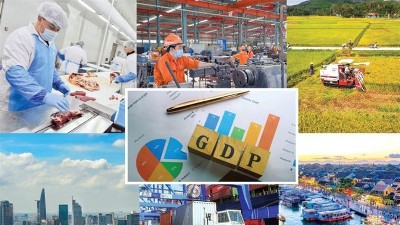
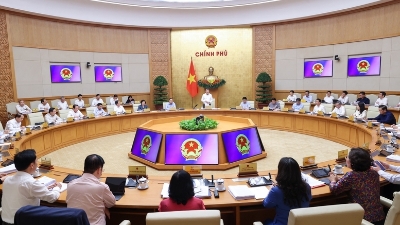
The Government on June 27 issued Resolution No. 168/NQ-CP regarding the update of growth scenarios and key solutions for the remaining quarters of 2026, aiming to achieve a GDP growth target of 10% or higher while maintaining macroeconomic stability.
A notable highlight of the new resolution is the requirement to continue managing fiscal policy in a "focused and targeted expansionary" direction to support economic growth.
The Government has directed the Ministry of Finance (MoF) to urgently submit a proposal in June to flexibly adjust tax regulations on gasoline and jet fuel in accordance with global energy price fluctuations. Additionally, the ministry must complete the allocation of the 2025 central budget revenue surplus and the medium-term public investment plan for the 2026-2030 period by July. This is to ensure sufficient resources for the base salary increase effective from July 1, 2026.
Furthermore, the MoF is tasked with improving the institutional framework for capital market development. This includes submitting amendments to the Law on Securities to the National Assembly for consideration during its October 2026 session and researching new financial products to attract international capital flows into Vietnam’s International Financial Center.
Regarding public investment, the Government requires ministries, agencies, and localities to disburse 100% of the capital plan assigned for 2026. Project owners must develop detailed disbursement schedules on a weekly, monthly, and quarterly basis, while continuing to link the accountability of heads of organizations with disbursement results.
Parallel to promoting investment, the resolution calls for tightened financial discipline, thorough savings on regular expenditures, the cutting of non-essential costs, and a definitive resolution to delays in budget estimation and allocation.
In the monetary sector, the Government requires the State Bank of Vietnam (SBV) to manage policies proactively and flexibly to stabilize interest rates, ensure system liquidity, and maintain stability in the money and foreign exchange markets. These measures aim to contribute to inflation control while simultaneously supporting growth targets.
The SBV is also tasked with controlling credit in high-risk sectors while prioritizing capital for key national projects and new growth drivers. It must also study appropriate adjustments to credit limits and strictly handle instances where growth limits are exploited to hike lending rates.
Notably, the Government continues to request research into increasing the ratio of State Treasury term deposits at commercial banks. This move is intended to boost liquidity for the banking system, thereby enhancing the coordination between fiscal and monetary policies.
Removing bottlenecks, promoting new growth drives
In addition to macroeconomic management solutions, the resolution devotes significant attention to promoting production, investment, and growth drivers.
Accordingly, the Government requires continued improvement of the business investment environment and a sharp reduction in administrative procedures, particularly in the areas of quarantine, import-export, and logistics. It also calls for regular dialogues with businesses to promptly resolve difficulties in the spirit of the Politburo's Resolution 68.
In the industrial sector, the Ministry of Industry and Trade is tasked with accelerating mineral and rare earth extraction projects linked with deep processing; increasing oil and gas exploitation for power generation; and developing key mechanical engineering industries—specifically the railway industry, including the manufacturing of locomotives, rolling stock, signaling systems, and electrification equipment.
Regarding infrastructure, the Ministry of Construction is required to coordinate with localities to speed up the progress of key transport projects. It must proactively handle obstacles related to construction materials, establish an inter-regional supply coordination mechanism, and resolve difficulties in licensing the exploitation of material mines for public investment.
The Government also demands the urgent removal of bottlenecks for delayed projects across all economic sectors, especially national key projects such as the Hanoi and Ho Chi Minh City urban railway systems, railway lines connecting with China, sections of the North-South high-speed railway, Gia Binh International Airport, the expansion of Phu Quoc, Chu Lai, and Ca Mau airports, and various long-stalled projects.
Alongside infrastructure investment, the resolution sets the goal of developing the real estate market in a safe, healthy, and sustainable direction. This includes promoting the development of social and rental housing associated with industrial zones and economic zones in key localities such as Hanoi, Ho Chi Minh City, Hai Phong, Dong Nai, Quang Ninh, Bac Ninh, Hung Yen, and Ninh Binh.
For tourism, the Government requires continued restructuring of the international tourist market, effectively tapping into markets in Northeast Asia, Southeast Asia, India, and Asia-Pacific.
In the agricultural sector, the Ministry of Agriculture and Environment is tasked with supporting localities in removing obstacles for the export of agricultural, forestry, and fishery products—particularly durian and other key commodities. At the same time, it must accelerate the granting of growing area codes and packing facility codes to meet the traceability requirements of import markets.
To ensure macroeconomic stability, the Government requires ministries and agencies to carefully calculate the roadmap for adjusting prices of State-managed goods, strictly control inflation, and ensure a sufficient supply of petroleum and electricity in all situations.

 Google translate