


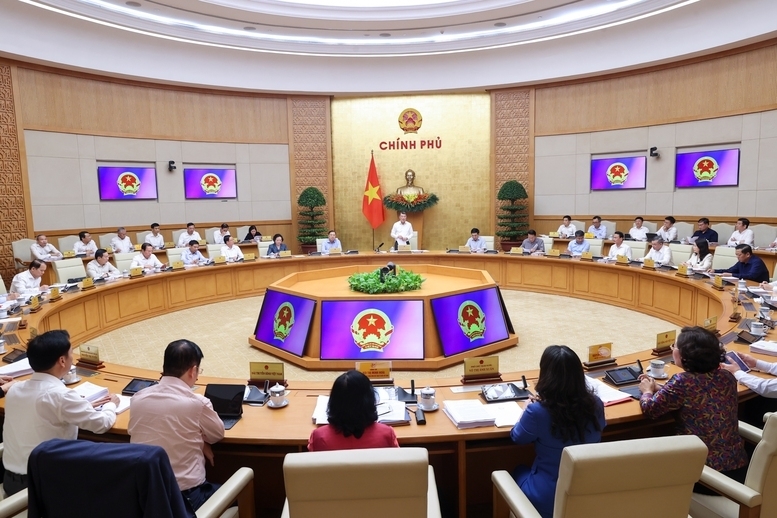
Prime Minister Le Minh Hung chaired the Government’s regular monthly meeting for April 2026 on May 4, the first regular session of the 16th-tenure Government following its consolidation since March this year.
The meeting focused on discussing the socio-economic development situation in April and the first four months of 2026, the progress of public investment allocation and disbursement, the implementation of national target programs, the Government's leadership and management performance, and key tasks for May and the upcoming period.
Stable macro-economy and rebounding growth drivers
According to evaluations at the meeting, immediately following its consolidation, the Government and the Prime Minister promptly updated and supplemented the Action Program to implement the Resolution of the 14th National Party Congress and Conclusion No. 18 of the Party Central Committee's 2nd plenum, regarding plans for socio-economic development, national finance, public debt management, and mid-term public investment for the 2026–2030 period—all aimed at the ambitious goal of achieving "double-digit" growth.
Furthermore, the Government issued eight resolutions focused on cutting, decentralizing, and simplifying administrative procedures and business conditions. Under these resolutions, 184 administrative procedures were abolished, 134 were decentralized to local authorities, 349 were simplified, and 890 business conditions were removed.
Regarding the socio-economic situation, delegates reached a consensus that the macro-economy remains fundamentally stable, inflation is under control, and major economic balances are maintained. The average Consumer Price Index (CPI) for the first four months is estimated to have increased by 3.99%.
Import-export activities maintained positive growth momentum, with total turnover for the four months estimated at $344,2 billion, up 24.2%. Development investment continued to show promising results, with public investment disbursement reaching approximately 14.2% of the yearly plan. Foreign Direct Investment (FDI) attraction saw a sharp increase, with newly registered capital exceeding $18.2 billion (up 32%), while realized FDI reached $7.4 billion (up 9.8%).
In addition to the achievements, the meeting also identified several shortcomings, limitations, and challenges. Notably, macroeconomic management remains under significant pressure, particularly regarding interest rates, exchange rates, and inflation. Traditional growth drivers have yet to reach their full potential, while new growth engines require more time to produce clear results.
Furthermore, the operation of the two-tier local government system still faces certain inadequacies. The decentralization and delegation of authority have not been fully realized, and the progress of issuing legal documents and implementation guidelines remains slow.
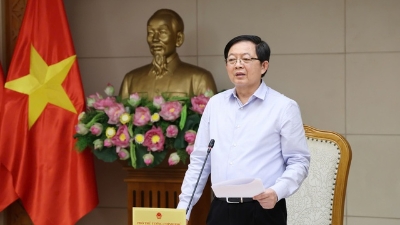
In his remarks, regarding the task of promoting growth in tandem with macroeconomic stability, the Prime Minister requested the synchronized implementation of solutions to mobilize and effectively utilize all resources for development.
Accordingly, the Ministry of Finance (MoF) was assigned to lead and coordinate with the State Bank of Vietnam (SBV) and relevant ministries to develop management scenarios and proactively respond to both domestic and international fluctuations.
The MoF was also directed to urgently propose plans for utilizing revenue increases and expenditure savings, reporting to the Prime Minister by May 15, 2026.
Simultaneously, the ministry must refine tax and financial policies to broaden the tax base, prevent revenue erosion, and strengthen collection management—particularly regarding cross-border e-commerce. Furthermore, the Government continues to prioritize the completion of the legal framework for the capital market, corporate bonds, the digital asset market, and investment funds.
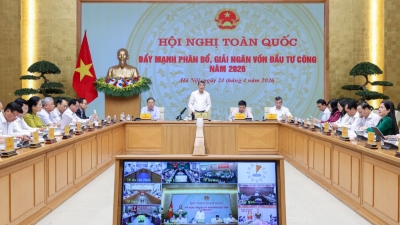
On public investment, PM Hung emphasized the urgent need to allocate and disburse capital, improve usage efficiency, and strengthen discipline in management. He called for a definitive resolution to delayed capital allocation and urged the promotion of online bidding to increase transparency and prevent corruption and waste. Disbursement results are to be made public on a monthly basis.
The SBV was tasked with managing monetary policy flexibly, maintaining control over foreign exchange and credit markets, and ensuring systemic liquidity. The SBV must create favorable conditions for citizens and businesses to access capital at reasonable interest rates while continuing to refine the legal framework for credit activities.
In the management of specific sectors and fields, the PM requested the Ministry of Agriculture and Environment to ensure food security under all circumstances, promote the consumption of agricultural products, and enhance the capacity for forecasting and responding to climate change and natural disasters.
The Ministry of Industry and Trade was directed to proactively expand export markets, develop the domestic market, and accelerate the implementation of energy master plans to ensure energy security and prevent power shortages for both production and daily life.
The Ministry of Construction was told to focus on accelerating the progress of key infrastructure projects, promoting a healthy real estate market, and advancing the development of social housing in accordance with the established targets.

 Google translate