


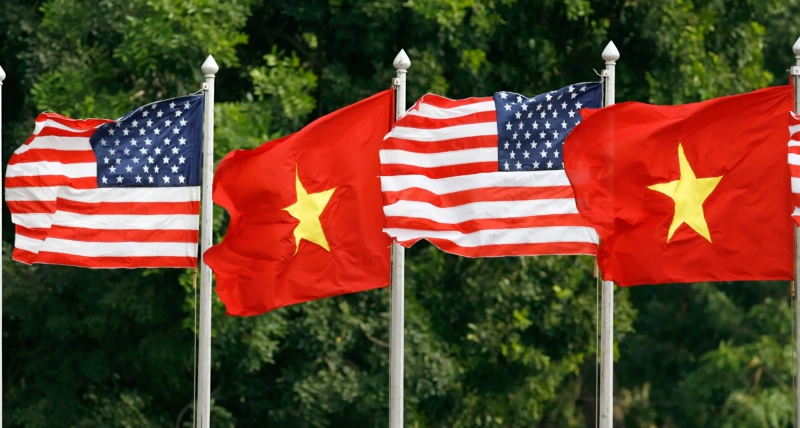
Alongside the growth in trade, Vietnam and the US still have considerable potential to expand and deepen cooperation in areas with significant room for development, according to a report by the Government News.
According to data from the Vietnam Customs, total bilateral trade between the two countries reached approximately $137.42 billion as of the end of August 2026, up 23.4% from the same period in 2025.
The US continues to be one of Vietnam’s leading export markets, accounting for approximately 32.1% of Vietnam’s total export turnover. According to US statistics, by the end of July 2026, Vietnam had become the US’s fifth-largest trading partner, moving up five places from the same period a year earlier.
Commercial Counselor and Head of the Vietnam Trade Office in the US Do Ngoc Hung said that what is noteworthy is not only the increase in the scale of bilateral trade, but also the increasingly deep integration between the two economies.
According to Mr. Hung, one of the key drivers of bilateral trade is the complementary nature of the two economies. Vietnam has strengths in manufacturing and processing, consumer goods, electronics, textiles and garments, footwear, wood products, and agricultural and seafood products. Meanwhile, the US has strengths in technology, machinery and equipment, energy, aviation, agricultural products, and production inputs.
According to the trade office, there remains considerable room to expand bilateral trade if the two countries continue to leverage the complementary strengths of their economies.
Vietnam has strong demand for machinery, equipment, technology, production materials, energy, aviation products, and agricultural products in which the United States has strengths. Increasing imports of these products would not only meet domestic demand but also provide inputs for production, helping enhance the competitiveness of Vietnamese businesses.
New areas for cooperation
Alongside trade, investment cooperation between Vietnam and the US has also shown positive signs.
As of the end of July 2026, US investors had 1,587 active projects in Vietnam, with total registered capital of approximately $12.5 billion. In the first seven months of the year alone, US investment reached approximately $437.6 million, covering 86 newly licensed projects, an increase of 67.9% year-on-year.
In the opposite direction, as of the end of April 2026, Vietnamese investors had 279 investment projects in the US, with total registered capital of approximately $1.45 billion.
Based on his discussions with US agencies, associations and business communities, Mr. Hung said several sectors are emerging as promising areas for cooperation in the coming period, including high technology and semiconductors.
Vietnam has advantages in human resources, electronics manufacturing capabilities and its position in regional supply chains, while the US has strengths in technology, chip design, artificial intelligence and foundational technologies. As a result, cooperation could expand beyond manufacturing investment to include research, chip design, workforce training and the development of supporting-industry ecosystems.
Energy and aviation are also areas with significant potential, given Vietnam’s substantial development needs and the strengths of US companies in technology, capital and management expertise.
As Vietnam becomes increasingly integrated into US supply chains, it needs to continue diversifying its sources of supply while ensuring transparency, traceability and compliance with market standards.
According to the trade office, going forward, the two economies should aim not only to increase the exchange of goods, services and energy, but also to jointly create greater value across supply chains.







 Google translate