


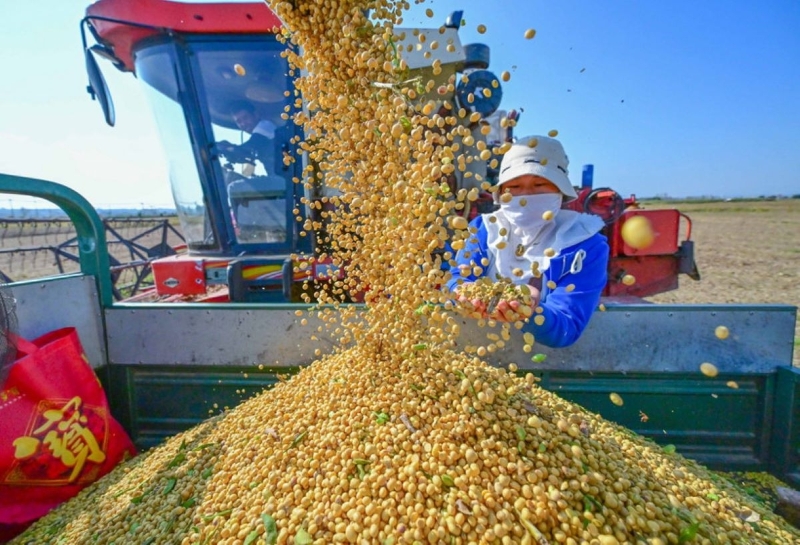
Vietnam’s import turnover of agro-forestry-fishery products in March 2026 is estimated at $4.46 billion, a sharp increase of 37% compared to the previous month and 6.6% over the same period in 2025.
Cumulatively, for the first three months of 2026, total import turnover for the sector reached $11.91 billion, a 3.6% year-on-year increase, according to the Ministry of Agriculture and Environment.
By product group, the import value of agricultural products reached $7.62 billion (up 6.3%); livestock products hit $1.16 billion (up 10%); and forestry products totaled $786.8 million (up 16.1%). Conversely, fishery imports stood at $746.8 million (down 1.8%), while production inputs fell to $1.59 billion (down 13%). Notably, salt imports reached $9.1 million, a surge of 75.6% compared to the same period last year.
Regarding markets, Asia and the Americas remain the primary suppliers, holding market shares of 27.7% and 26.6%, respectively. Other regions accounted for smaller proportions, including Oceania (4.6%), Europe (3.9%), and Africa (3.8%). Compared to the same period in 2025, imports from Asia decreased by 2.7%, while the Americas grew by 10.9%, Oceania surged by 38.2%, and Africa saw a massive 56% increase. Imports from Europe declined by 3.3%.
At the national level, the United States, China, and Brazil are the three largest suppliers, with market shares of 11.8%, 9.9%, and 9.8%, respectively. Most notably, imports from the US soared by 53.4%, while China rose by 13.3% and Brazil increased by 11.1% year-on-year.
Among key import commodities, wheat recorded impressive growth. For the first quarter of 2026, Vietnam imported 3 million tons and $603.8 million, up 84.5% in volume and 40.3% in value compared to Q1 2025.
Soybean imports in Q1 2026 reached 847,100 tons and $404.9 million, up 46.9% and 54.6% respectively. Corn also saw a sharp increase, with a three-month cumulative total of 4.1 million tons and $1 billion, representing a 90.2% jump in volume and an 83.4% rise in value.
In the cashew nut segment, imports reached 636,000 tons and $1.04 billion in Q1, representing growth of 12.5% in volume and 13.1% in value. Tanzania was the largest supplier with a 33.1% market share, followed by Cambodia (21.2%), Ivory Coast (19.8%), and Indonesia (2.2%).
Finally, rubber imports in the first quarter of 2026 reached 441,400 tons, valued at $707.4 million. This reflects a 3.2% increase in volume but a 4.7% decrease in value. The three main supplying markets were Cambodia (31.4%), China (16.2%), and South Korea (10.7%).







 Google translate