


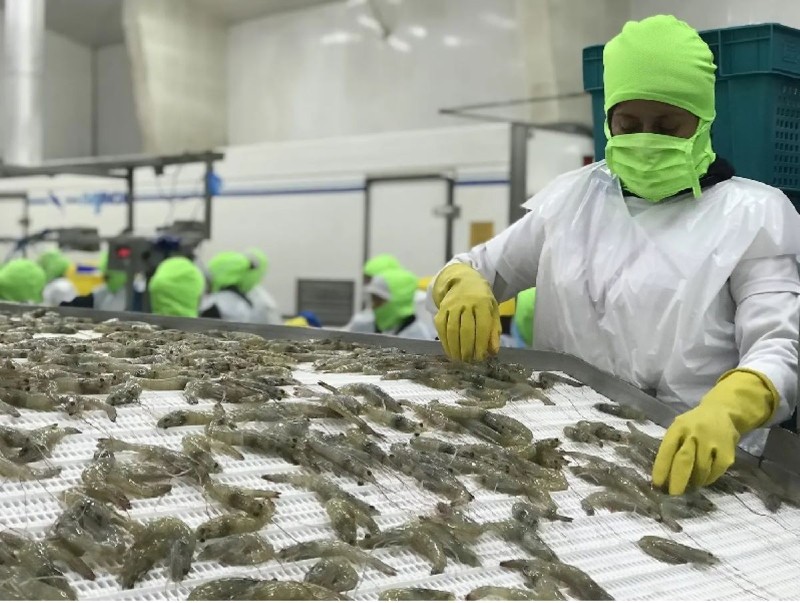
Shrimp exports remained a bright spot for Vietnam’s seafood industry in the first half of 2026, recording double-digit growth driven largely by the Chinese market and a breakthrough in lobster exports. However, beneath these positive figures, businesses continue to grapple with challenges ranging from US tax policies to rising logistics costs.
According to the Vietnam Association of Seafood Exporters and Producers (VASEP), shrimp export turnover in June 2026 reached approximately $458 million, a 24% increase compared to the same period in 2025, bringing the cumulative total for the first six months of 2026 to $2.35 billion, up 14.2% year-on-year.
As a result, shrimp maintains its position as the largest export group in the seafood sector in the 6-month period, accounting for 40.7% of the sector's total export turnover.
Mainland China and Hong Kong (China) continue to be the most vital growth drivers for the Vietnamese shrimp industry. In the first half of the year, exports to the two markets reached approximately $845 million, a 44% surge year-on-year, representing 36% of the country’s total shrimp export value.
Beyond China, several other traditional markets also showed positive results. In the first half of 2026, shrimp exports to Japan reached approximately $271 million, South Korea $169 million, and Australia $126 million—all maintaining growth compared to the same period last year. Meanwhile, exports to the European Union (EU) saw a modest increase of about 2%, reflecting a slow recovery in demand within this market.
The US market presented a polarized picture between monthly and cumulative figures. In June 2026 alone, shrimp exports to the US reached approximately $62 million, up 32% year-on-year. However, for the January-June period, the total export turnover to this market still fell by 15% to approximately $290 million.
Moving forward, exports to the US face significant pressure from anti-dumping and countervailing duties, increasingly stringent traceability requirements, and fierce competition from other major global suppliers. Additionally, rising logistics costs remain a major burden on the production, processing, and export activities of Vietnamese enterprises.
According to VASEP, competition in the global shrimp market is intensifying as major exporting nations report diverging trends. In the first five months of 2026, Ecuador continued its breakout performance, exporting 668,763 tons of shrimp valued at $3.52 billion—a 13% increase in volume and a 12% rise in value—leveraging its economies of scale and competitive pricing. Conversely, Indonesia exported 78,341 tons worth $696 million, reflecting a 16% drop in volume and a 9% decline in value, despite a 53% surge in its exports to China. Thailand also saw a contraction, with exports totaling 46,201 tons, down 6.51% in volume and 10.42% in value.
In the face of growing competitive pressure, experts suggest that the Vietnamese shrimp industry must prioritize deep processing, enhance product quality, reduce production costs, and diversify markets.
To boost competitiveness, there is a call for increased investment in research and development, particularly in high-quality breeding stocks, biotechnology applications, and disease control. Furthermore, breeding facilities are urged to strictly adhere to biosecurity regulations, ensure transparency in origin, and manage quality effectively. These measures are seen as the essential foundation for the sustainable development of Vietnam’s shrimp industry.






 Google translate