


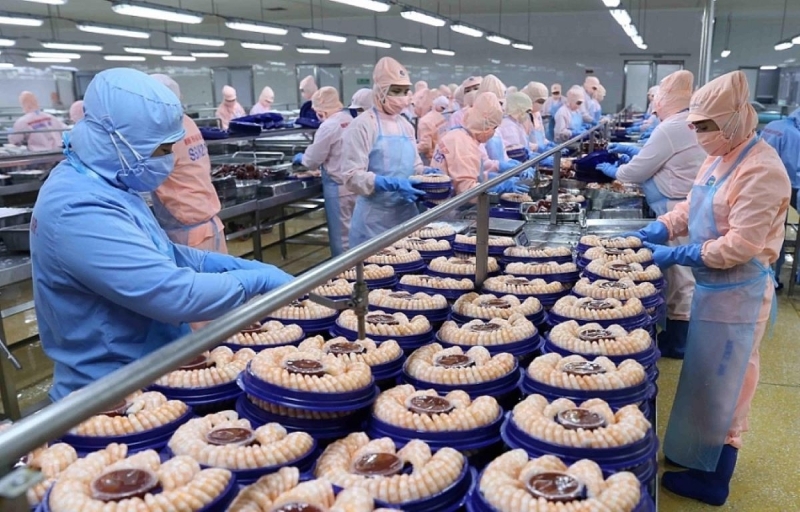
The United States market accounted for 17.2% of Vietnam's total shrimp export turnover in 2025. While the downward adjustment of U.S. anti-dumping duties is expected to create more favorable conditions for exports in 2026, a new trade agreement between India and the US is mounting significant competitive pressure on Vietnamese shrimp in this key market.
Recently, US President Donald Trump signed an executive order formalizing a trade deal with India following discussions with Prime Minister Narendra Modi. Under the agreement, the US has reduced reciprocal tariffs on Indian goods from 25% to 18% and abolished the 25% supplemental tariff that had been in place since August 2025.
The Vietnam Association of Seafood Exporters and Producers (VASEP) observed that India’s trade shifts during the 2025–2026 period are creating increasingly visible pressure on Vietnam’s shrimp industry.
This impact is felt not only in the US but also in the European Union (EU), a market where Vietnam has traditionally held a competitive edge thanks to the EU-Vietnam Free Trade Agreement (EVFTA). In the EU, if Indian shrimp begins to enjoy similar or lower tax rates, its price advantage—driven by large-scale farming and low production costs—will become even more pronounced. Consequently, the raw shrimp and commodity product segments in the EU are expected to face much fiercer competition.
Meanwhile, India is also gradually reclaiming its market share in the US through these new trade pacts, intensifying the struggle in major export hubs. This trend makes it increasingly difficult for Vietnamese shrimp enterprises to compete directly on price or volume.
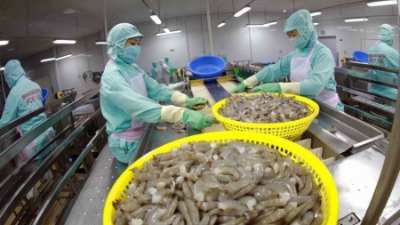
Despite these challenges, Vietnam maintains critical advantages in the deep-processed and high-value-added segments. Stringent quality standards, robust traceability, the ability to meet sustainability requirements, and extensive experience navigating strict EU regulations remain the domestic industry's core strengths. These factors serve as a foundation for Vietnamese businesses to secure their position in the mid-to-high-end segments rather than engaging in a "race to the bottom" on pricing.
Amid intensifying competition, experts suggest that the most viable path for Vietnamese shrimp exporters is to increase the proportion of deep-processed products, reduce reliance on frozen raw shrimp, and maximize tariff preferences provided by the EVFTA.
Simultaneously, businesses must expand into other potential markets, such as Japan, South Korea, and the Comprehensive and Progressive Agreement for Trans-Pacific Partnership (CPTPP) bloc, to diversify their outlets and mitigate concentration risks.
Furthermore, heavy investment in sustainability standards, ESG (Environmental, Social, and Governance) criteria, traceability, and "green" certifications will serve as strategic differentiators. In the coming period, the competitive edge of the Vietnamese shrimp industry will no longer be defined by scale or low costs, but by added value, brand reputation, and sustainable quality. These will be the decisive factors for the long-term standing of Vietnamese shrimp on the global stage.


 Google translate