


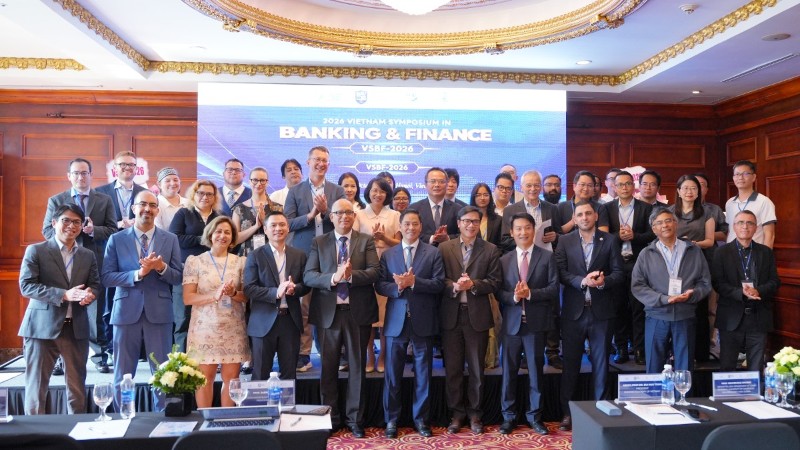
Rapid advances in science and technology, particularly artificial intelligence (AI), are fundamentally reshaping financial operations and governance, according to Assoc. Prof. Dr. Bui Huu Toan, Chairman of the Board of Trustees of the Banking Academy of Vietnam.
Delivering the opening address at the 11th Vietnam International Symposium in Banking and Finance (VSBF 2026) on October 22, Mr. Toan emphasized: "This dynamic presents a major practical challenge for Vietnam: how to accelerate growth while maintaining long-term sustainability, and how to aggressively integrate cutting-edge technologies while rigorously identifying, controlling, and mitigating risks. Rigorous academic research serves as the foundational knowledge base, providing vital empirical rationale to support macroeconomic governance by the State Bank of Vietnam and regulatory agencies."
The two-day VSBF 2026 symposium was jointly organized by the Banking Academy of Vietnam, the International Society for the Advancement of Financial Economics (ISAFE), and the Association of Vietnamese Scientists and Experts (AVSE Global). The event convened leading domestic and international regulatory experts, economists, and researchers for in-depth academic deliberations.
In addition to breakout plenary and technical sessions, the symposium featured a dedicated "Meet the Editors" panel, which addressed emerging operational themes such as integrating AI tools into academic research and navigating global academic publishing standards.
Offering an international perspective, Prof. Dr. Sabri Boubaker, representative of the Journal of International Financial Management & Accounting, noted that VSBF transcends the conventional presentation of research papers. Its core mission is fostering an environment that stimulates intellectual exchange, expands global research networks, and links Vietnamese scholars domestically and abroad with high-level international academia.
Prof. Boubaker underscored that the global financial landscape is undergoing deep structural shifts. The proliferation of AI, rapid technological breakthroughs, and intensifying mandates for sustainable transitions are presenting markets with unprecedented scenarios. Consequently, maintaining multifaceted dialogue platforms like VSBF that bridge academic theory with regulatory practice has become necessary.
Echoing this sentiment, Prof. Dr. Nguyen Duc Khuong, Chairman of AVSE Global, highlighted the remarkable resilience and recovery capacity of the Vietnamese economy. Despite global geopolitical headwinds, Vietnam continues to maintain its standing among the region's most dynamic and fast-expanding economies. Notably, national import-export turnover in the first nine months reached approximately $888 billion, underscoring high trade openness running at nearly double projected GDP.
Furthermore, aggressive investments in strategic national infrastructure—including seaports, international airports, and inter-regional logistics corridors—alongside streamlined administrative apparatus reforms are establishing a solid foundation for Vietnam's upcoming development phase.
Active compliance with environmental, social, and governance (ESG) standards alongside the operational launch of Vietnam's International Financial Center provide prime conduits to capture high-quality green FDI inflows, advancing Vietnam's commitment to net-zero emissions by 2050 and its strategic objective of attaining high-income developed nation status by 2045.






 Google translate