


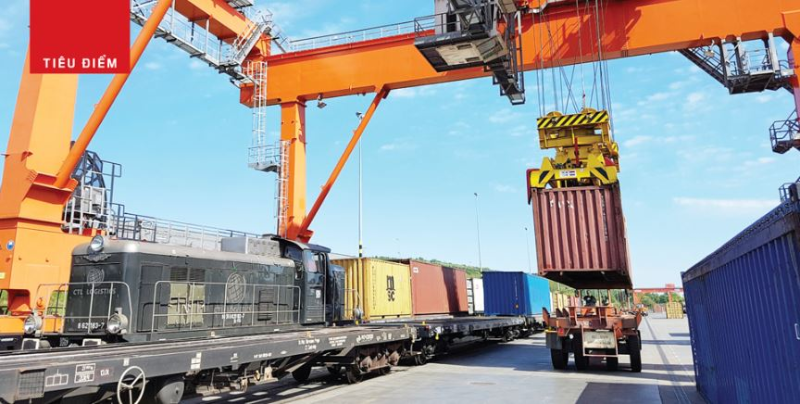
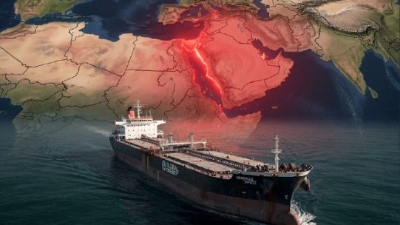
Disruptions along strategic maritime routes are exposing the limits of a logistics system heavily dependent on sea transport. Against this backdrop, international intermodal rail is emerging as a new pillar in transcontinental trade, offering advantages in speed and insulation from maritime risks.
The rise of Eurasian rail, therefore, is not a temporary phenomenon but reflects a broader shift in global logistics thinking, from prioritizing cost alone to balancing cost with resilience. As risks intensify, the ability to flexibly allocate cargo across transport modes has become a practical necessity, with rail gradually assuming the role of a contingency corridor for intercontinental trade.
Reliable trade alternative
Unaffected directly by maritime chokepoints in the Middle East and less vulnerable to weather volatility and sea-based disruptions, rail enables relatively stable cargo flows between Asia’s manufacturing hubs and Europe’s consumer markets. This reliability is elevating rail from a supplementary option to a core component in the restructuring of transcontinental transport networks.
The expansion of Eurasian rail routes also signals a deeper transformation in global logistics strategy. Under normal conditions, businesses tend to favor maritime shipping for its lower cost. However, amid geopolitical uncertainty and rising disruption risks, the ability to distribute cargo across multiple transport modes has become more critical. Rail, which is faster than sea and less exposed to maritime shocks, is increasingly positioned as a “backup corridor” for intercontinental trade.
In practice, trans-Eurasian container trains are redefining the modern-day Silk Road. The advantages of international intermodal rail are no longer theoretical; they are reflected in compelling growth figures globally and regionally. According to the China State Railway Group, China - Europe freight rail services operated 3,501 trips in the first two months of 2026, carrying 352,000 twenty-foot equivalent units (TEUs), up 32 per cent and 25 per cent year-on-year, respectively. This surge underscores how rail freight is becoming a key driver of Asia-Europe trade flows as other modes face constraints.
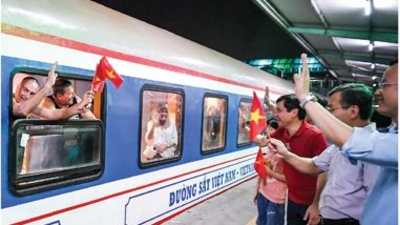
Vietnam’s railway sector is also recording notable operational gains. For instance, container transport between Yen Vien Station in Hanoi and Nanning in China now takes just 14 hours, compared with up to 45 hours by road or sea. Beyond time savings, rail freight costs per ton-kilometer can be 15-20 per cent lower than road transport, directly reducing logistics pressure and enhancing the competitiveness of exporters.
Freight volumes further illustrate this momentum. In 2025, data from the Vietnam Railways Corporation showed that cargo transported from Vietnam to China stood at approximately 500,000 tons, while shipments to third countries totaled some 27,000 tons. Through this network, Vietnamese goods have reached distant markets such as Mongolia, Kazakhstan, Russia, and Europe.
Notably, intermodal rail also optimizes two-way logistics flows. Rather than returning empty, containers can be filled with goods from China and Central Asia bound for Vietnam, lowering overall transport costs and ensuring operational stability regardless of weather or geopolitical disruptions. Shorter transit times, reduced costs, and diversified routing are turning rail into a new backbone for import-export businesses.
North-South backbone
The rise of intermodal rail is not merely a temporary response to geopolitical volatility; it also opens new opportunities for Vietnam to integrate more deeply into global logistics chains. With its capacity for high-volume transport at competitive costs, rail is becoming a strategic gateway for goods moving in and out of the country. However, translating this potential into sustained economic momentum requires comprehensive infrastructure synchronization.
According to Deputy Minister of Construction Nguyen Danh Huy, the full potential of Vietnam - China rail transport can only be realized through coordinated investment in cross-border rail lines with standardized technical systems. Eliminating technical “breaks” at border gates would not only shorten customs clearance times but also facilitate seamless cargo flows and reduce transshipment costs.
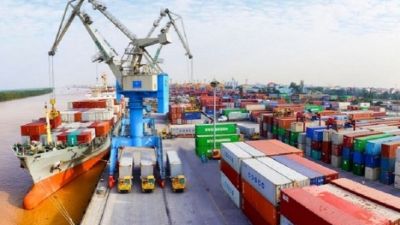
This vision is embedded in Vietnam’s national railway development plan to 2050. Rail is set to become the North - South backbone, serving as the central axis connecting seaports, airports, and key industrial parks. Integrating national rail with urban, local, and road networks will create a multimodal transport ecosystem capable of moving goods efficiently along the length of the country.
While Eurasian rail corridors are reshaping trade flows at the continental level, at the national level the challenge lies less in cross-border connectivity and more in internal transport structure. For Vietnam, effective participation in these networks depends on building a strong domestic transport backbone capable of receiving and distributing cargo, rather than remaining merely an origin or destination point.
Within this framework, the North-South railway is envisioned as the core axis of the national transport system, linking seaports, airports, industrial parks, and economic centers. Its significance extends beyond transport to the reorganization of logistics space into a connected corridor that integrates multiple transport modes and supports continuous supply chains.
However, current realities indicate that the railway system has yet to fulfill this role. Links between stations and seaports, airports, and industrial parks remain fragmented. Integrated logistics hubs are lacking, and freight operations are not yet organized around dedicated container routes. These limitations prevent rail from effectively participating in multimodal logistics chains or fully leveraging existing regional connections.
In the short term, upgrading intermodal stations, standardizing customs procedures, and organizing fixed container routes could yield immediate efficiency gains. At the same time, improving connectivity between rail stations and ports, industrial parks, and logistics centers would help form closed-loop transport chains rather than the fragmented links seen today.
Amid mounting geopolitical pressures on traditional maritime routes, the reallocation of transport modes is no longer a long-term consideration but an immediate market response. For businesses, especially logistics firms, rail is evolving from a supplementary option into a necessary contingency to maintain supply chain continuity. Its scheduling reliability and reduced exposure to maritime chokepoints provide an added margin of operational security, particularly for Asia-Europe routes.
Over the longer term, however, the objective extends beyond incremental improvements. It requires building a systemic transport structure centered on the North-South axis. This includes phased investment in appropriately standardized rail lines, the development of integrated logistics hubs, and the establishment of industrial parks along the corridor, laying the foundation for a transport system capable of direct integration with regional networks.
At the strategic level, this direction has already been articulated. Party General Secretary To Lam has emphasized that Vietnam - China rail connectivity should be treated as a breakthrough in bilateral economic cooperation, aimed at reducing logistics costs, shortening transit times, and progressively linking Vietnam to the broader Eurasian transport network. In this context, rail is not merely a mode of transport but a tool for reorganizing economic space and diversifying international logistics corridors.





 Google translate