


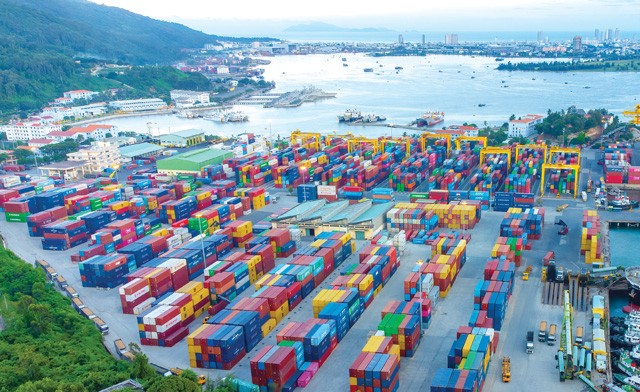
The ongoing sweeping restructure of global supply chains is creating an opportunity for Vietnam to deepen its integration into international value chains, attract high-quality investment, and expand its role in regional production networks. Turning this opportunity into sustainable competitive capacity, however, will require Vietnam to rapidly implement policy measures that strengthen the capabilities of domestic businesses, particularly in technology, R&D, human resources, and support industries.
New phase of restructuring
Mr. Nguyen Anh Duong from the Institute for Policy and Strategy Studies (IPSS) at the Central Commission for Policy and Strategy said the global economic recovery remains fragile and uneven, while facing significant pressure from geopolitical competition and policy adjustments by major economies.
As a highly-open economy heavily dependent on exports, Vietnam faces both opportunities and challenges. These developments directly affect exporters to major markets such as the US, while also increasing risks for manufacturing industries that rely heavily on imported raw materials and components. Against this backdrop, global corporations are implementing a range of measures to protect revenues, sustain growth, and strengthen resilience. One of the most prominent trends is greater participation in new-generation free trade agreements (FTAs) to diversify economic relationships and spread risks.
Before 2024, FTAs were primarily viewed as tools to remove tariff barriers and expand export markets. Since 2025, however, their role has increasingly shifted toward helping businesses diversify their import and export relationships. Global companies are proactively expanding connections with different markets, partners, and technologies to reduce their dependence on any single source of supply or market.
Alongside diversification, digital and green transformations are emerging as two long-term forces reshaping global supply chains. Supply chain relocation is therefore no longer simply about moving factories from one location to another; it increasingly involves fundamental changes in markets, sources of supply, technology, and modes of cooperation.
For Vietnam, this presents an opportunity to attract high-quality FDI, particularly from the East Asia-Pacific region, supporting the country’s target of achieving annual economic growth of at least 10 per cent in 2026-2030. Such investment could not only boost exports but also help Vietnam develop manufacturing ecosystems and international logistics hubs linked to economic corridors and belts, while strengthening digital connectivity across the region.
However, Vietnam will also face barriers such as increasingly stringent import tax policies, technical requirements for inputs sourced from “third countries,” the risk of a race to the bottom in investment incentives across ASEAN, and, in particular, the persistent disconnect between the FDI sector and domestic businesses.
From incentives to value creation
According to Ms. Le Thi Duyen Hai, Vice Chairwoman and Secretary General of the Vietnam Tax Consultants’ Association, global supply chains are becoming shorter, more resilient, and more diversified in terms of risk. Vietnam is well positioned to attract projects and orders relocating to Southeast Asia, but its ability to capitalize on this opportunity will depend significantly on the capabilities of domestic businesses.
She believes Vietnam needs to shift its approach from “attracting investment at all costs” toward “upgrading the capabilities of Vietnamese businesses so they can become high-value links in global value chains.” Under this approach, tax policy should not focus solely on reducing businesses’ short-term financial obligations, but should also create incentives for companies to upgrade across a chain of outcomes: “Technology - R&D - Human Resources - Supply Chains - Global Markets.” One proposed measure is to increase tax incentives for R&D by introducing mechanisms to deduct R&D expenses at rates of 10-20 per cent, depending on priority sectors, while allowing businesses to carry forward unused tax deductions to subsequent years. Such a mechanism could help companies move from contract manufacturing toward designing, developing, and owning their own technologies.
In addition, corporate income tax incentives could be linked to specific performance criteria, including the share of revenue generated from supplying multinational corporations, localization rates, compliance with international quality standards, and R&D investment.
Ms. Hai also proposed aligning other support policies, including stronger incentives for support industries, tax incentives for businesses taking on relocated orders, reforms to value-added tax refund procedures for exporters, and exemptions or reductions in import duties on technologies and inputs that are not yet available domestically. Under this approach, tax policy would not simply serve as a cost-reduction tool. It could also help build a network of Vietnamese businesses capable of becoming Tier 1 and Tier 2 suppliers to multinational corporations, thereby increasing the share of value-added generated domestically.
Supplier development
Another priority is to change how domestic businesses are supported. Dr. Do Dieu Huong, Deputy Director of the Center for Strategy and Policy at the Institute of World Economics and Politics under the Vietnam Academy of Social Sciences, said that the rapid expansion of trade and exports has enabled Vietnam to participate more deeply in global production networks, but this has not translated into greater roles and value-creation capabilities for domestic businesses.

Vietnam needs to shift from ‘attracting investment at all costs’ toward ‘upgrading the capabilities of Vietnamese businesses so they can become high-value links in global value chains.

The domestic sector’s share of exports has yet to see sustained improvement, while indicators relating to participation in global value chains, workforce skills, and export composition show that Vietnamese businesses still need to strengthen both their connectivity and their ability to participate in higher-value activities.
The challenge, therefore, is not simply to increase the number of businesses participating in supply chains. More importantly, Vietnam needs to enable companies to enter supply chains, maintain supplier relationships, and gradually move into higher-value positions.
Ms. Huong said the approach should shift from asking “what tools are available to support businesses?” to “what does the supply chain need, and what capabilities are businesses still lacking to meet those requirements?” Supplier development should therefore begin with the purchasing needs and specific requirements of lead firms.
A company seeking to become part of a supply chain typically has to meet multiple criteria simultaneously, including quality, cost, production capacity, delivery performance, data requirements, and compliance. Providing support for individual elements may improve one aspect of a company’s capabilities, but may not be sufficient to help it meet a customer’s overall qualification threshold.
She also said Vietnam should strengthen links with lead firms and develop multi-tier supplier networks. Lead companies, including both FDI enterprises and core domestic businesses, should be encouraged to participate from the stages of providing information on purchasing needs and defining technical requirements to screening potential suppliers, identifying capability gaps, supporting trials, and evaluating upgrading results.
At the same time, Vietnam needs to develop infrastructure and tools that directly support businesses in closing capability gaps. Three closely linked areas should be prioritized: data on supplier capabilities, shared compliance infrastructure and technical services, and financing for business upgrading.




 Google translate