


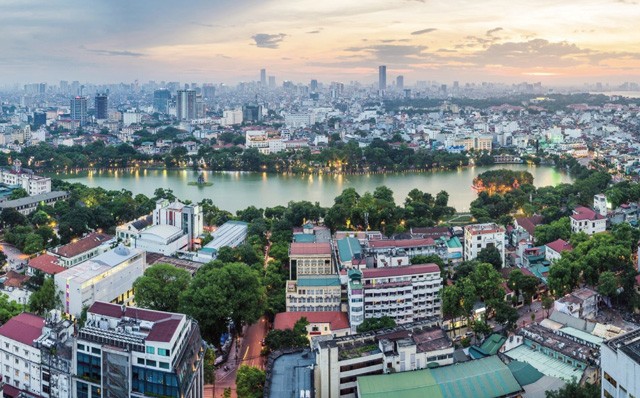
Vietnam aims to post annual growth of at least 10 per cent during the 2026-2030 period and reach GDP per capita of $8,500 by 2030, becoming a developing country with modern industry and upper-middle incomes. This will provide the foundation for it to achieve its overarching goal of becoming a developed, high-income country by 2045, and places urgent demands on the next phase of development. Vietnam must not only pursue high growth but also drive a fundamental transformation of its growth model and establish and operate a new and more inclusive and sustainable development model.
Turning resources into growth value
Major resolutions and policy directions from the Party Central Committee over recent years have provided strategic direction and an important legal framework for further developing appropriate mechanisms, policies, and growth models. In practice, Vietnam’s economy has continued to maintain positive growth momentum.
However, the spillover of growth to the domestic business sector and underlying consumer demand remains limited. Public investment disbursement has been uneven, while many projects continue to face obstacles related to land clearance, materials, and labor.
Notably, constraints on high growth are becoming increasingly apparent in macro-economic stability, the financial system, and supply capacity. Average CPI growth over the first eight months of 2026 reached 4.45 per cent, while core inflation rose 4.24 per cent, leaving limited room within the 4.5 per cent inflation target for the year as a whole. Lending rates have risen, while the non-performing loan (NPL) ratio has exhibited an upwards trend.
At the same time, the international environment is creating new demands on the adaptability of Vietnamese localities and businesses. Global economic growth continues to be supported by investment in technology and AI, but faces pressure from geopolitics, energy prices, trade fragmentation, and international financial conditions.
Global trade is tending to slow, while tariffs, trade investigations, technology controls, and rules of origin may reshape orders and supply chains. This creates opportunities to attract shifting orders and investment, while also requiring Vietnam to strengthen self-reliance, domestic business capabilities, and the share of domestic value-added.
Those developments show that sustaining high growth in the period ahead will depend not only on mobilizing additional resources but increasingly on the ability to absorb those resources and convert them into productive capacity, output, and domestic value-added. This is directly linked to the quality of institutions, governance effectiveness, the policy implementation capacity of local governments, and the ability of businesses to invest, innovate, and expand production and operations.
The challenge, therefore, is not only to formulate sound and breakthrough policies but also to translate those policies into tangible results, growth, and development. This means creating substantive improvements in the investment and business environment, competitiveness, labor productivity, innovation, and the ability to mobilize, allocate, and efficiently use resources.
Policies only create value when they are translated into implementation capacity and development outcomes. The gap between policy direction and implementation, as well as between general policies and their application at the local and business levels, needs to be more clearly identified and addressed.
Creating momentum
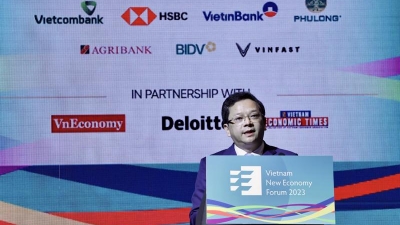
Against this backdrop, the 4th Vietnam New Economy Forum, with the theme “Breakthrough Policies & Momentum for Localities and Enterprises,” held in Hanoi on October 3, focused on how to improve the effectiveness of mechanisms and policies developed and issued in recent years, strengthen the capabilities of localities and businesses, and translate available resources and policy frameworks into productive capacity, competitiveness, and new growth momentum.
In particular, the Forum contributed to the effective and coordinated implementation of Resolution No. 19-NQ/TW, dated July 28, 2026, from the 14th Party Central Committee on “Renewing Vietnam’s Development Model,” and Conclusion No. 18-KL/TW, dated April 2, 2026, from the 2nd Plenum of the 14th Party Central Committee on the socio-economic development plan, national financial plan, public debt borrowing and repayment, and the five-year medium-term public investment plan for 2026-2030, linked to the goal of achieving double-digit growth.
Accordingly, the Forum focused on seven key issues.
First, clarifying the new requirements for Vietnam’s growth and identifying emerging challenges through the lens of change management and implementation governance in the new international context.
Second, explaining the relationship between policy breakthroughs, governance capacity, and implementation capacity, focusing on identifying bottlenecks in translating Party policies and directions into tangible development outcomes. This will provide a basis for determining requirements for innovation in governance approaches, decentralization, delegation of authority, coordination, and implementation to create new momentum for growth.
Third, sharing practical experiences from localities in creating new development spaces and growth drivers, and clarifying the factors determining their ability to achieve breakthroughs.
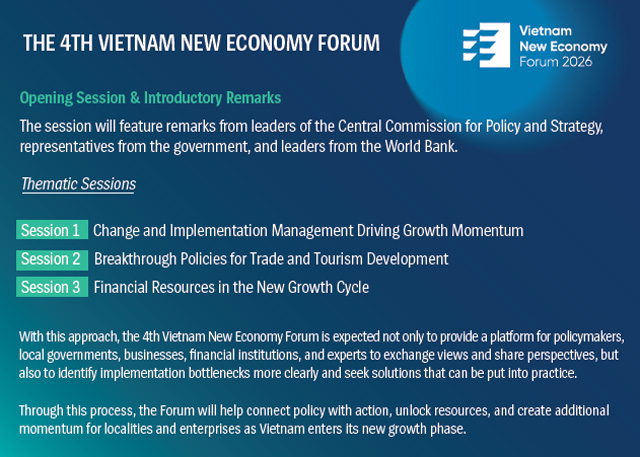
Fourth, determining the available space and requirements for policy breakthroughs in trade and tourism development, with a focus on better leveraging domestic and international markets, increasing value added, and developing higher-quality tourism.
Fifth, assessing the requirements for mobilizing and allocating financial resources during the new growth cycle and clarifying the capacity to meet funding needs for investment and business production while identifying requirements for financial safety, monetary stability, risk control and more efficient resource allocation, thereby creating a sustainable financial foundation for high growth.
Sixth, creating a dialogue platform between policymakers, local governments, businesses, financial institutions, and experts, connecting policy breakthroughs and stronger implementation capacity with new momentum for localities and enterprises.
And seventh, consolidating and proposing specific, feasible, and actionable policy recommendations, focusing on issues requiring immediate resolution for localities and businesses, as well as foundational reforms to strengthen implementation capacity, unlock resources, and create greater space for high growth in 2027 and to 2030.





 Google translate