


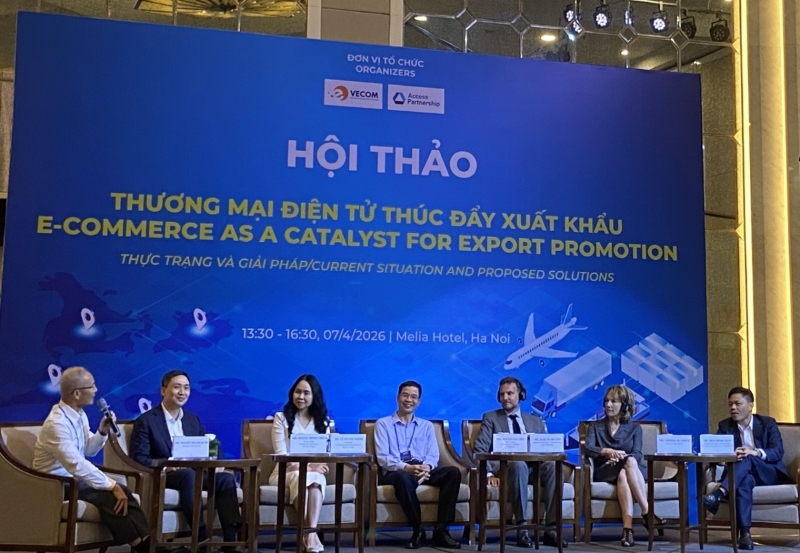
E-commerce has evolved from an auxiliary sales channel into a transformative export method, experts told the "E-commerce as a Catalyst for Export Promotion: Current Situation and Proposed Solutions" workshop on Apirl 7.
According to Mr. Tran Thanh Hai, Deputy Director General of the Agency of Foreign Trade under the Ministry of Industry and Trade (MoIT), Vietnam’s total import-export turnover has seen a meteoric rise—from a modest $13 billion in 1995 to $930 billion in 2025. This represents a 70-fold increase over 30 years, with export value alone exceeding $475 billion.
In this broader economic context, cross-border e-commerce serves as a vital "catalyst." Currently, Vietnam’s total e-commerce market is valued at approximately $31 billion, with the cross-border segment accounting for about $4.45 billion (representing 15-16% of the total scale).
Although the absolute value remains modest, a steady growth rate of 17-18% signals immense potential that businesses are now actively tapping into, said Mr. Hai.
Ms. Le Hoang Oanh, Director General of the Vietnam E-commerce and Digital Economy Agency (iDEA) under the MoIT, highlighted the importance of e-commerce across four core pillars: expanding global market reach; supporting small businesses by removing scale barriers; optimizing costs ranging from logistics to advertising; and unlocking massive market growth potential.
"While traditional exports only allow us to reach a specific group of customers, global e-commerce enables businesses to connect with billions of consumers," she said.
Market concentration and structural challenges
Major markets such as the United States, China, and the European Union (EU) continue to be the priority destinations for Vietnamese goods. In the e-commerce sector specifically, the US accounts for more than 22% of Vietnam's online export revenue. However, Mr. Hai pointed out several limitations that must be addressed.
Currently, e-commerce activities remain heavily concentrated in large markets like China (particularly for imports), the US, and the EU. Most transactions rely on global "giants" such as Alibaba and Amazon. While domestic platforms have made significant efforts, they primarily support exports to neighboring countries.
Mirroring the challenges of traditional exports, goods sold via e-commerce platforms are still predominantly processed or outsourced items, lacking distinct branding and high added value. Cross-border logistics costs—including shipping, warehousing, and order fulfillment—remain a top hurdle, especially for bulky items such as furniture.
Furthermore, the cross-border export sector lacks a professionally trained workforce capable of operating platforms, handling international payments, and managing high-level strategies. Legal risks and high-tech scams, particularly those utilizing AI, have also undermined consumer trust in the digital environment.
Director of Access Partnership, MSam Charlton, noted that businesses are struggling with the burden of frequently changing administrative procedures, complex VAT refund processes, and confusion regarding the implementation of e-invoices. He identified the shortage of specialized personnel to operate platforms and manage high-level strategies as a critical "bottleneck" that needs to be cleared.
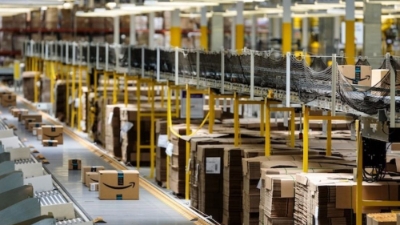
Representing Amazon, Head of Public Policy, Digital Services & Global Selling, Southeast Asia, Darren Ong emphasized that logistics remains the most difficult puzzle to solve for businesses looking to expand globally.






 Google translate