


Vietnam posted GDP growth of 8.2 per cent in the first half of 2026, according to the Asian Development Bank (ADB), but this stronger growth is also putting mounting pressure on inflation, the exchange rate, and financial stability amid the economy’s heavy reliance on bank credit.
Mr. Shantanu Chakraborty, ADB Country Director for Vietnam, said the country’s positive economic performance in the first half demonstrated its resilience and potential to sustain strong growth momentum. “To maintain this trend and achieve higher-quality progress, Vietnam needs to continue managing the macro-economy prudently, curbing inflation, ensuring financial stability, and accelerating structural reforms, while ensuring that investment-led economic expansion drives productivity improvements,” he said.
Broad-based growth, rising pressure
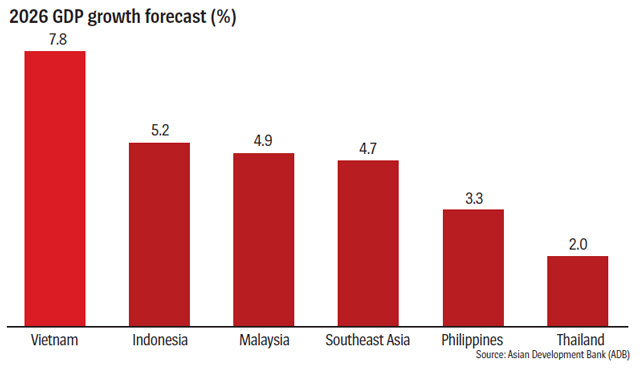
The ADB has raised its forecast for Vietnam’s 2026 GDP growth to 7.8 per cent, up 0.6 percentage points from the 7.2 per cent presented in its July forecast, while lifting its 2027 projection to 7.6 per cent from 7 per cent.
Compared to major economies in the region, Vietnam’s projected growth rate of 7.8 per cent for this year exceeds the 5.2 per cent forecast for Indonesia, 4.9 per cent for Malaysia, 3.3 per cent for the Philippines, and 2 per cent for Thailand. The ADB projects an average growth rate of 4.7 per cent for developing Southeast Asia in 2026, meaning the forecast for Vietnam is 3.1 percentage points higher than the regional average.
For 2027, Vietnam is projected to continue growing faster than major economies in the region, with a rate of 7.6 per cent forecast. Indonesia is projected to grow 5.2 per cent, the Philippines 5.1 per cent, Malaysia 4.7 per cent, and Thailand 1.9 per cent.
Mr. Bui Minh Giap, Chief Economist at the ADB in Vietnam, said the country has emerged as a growth bright spot among developing Southeast Asian economies. A notable feature of its current expansion is that growth has not been driven by a single sector.
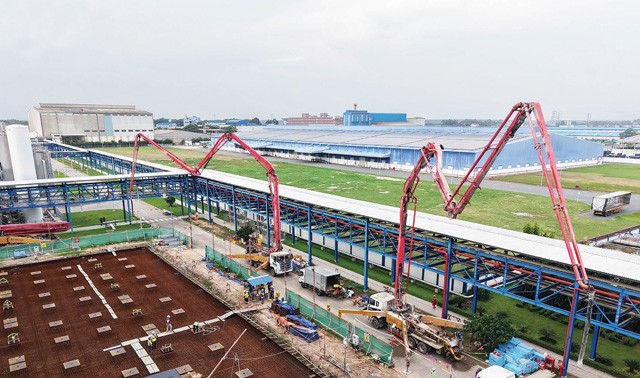
Manufacturing and processing continued to expand in the first half of the year, while domestic consumption remained resilient. Public investment, FDI, and private sector investment all contributed to overall growth. Notably, FDI has remained another bright spot. Both registered and disbursed FDI increased during the first eight months of the year, indicating continued investor interest in the Vietnamese market. Investment is expected to remain an important growth driver in the second half of the year, including public investment, FDI, and private sector investment in major infrastructure projects.
In the first half of the year, nearly VND357 trillion ($13.7 billion) in public investment capital was disbursed; an increase of approximately VND38 trillion ($1.4 billion) compared to the same period last year. Key national transport projects accounted for about VND59 trillion ($2.2 billion) of this total.
Updated ADB figures reveal that, as of August, newly-committed FDI had reached approximately $40.6 billion this year, while disbursed capital stood at $17.3 billion. The manufacturing Purchasing Managers’ Index (PMI) rose from 51.8 points in June to 52.9 points in July, and has remained above the 50-point threshold for 13 consecutive months, indicating continued expansion in production activity and new orders.
The ADB forecasts that the industrial sector will grow by approximately 9 per cent in 2026, the services sector by 8 per cent, and the agriculture, forestry, and fisheries sector by 3.9 per cent.
Yet Mr. Giap cautioned that the strong first-half performance also raises questions about the sustainability of growth, given the economy’s significant reliance on investment and credit. The challenge, he explained, is not simply to maintain a high growth rate, but also to ensure that resources are translated into greater productive capacity and higher productivity.
This issue is becoming more important as the external environment grows more challenging. The ADB expects economic growth across the Asia-Pacific region to slow in 2026 amid shocks stemming from energy, trade, and geopolitical developments. Prolonged disruptions to energy supplies could push up transportation, logistics, and food costs while putting additional pressure on household purchasing power. For a highly-open economy such as Vietnam, these developments could have direct implications for exports, investment, and the exchange rate.
At home, meanwhile, monetary policy has continued to support growth, with liquidity managed flexibly and the exchange rate closely monitored to mitigate external shocks. But Mr. Giap said there is now limited room for further monetary easing. The concern is not only headline inflation but also core inflation, which has risen compared to last year. This suggests that price pressures are becoming broader-based rather than being concentrated in a few commodity groups such as energy.
The ADB currently forecasts inflation at 4.3 per cent in 2026, up from its previous 4 per cent, before easing to 4 per cent in 2027.
The issue of credit is particularly important because of the banking sector’s dominant role in financing the economy. According to ADB figures, total outstanding bank credit was equivalent to around 145 per cent of GDP at the end of 2025, while the corporate bond market was equivalent to only around 10 per cent of GDP. The figures highlight the economy’s heavy dependence on bank financing, while the capital market remains relatively underdeveloped.
Reforms key to quality growth
Against this backdrop, according to Mr. Giap, Vietnam needs to expand and diversify its financial instruments while deepening its capital markets. The economy should reduce its reliance on bank credit by developing additional long-term funding channels, including bonds and other financial products.
Diversification is particularly important for large infrastructure projects, which require long-term financing. Relying on bank funding with mismatched maturities can increase maturity-mismatch risks.

Vietnam needs to continue managing the macro-economy prudently, curbing inflation, ensuring financial stability, and accelerating structural reforms.
Digital assets are also considered one potential tool for diversifying financial products alongside bank lending. However, expanding funding channels needs to go hand-in-hand with deeper markets, greater transparency, and stronger risk management.
For the capital market, the issue is not simply its size, but its ability to provide funding that matches the long-term investment needs of the economy.
Public investment also has an important role to play as monetary policy space becomes more limited. “Public investment projects should be selected according to clear criteria, with priority given to projects capable of playing a catalytic role and generating spillover effects across the business sector,” Mr. Giap said. “Rather than simply increasing the volume of investment, such projects should help address infrastructure bottlenecks, reduce production and business costs, and create conditions for the private sector to expand investment.”
The ADB also emphasized project readiness, implementation quality, and the effectiveness of public investment. Well-targeted public investment can address infrastructure constraints, attract private capital, and strengthen the economy’s productive capacity. The focus, therefore, should not be limited to accelerating disbursement, as equally important is selecting the right projects and ensuring that capital generates greater economic impact once deployed.
Alongside fiscal and monetary policy, structural reforms will remain critical to sustaining Vietnam’s growth momentum. Mr. Chakraborty said the economy’s strong performance in the first half of the year demonstrated its resilience and potential to sustain growth. However, maintaining this momentum while improving the quality of growth will require prudent macro-economic management, stronger financial stability, and faster structural reforms.
One priority highlighted by the ADB is continued administrative simplification and maintaining a favorable business environment. “Vietnam needs to ensure that its business environment and ease of doing business remain at least as favorable as those of neighboring countries, in order to facilitate continued capital inflows,” Mr. Chakraborty said. “This is particularly important as competition for FDI across the region intensifies.”








 Google translate