


Macro-economic developments in July and the first half of August have prompted a marked shift in GDP growth forecasts for Vietnam among international financial institutions and securities companies. While forecasts remained cautious earlier in the year amid global geopolitical risks, expectations shifted after official data showed Vietnam’s GDP rose 8.39 per cent year-on-year in the second quarter of 2026.
The country’s growth outlook is now more positive, supported by several favorable macro-economic factors. Yet forecasts remain divided, reflecting different assessments of the economy’s underlying strengths and risks and the quality of growth anticipated in the second half of the year.
Diverging growth forecasts
Standard Chartered has made the biggest revision, raising its GDP growth forecast from 7.2 per cent to 9.5 per cent for 2026 and projecting 11 per cent for 2027. The bank attributed the upgrade to a broad-based recovery in manufacturing, services, and investment, supported by timely and flexible government policies.
The United Overseas Bank (UOB) also raised its forecast, from 7 per cent to 8.5 per cent, saying first-half growth had significantly exceeded expectations. It pointed to strong momentum in AI-related sectors and signs of easing global energy prices.
Multilateral institutions have taken a more cautious, though still positive, view. The International Monetary Fund (IMF) raised its forecast by 0.4 percentage points from its April 2026 projection, from 7.1 per cent to 7.5 per cent. It expects Vietnam to remain the fastest-growing economy in ASEAN and among Asia’s growth leaders. The Asian Development Bank (ADB), meanwhile, kept its forecast unchanged at 7.2 per cent.
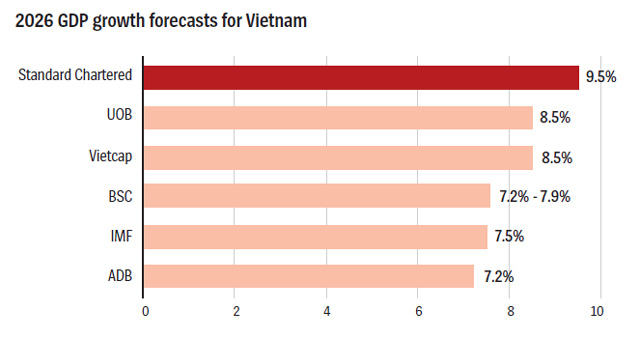
Securities companies have also remained relatively cautious despite strong second-quarter performance. The BIDV Securities Company (BSC) forecasts GDP growth of 7.1 per cent under its first scenario and 7.9 per cent under its second, while Vietcap projects 8.5 per cent.
The divergence shows that while institutions broadly agree Vietnam is heading for a strong year, they see very different limits to its growth potential. The gap between 7.2 per cent and 9.5 per cent is substantial, reflecting both exceptional opportunities and significant uncertainty.
International institutions point to a global “boost” behind the acceleration. The AI boom has revived technology supply chains, driving stronger trade activity in Vietnam.
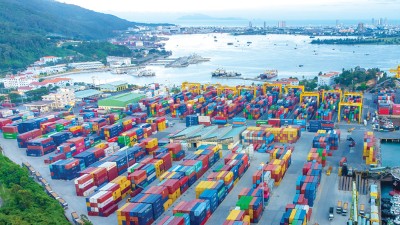
Merchandise exports reached $319.53 billion in the first seven months of 2026, up 21.7 per cent year-on-year. Exports of computers and electronic components surged 50.1 per cent to $85.2 billion, accounting for 26.7 per cent of total exports. UOB said this demonstrates that Vietnam is benefiting directly from the global AI boom.
The Index of Industrial Production (IIP) rose 11.4 per cent in the first seven months, with manufacturing up 12 per cent. Vietnam’s manufacturing Purchasing Managers’ Index (PMI) reached 52.9 in July, marking the 13th consecutive month of expansion and the strongest improvement since February. Output and new orders both increased rapidly, pointing to strong manufacturing momentum.
FDI and public investment have also remained key pillars. Total registered FDI surged 58 per cent in the first seven months to $38.1 billion, nearly matching the full-year 2025 figure. Disbursed FDI stood at $15.2 billion, up 11.8 per cent year-on-year, underscoring continued investor confidence.
Public investment is also accelerating. As of the end of July, State budget spending on development investment had risen 23.7 per cent year-on-year to VND418.9 trillion ($16.1 billion), equivalent to 37.4 per cent of the annual plan. The government’s pilot Key Performance Indicator (KPI)-based evaluation system to accelerate disbursement is also beginning to show results.
Growth scenarios and economic pressures
Based on these drivers, growth forecasts for the remainder of the year range from 7.2 per cent to 9.5 per cent. Yet macro-economic data show that significant pressure remains, particularly around domestic consumption and inflation.
July data showed that total retail sales of goods and consumer services rose 13.1 per cent year-on-year. After adjusting for prices, however, real retail sales increased just 7.5 per cent, broadly unchanged from 7.4 per cent a year prior. This suggests underlying purchasing power has not strengthened in line with GDP growth, with much of the increase in retail sales driven by higher prices.
Inflation also remains a key risk. Though July’s CPI eased slightly on lower gasoline and gas prices, inflation in the first seven months stood at 4.39 per cent. Public sector wage increases, higher university tuition fees, and potential energy price volatility linked to geopolitical tensions could add pressure over the final months of the year, complicating efforts to keep inflation around the 4.5 per cent target.
The trade balance is another concern. Imports surged 34.8 per cent in the first seven months to $340.1 billion; far outpacing the 21.7 per cent export growth. The cumulative trade deficit therefore reached a record $20.5 billion.
Much of this deficit reflects imports of computers and electronic components, which generated a $50.6 billion deficit as inputs for subsequent processing and exports. But a prolonged deficit of this scale could put pressure on the foreign exchange market. As of July, the USD/VND rate remained relatively stable, supported by strong FDI disbursement and a weaker USD. Still, balancing growth, inflation, and the exchange rate will remain a challenge for policymakers.
Trade policy is another major source of downside risk, particularly growing protectionism. According to a BSC report, Vietnam is currently subject to three Section 301 investigations launched by the US in 2026, covering overcapacity, forced labor, and intellectual property protection.
More than 40 per cent of Vietnam’s exports by value are exempt from tariffs related to forced labor, mainly machinery and electronic equipment under HTS codes 84 and 85. Traditional exports such as apparel and footwear are not covered. If the investigations into overcapacity and intellectual property, expected to conclude in late 2026 or early 2027, result in further punitive measures, tariffs on Vietnamese goods could reach 25-30 per cent under a worst-case scenario.
This is a significant cloud over the export outlook, requiring Vietnamese businesses to improve product quality, strengthen supply chain transparency, and comply more rigorously with international labor and environmental standards.
Conditions for sustained growth
Addressing these risks and realizing the more optimistic growth scenarios will require more than short-term measures. Sustaining high growth will remain a major challenge both this year and over the longer term.
According to Ms. Nguyen Thi Huong, Director General of the National Statistics Office at the Ministry of Finance, as global uncertainty persists and growth driven by capital expansion, labor-intensive activity, and natural resources faces increasingly limited space to expand, Vietnam must improve quality, productivity, and efficiency.
Three priorities are of particular importance.
First, Vietnam must maintain macro-economic stability and strengthen resilience. With inflation, exchange rate, and energy price pressures already emerging, fiscal and monetary policy should remain proactive and flexible, supporting growth while containing inflation and safeguarding major economic balances. Diversifying markets and strengthening domestic supply chains will also reinforce investor confidence and reduce exposure to global trade shocks.
Second, Vietnam needs stronger institutions and more efficient resource allocation. Faster growth will depend not only on mobilizing more FDI and public investment but on directing capital toward areas with the highest productivity and value added. Legal frameworks should continue to improve, the business environment should become more transparent and administrative procedures should be streamlined. Public investment should remain focused on strategic infrastructure with strong spillover effects, improving regional connectivity, and catalyzing private investment.
Third, the growth model should shift toward science, technology, and innovation. As the AI boom boosts exports, Vietnam should use the opportunity to move deeper into global value chains rather than remain focused on processing and assembly. Technology adoption, digitalization, and high-quality human capital will help businesses improve productivity and adapt to increasingly stringent labor and environmental standards, while reducing exposure to trade protectionism.
“These three conditions are closely interconnected,” Ms. Huong said. “Macro-economic stability provides the foundation, strong institutions unlock resources, and technology and innovation determine sustainability. If progress is made across all three areas, Vietnam will have a solid basis for achieving strong growth in 2026 and beyond.”

 Google translate