



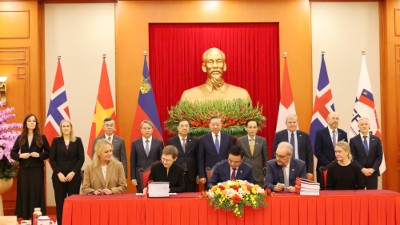
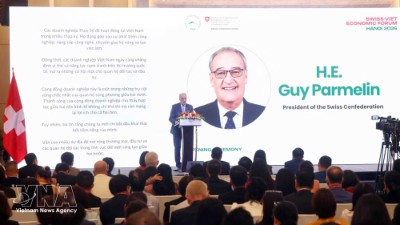
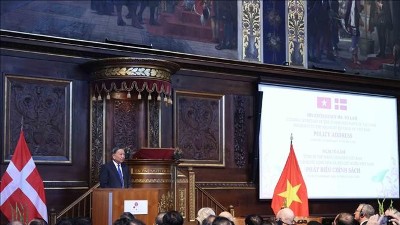
Organized shortly after the signing of the Free Trade Agreement between Vietnam and the European Free Trade Association (EFTA—comprising Switzerland, Norway, Iceland, and Liechtenstein), the 2026 Swiss–Viet Economic Forum (SVEF), which runs from Octovber 18-20, aimed to translate multilateral commitments into tangible trade and investment cooperation opportunities for the two sides.
In her remarks at the Forum, State Secretary for Economic Affairs (SECO) of Switzerland, Ms. Helene Budliger Artieda, emphasized that concluding the agreement after 21 rounds of negotiations marks only the beginning of concrete opportunities ahead for both sides.
According to Ms. Artieda, the agreement’s value extends far beyond conventional market-access concessions. Nearly all tariff lines will be phased out according to schedule, creating direct commercial advantages amid mounting global tariff protectionism.
The accord also establishes a solid framework for innovation, incentivizing enterprises to invest in intellectual property, advanced technologies, and higher value-added goods.
Crucially, for the first time, binding climate commitments, green transition roadmaps, and decent labor standards have been deeply integrated, aligning with the sustainable development strategies shared by both parties.

Beyond bilateral trade, she affirmed that Switzerland remains a long-term development partner of Vietnam, having disbursed more than $800 million in Official Development Assistance (ODA) since 1991. Swiss support has now shifted decisively toward building technical capacity and strengthening regulatory frameworks, empowering Vietnam’s private sector to achieve self-reliant breakthroughs.
Sharing this perspective, Dr. Philipp Rösler, former Vice Chancellor of Germany and Chairman of SVEF, reiterated that free trade and fair competition remain the fundamental drivers of economic prosperity.
Underscoring the forum's role in fulfilling treaty obligations, Mr. Rösler remarked that while cutting-edge technologies and virtual communication tools are essential, direct human-to-human connectivity remains paramount. The relationships forged today will provide momentum for bilateral trade flows and direct investment in the years ahead.
Three key priorities for enterprises
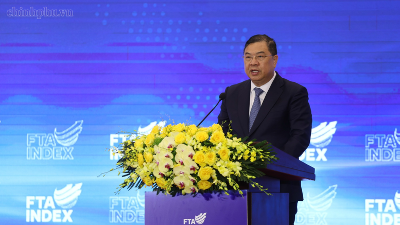
Representing state regulatory authorities, Deputy Director of the Ministry of Industry and Trade’s Department of Foreign Market Development and Multilateral Trade, Mr. Ngo Chung Khanh, argued that the success of the Vietnam–EFTA trade agreement cannot be measured solely by the number of eliminated tariff lines. Rather, it must be evaluated by actual export contracts signed, the scope of technology transfer achieved, and tangible wage improvements for the workforce.
To that end, Mr. Khanh outlined three strategic priorities for the business community:
First, regarding tariff structures, he cautioned that zero-duty tariffs become meaningless if export products fail to clear technical barriers to trade, strict sanitary and phytosanitary rules, sustainability benchmarks, and digital traceability mandates. Consequently, Vietnamese exporters must proactively review rules of origin and precisely audit compliance costs prior to penetrating the affluent yet highly stringent EFTA markets.
Second, linking trade expansion to global supply chains and technology transfer, Vietnam does not aim merely to import machinery or operate as a low-margin assembly hub. Instead, it seeks to attract Swiss investment across precision engineering, pharmaceuticals, green energy, logistics, and digital technologies to reinforce domestic industrial capacity.
Third, regarding demand-driven implementation, enterprises require targeted administrative guidance on preferential documentation, regulatory procedures, and dedicated focal points to resolve emerging bottlenecks swiftly.
To support the corporate community, the Ministry of Industry and Trade is finalizing an integrated FTA Implementation and Management Framework built upon three core pillars: an open-access FTA Information Portal providing public data; an FTA Implementation Index evaluating provincial performance; and an FTA Ecosystem designed to connect stakeholders across value chains.

 Google translate