


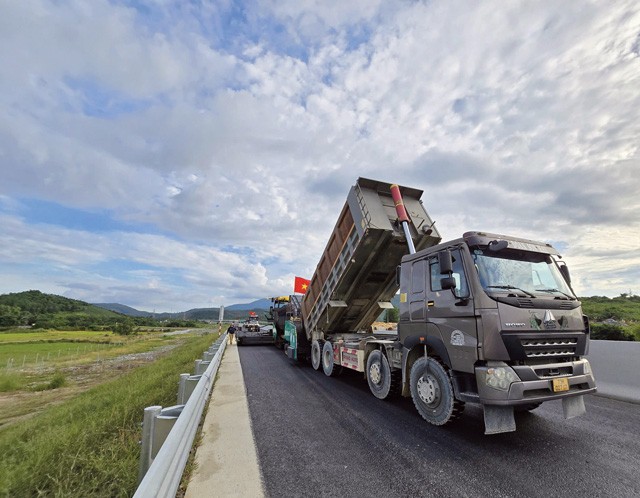
Figures from the Ministry of Finance (MoF) show that public investment disbursement posted notable progress in the first seven months of 2026, with more than VND425.3 trillion ($16.4 billion) injected into the economy, or 41.9 per cent of the annual plan.
While disbursement this year has improved since a year prior, the broader picture remains uneven, with a number of ministries, sectors, and localities still struggling to overcome bottlenecks and, in some cases, even seeking to return allocated funds. More than ever, resolving obstacles at the project level and rigorously implementing government directives will be critical to turning capital on paper into completed works, new productive capacity, and sustainable value for the economy.
Disbursement remains tardy
The MoF reported that, as of the end of July, nine ministries and central agencies and 21 localities had maintained disbursement rates above the national average. At the same time, 24 ministries and central agencies and 14 localities remained below the average. More concerning, five ministries and sectors recorded disbursement rates below 10 per cent or had yet to disburse any funds.
Delays are particularly serious for major national transport projects. By the end of July, such projects had disbursed an estimated VND73.3 trillion ($2.8 billion), equivalent to just 31.7 per cent of the plan. Twenty-two projects and sub-projects had disbursement rates below 5 per cent, including 13 projects where no progress had been recorded at all.
Mr. Le Thanh Quan, Director of the Department of Infrastructure Development at the MoF, said that, in some localities, the supply of construction materials has failed to meet demand, while coordination between regions remains insufficient. Combined with fluctuations in fuel prices and transportation costs, these factors have forced many projects to review and adjust contracts, negatively affecting implementation schedules.
Another longstanding bottleneck is site clearance. According to Mr. Quan, determining land origins, preparing compensation plans, and finalizing compensation prices have taken considerable time at many projects, delaying site handovers and preventing contractors from maintaining continuous construction.
In addition, as part of the normal project cycle, many investors in the early months of the year remained focused on completing design and cost-estimate documents and organizing contractor selection. As a result, the volume of completed work eligible for acceptance and payment remained limited, keeping disbursement below expectations.
The MoF said some problems originate in investment preparation itself. Project preparation remains inadequate in certain areas, while capital plans are sometimes drawn up largely as a formality rather than being aligned with actual needs and implementation capacity. This creates a vicious cycle: projects facing obstacles require repeated adjustments, while those unable to absorb funding may ultimately have to return it.
In addition, the implementation capacity of some investors, project management boards, and contractors remains limited. Following the restructuring of administrative units, many communes and wards have also faced shortages of specialized staff with expertise in public investment, creating significant gaps in project management and implementation at the grassroots level.
Clearing local bottlenecks
Facing mounting pressure over disbursement progress, local leaders have begun changing their approach to project management, conducting field inspections and assigning responsibility more directly to individual officials to resolve obstacles.
In Hai Phong, a dynamic growth pole in the northern region that was assigned the country’s highest annual growth target by the central government, of 13-14 per cent, public investment disbursement is viewed as an important driver of the local economy.
In mid-August, Mr. Le Ngoc Chau, Secretary of the Hai Phong City Party Committee, personally inspected six public investment projects in the western reaches of the city. He called on investors and contractors to identify subjective shortcomings in project management rather than simply citing higher material prices or labor shortages.
Hai Phong is therefore tightening discipline by requiring investors to stay close to construction sites, establish critical-path schedules, and proactively manage capital. Funds are to be promptly shifted from delayed projects to works with stronger capacity to absorb investment.
Also in the north, Phu Tho province is stepping up efforts to accelerate project implementation. At a series of recent public investment review meetings, Mr. Tran Duy Dong, Chairman of the Phu Tho Provincial People’s Committee, called on the entire administrative system, from departments and sectors to project management boards and grassroots authorities, to shift decisively from a “management” mindset toward one focused on enabling development. The province has introduced a “green lane” mechanism, targeting a reduction of at least 50 per cent to administrative processing times to clear the way for projects.
Longstanding obstacles at key projects, including the South Korea-funded Waterway and Irrigation Transport Connectivity Project and the Hoa Binh - Moc Chau Expressway, have been assigned firm deadlines for resolving issues such as site clearance and cemetery relocation. The province has also moved to remove underperforming contractors.
In central Vietnam, Quang Ngai province has opted to make accountability more transparent by publicly disclosing the performance of individual entities. A total of 76 investors were identified as exceeding the national average, while 33 underperforming investors were warned. The province has required agencies to sign monthly disbursement commitments with clear roadmaps toward the 100 per cent target.
As part of the normal project cycle, many investors in the early months of the year remained focused on completing design and cost-estimate documents and organizing contractor selection. As a result, the volume of completed work eligible for acceptance and payment remained limited, keeping disbursement below expectations.
In the southern economic hub, Ho Chi Minh City has set a target of reaching 70 per cent disbursement by the end of the third quarter of 2026 and 100 per cent for the year as a whole. City leaders have emphasized that the pace of public investment disbursement serves as “seed capital” for the economy and must be both fast and disciplined enough to lead private investment and support the goal of double-digit growth.
Improving investment quality
To support economic growth, Prime Minister Le Minh Hung has repeatedly issued strong directives, calling on the entire political system to make maximum efforts to fully disburse the 2026 public investment plan.
Under the directives, Minister of Finance Ngo Van Tuan has moved to strengthen fiscal discipline, requiring localities to stop proposing the return of central government budget capital before thoroughly reviewing their actual needs. Localities have also been urged to urgently complete procedures to bring more than VND2,630 trillion ($101.2 billion) in capital under the 2026-2030 medium-term plan into the economy.
But faster disbursement is only half the equation. As the economy seeks stronger momentum, disbursing capital is a necessary condition, but putting projects into operation early and maximizing their economic impact is the ultimate objective. When major infrastructure projects are completed on schedule, public investment can fulfill its role as an “enabler,” opening new space for development and creating spillover effects that attract substantial private sector capital. Conversely, delays and repeated capital adjustments can drive up project costs, directly eroding the efficiency of public funds and slowing economic growth.
This efficiency is reflected in the Incremental Capital-Output Ratio (ICOR). The MoF said the average ICOR for the 2021-2025 period was around 6.43; a significant improvement upon the 6.77 posted in the 2016-2020 period. In particular, the ratio fell sharply in 2025, to 5.15, compared to 5.79 in 2024, indicating a notable recovery in capital absorption and investment efficiency following global disruptions. Even so, the macro-economic target for 2026-2030 is to bring the ICOR down further, to 4.5-4.8.
To achieve this target, the MoF has proposed a series of strategic measures. Priorities include improving the transparency of the public investment framework, fundamentally strengthening the quality of planning and project preparation, and assigning direct responsibility to project leaders for resolving site clearance issues, managing material supplies, and ensuring contractor capacity.







 Google translate