


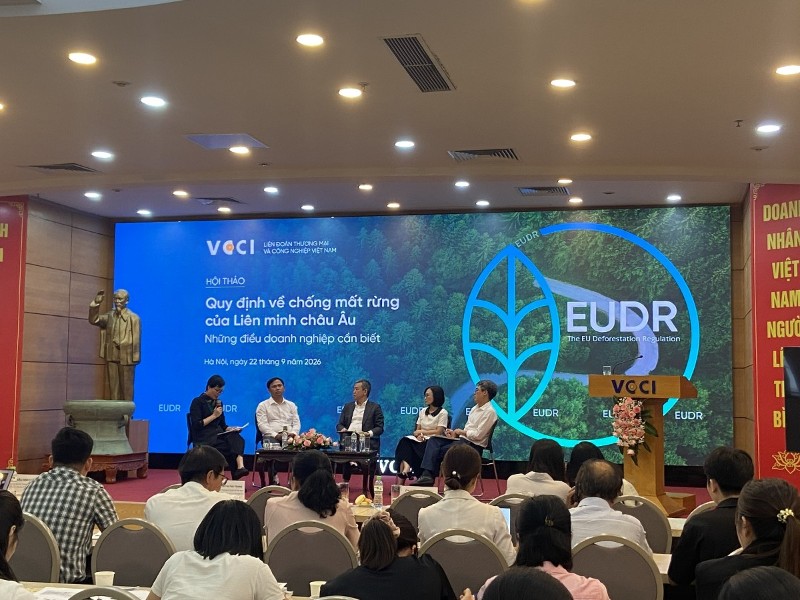
The European Union Deforestation Regulation (EUDR) targets seven core commodity groups - cattle, cocoa, coffee, oil palm, rubber, soya, and wood, covering over 80 product lines derived from raw materials produced after June 29, 2023. Implementation begins on December 30, 2026 for large and medium-sized enterprises, before extending to micro and small businesses on June 30, 2027.
Speaking at a seminar on EUDR in Hanoi on September 24, Ms. Tran Minh Thu from the WTO and Integration Office of the Vietnam Chamber of Commerce and Industry (VCCI) clarified that while the law directly regulates EU operators and importers, Vietnamese suppliers must comply indirectly. Local exporters are required to furnish fully verifiable data confirming that shipments are deforestation-free and legally produced under Vietnamese law.
Dr. Nguyen Thi Thu Trang, arbitrator at the Vietnam International Arbitration Centre (VIAC), detailed the three-step due diligence process required of EU importers: collecting origin data, assessing risks, and adopting mitigation measures before filing Due Diligence Statement.
EU importers cannot fulfill due diligence without primary data from Vietnam, Dr. Trang noted. She emphasized that EU buyers must store data for five years, meaning any inaccuracies discovered during post-audits will create severe legal liabilities for Vietnamese suppliers.
To support due diligence, Vietnamese firms must prepare three core information packages. First, they need basic product data, including commodity type, quantity, production dates, and precise geolocation coordinates of cultivation plots. Second, they must provide deforestation-free verification through local authority confirmations regarding land use. Third, suppliers need legal compliance documentation proving that production adheres strictly to local laws and land regulations.
Mr. Dau Anh Tuan, Vice Secretary General and Head of the Legal Department at VCCI, said: “EUDR is part of the EU’s broader green policy framework. Because key Vietnamese exports like coffee, rubber, and timber rely heavily on the EU market - which consistently sets global benchmark standards - Vietnamese businesses must execute three strategic shifts.”
First, businesses must shift from export documentation to supply chain data. Compliance demands continuous end-to-end traceability from plot to shipping container, rather than last-minute paperwork.
Second, the industry must transition from individual compliance to industry-wide collaboration. Digitalizing hundreds of thousands of smallholders requires sector-wide coordination, led by industry associations and supported by public land databases.
Third, firms should move from passive compliance to proactive standardization. While Vietnam’s classification as a low-risk country reduces audit burdens, firms must convert this national standing into verifiable, shipment-specific data.
Mr. Tuan advised companies against switching to less demanding export markets or incurring unnecessary expenses by over-preparing beyond mandatory requirements. EUDR should ultimately be viewed as a vital opportunity to standardize and professionalize Vietnam's agricultural supply chains.




 Google translate