


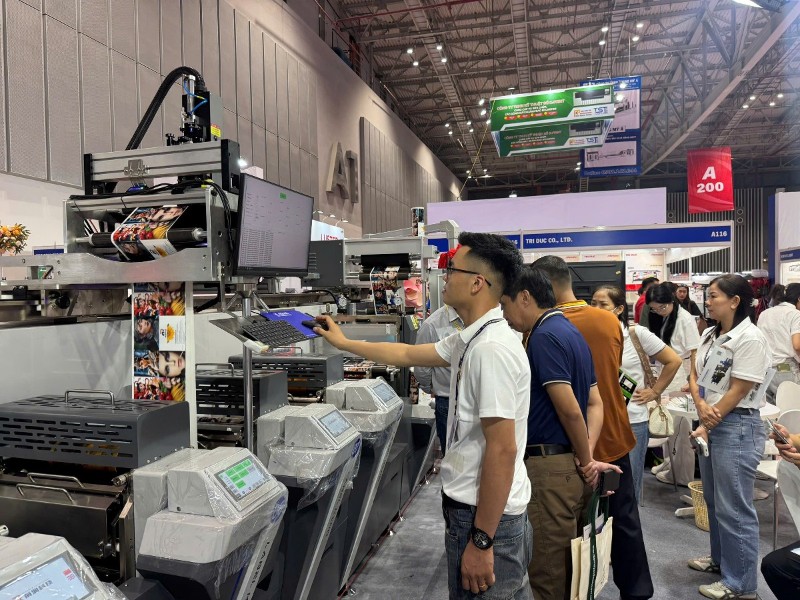
Local enterprises in Vietnam’s printing and packaging industry are confronting unprecedented challenges as foreign direct investment (FDI) inflows intensify domestic competition and global supply chains demand rigorous green transformation.
Speaking at the 24th International Printing and Packaging Industry Exhibition (VietnamPrintPack 2026), held in Ho Chi Minh City from September 16 to 19, Mr. Nguyen Van Dong, Chairman of the Vietnam Printing Association (VPA), highlighted a severe performance gap between domestic firms and foreign competitors.
Average production costs for local businesses are currently around 15 percent higher than those of FDI enterprises due to limitations in management and digital transformation. Furthermore, nearly 80 percent of domestic companies still rely on traditional technology, facing a high risk of falling behind.
While the sector maintains an average annual growth rate of around 10 percent, Mr. Dong emphasized that investing in modern equipment is an urgent requirement to enhance competitiveness and sustain long-term growth. It is estimated that local firms need three to five years to bridge this capability gap.
As Vietnam integrates deeper into global trade, foreign investors are reshaping the domestic market structure. Multinational corporations entering Vietnam bring ready-made client ecosystems, advanced machinery, and high-quality raw materials.
This creates direct competitive pressure on local suppliers, threatening their market share despite recent progress in improving domestic autonomy.
At the same time, regulatory frameworks and corporate clients are imposing strict green compliance standards. New domestic rules require packaging origin transparency with integrated QR codes showing production history and material sourcing.
Concurrently, multinational buyers in pharmaceuticals and electronics strictly mandate international certifications, including FSC, ISO 12647, G7/GMI, ISO 14001, SA8000, and SCAN security audits.
Mr. Tran Viet Anh, Chairman of the Vietnam Waste Recycling Association (VWRA), noted that printing involves various substrates - paper, metal, and polymers - traditionally reliant on chemical solvents and adhesives. While post-print processing previously involved simple crushing into low-grade recycled materials, technological advances are driving a major shift toward bio-based and water-based inks, enabling total ink separation during recycling.
However, price competition remains the primary hurdle. Local manufacturers acknowledge their technical capability to meet quality standards but struggle to maintain competitive pricing while adopting green packaging, often having to accept narrower profit margins.
To overcome these barriers, industry leaders stress that long-term state assistance is vital. Although printing and packaging are classified as supporting industries, official support mechanisms remain largely on paper.
Mr. Dong recommended targeted government incentives, particularly regarding tax policies and preferential interest rates for supporting enterprises in major industrial hubs like Ho Chi Minh City. Such measures aim to raise the domestic content ratio above 50 percent and reduce reliance on imported raw materials.
Featuring 800 booths from 300 exhibitors across 13 countries and territories, VietnamPrintPack 2026 showcased key breakthroughs in automation, digital printing, RFID-integrated smart packaging, and sustainable materials, offering local firms a direct launchpad to upgrade technology and adopt AI-driven solutions.





 Google translate