


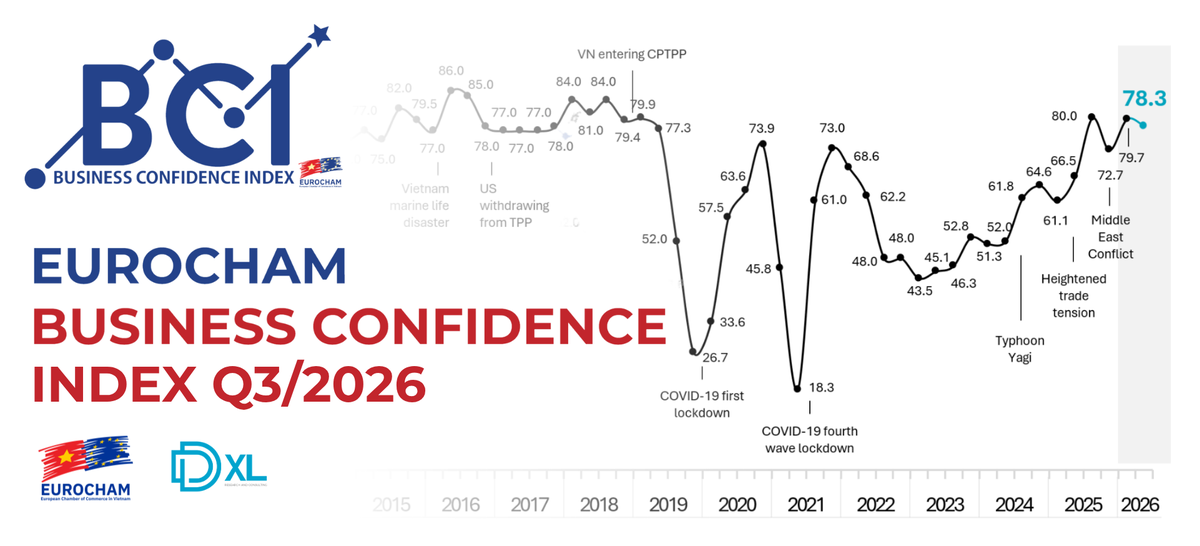
The European Chamber of Commerce in Vietnam (EuroCham) on October 15 released its Q3 2026 Business Confidence Index (BCI) report, conducted by DXL Research and Consulting.
The index demonstrated sustained long-term investor trust despite global economic uncertainties, easing slightly by 1.4 points from Q2.
Unlike previous survey iterations that primarily tracked macroeconomic sentiment and sector-specific fluctuations, the Q3 2026 report marks a distinct analytical shift by examining the cumulative weight of doing business in Vietnam.
For the first time, the survey measures how operational constraints aggregate, revealing that respondents navigate an average of eight challenges simultaneously. Nearly four in five businesses (77 percent) face at least five obstacles, while 16 percent contend with 14 or more. In highly regulated sectors such as Trade, Healthcare, and Agrifood, companies reported up to 27 administrative hurdles at once.
Overall, 93 percent of surveyed enterprises reported growth constraints, stemming from regulatory and administrative issues, as well as tax and financial administration. The most frequently cited obstacles are administrative procedures and paperwork (60 percent), unclear or inconsistently applied regulations (53 percent), tax administration issues (52 percent), and talent shortages (49 percent).
This quarter’s findings captured a defining tension in Vietnam’s economic trajectory: strong investment confidence alongside persistent operational friction. While Vietnam achieved GDP growth of 9.95 percent year-on-year in Q3 and 9.01 percent over the first nine months of 2026, business-level reality remains complex.
EuroCham Chairman Bruno Jaspaert emphasized that national growth figures do not tell the whole story, as local supply chains, manufacturing plants, and distributors continue to face pressures from rising costs and regulatory demands.
He stressed the importance of translating national growth into predictable, efficient conditions on the ground.
The report also highlighted significant divergence across sectors and firm sizes. Confidence in agriculture and food value chain rose 11.7 points to 83.9, whereas tourism and hospitality dropped 22.5 points to 67.9, driven by shifting spending patterns, operating costs, and extreme weather. Additionally, while 97 percent of companies with over 500 employees would recommend Vietnam as an investment destination, 14-17 percent of small firms (1-50 employees) express caution.
Despite these hurdles, 90 percent of respondents would recommend Vietnam as an investment destination, citing human capital (52 percent), cost competitiveness (51 percent), and political and macroeconomic stability (44 percent) as main strengths.
These findings will form an essential part of EuroCham’s annual mission to Brussels from October 19 to 22, bringing the perspectives of businesses in Vietnam to European policymakers.


 Google translate