


Experts have identified underground space development, the Transit-Oriented Development (TOD) model, and Public-Private Partnerships (PPP) as critical strategies to enhance the efficiency of urban railway stations in Hanoi.
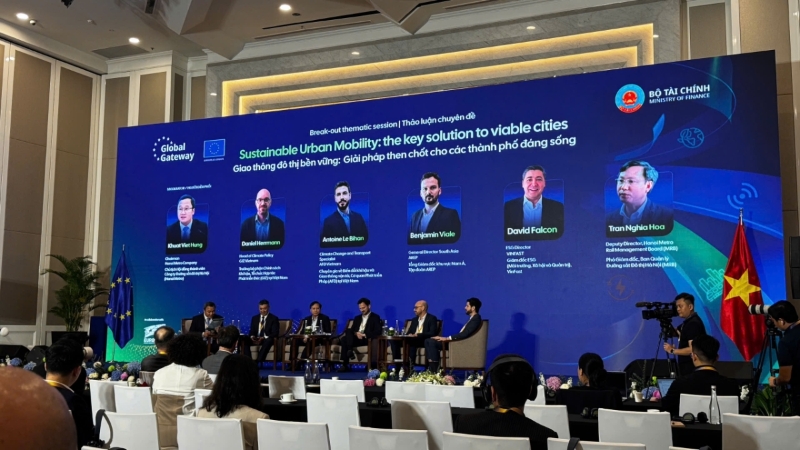
These insights were shared during the seminar "Sustainable Urban Transport: Key Solutions for Livable Cities," held on March 24 as part of the EU–Vietnam Global Gateway Business and Investment Forum 2026.
The seminar featured leaders from the Hanoi Metropolitan Railway Management Board (MRB) alongside several European experts.
Speaking at the seminar, Mr. Benjamin Viale, General Director South Asia, AREP, highlighted Hanoi’s significant potential for underground development. He noted that these spaces allow citizens to access a wide range of amenities—including shopping, sightseeing, and services—while using public transport.
However, he emphasized that the core requirement is to plan and design underground spaces that mirror surface conditions: they must be spacious, well-ventilated, and provide a positive user experience.
According to Mr. Viale, these areas should be designed so that commuters do not feel the urge to leave quickly; instead, they should feel encouraged to stay and enjoy the services as a natural part of urban life.
Furthermore, the AREP expert asserted that technical standards and a long-term vision must be established from the outset, drawing on the experience of long-standing metro systems like the one in Paris.
Regarding connectivity, Mr. David Falcon, ESG Director at VinFast, emphasized that urban transport development needs to adopt a multimodal approach. He suggested expanding connectivity not just within a single nation but toward regional integration to maximize operational efficiency.
Representing the Vietnamese side, Mr. Tran Nghia Hoa, Deputy Director of the MRB, stated that the TOD model is being identified as a central strategy. Under this model, each station is not merely a transit point but serves as an integrated hub capable of attracting foot traffic and fostering high-quality office complexes, residential areas, and service ecosystems. This, in turn, generates the revenue necessary to support the operation of the system.
He emphasized that implementing this model requires close coordination between the State and the private sector to share both resources and benefits.


 Google translate