


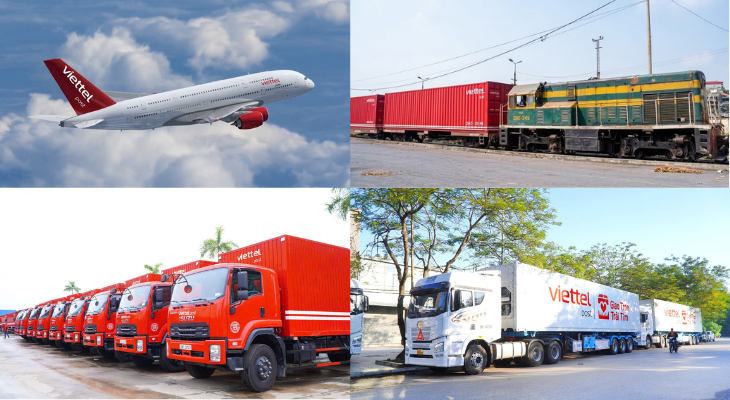
The transport network, logistics hubs, warehousing systems and distribution centers have continued to receive investment in recent years, creating a foundation for the circulation of goods and import-export activities, said Dr. Bui Ba Nghiem, senior expert at the Import-Export Department under the Ministry of Industry and Trade.
However, the biggest bottleneck at present lies in connectivity and the organization of logistics operations, Mr. Nghiem emphasized at the seminar “Current Status and Solutions for Developing Logistics Infrastructure,” held on September 16.
In practice, many logistics centers are still unable to connect directly with industrial parks and industrial clusters, where cargo is generated. Although seaports and airports have been upgraded, the movement of goods from production sites to these transport hubs still relies primarily on road transport.
The representative of the Import-Export Department also pointed out that road transport accounts for as much as 80–90% of total transportation costs. The lack of an integrated system utilizing lower-cost modes of transport, such as railways and inland waterways, has resulted in Vietnam’s overall logistics costs being significantly higher than those of other countries in the region.
In addition, infrastructure investment at the local level remains fragmented. Bottlenecks in the “last mile” — particularly roads connecting industrial parks with logistics centers and onward to border gates for import-export procedures — have yet to be fully resolved.
Echoing this view, General Director of OCL Logistics JSC, Mr. Tran Ngoc Khanh, said that for domestic logistics, the cost of transporting one ton of goods per kilometer remains very high.
Furthermore, investment in logistics centers located in industrial parks remains relatively fragmented and depends on investment policy approvals from both provincial authorities and the central government.
Sharing the practical challenges facing local authorities, Deputy Director of the Bac Ninh Department of Industry and Trade, Mr. Nguyen The Thi, said the province is proactively developing logistics based on its advantages in multimodal transportation.
Specifically, Que Vo is being oriented toward waterway logistics and inland container depots; Gia Binh is being developed in connection with aviation infrastructure; while Kep Station is being positioned for international rail freight services, combined with a network of satellite facilities serving industrial areas in northern Bac Ninh province.
To enhance competitiveness and bring logistics costs down to 14% during the 2030–2035 period, in line with the stated target, adjustments to planning policies will be decisive.
“Under the 2017 Law on Planning, responsibility for planning logistics centers has been delegated to individual localities. This has inadvertently resulted in a lack of coordination and a lack of an integrated, nationwide perspective, limiting operational efficiency,” said Mr. Nghiem.
To address this issue, under an action plan issued in March 2026, the Ministry of Industry and Trade assigned the Agency for Domestic Market Surveillance and Development to develop a proposal for the nationwide development of a logistics center system, with the aim of establishing a unified strategic vision.
Meanwhile, under the National Logistics Development Strategy approved by the Prime Minister in October 2025, Vietnam aims to establish at least five international logistics service centers by 2030 in key urban areas such as Hanoi, Ho Chi Minh City, Hai Phong and Da Nang, while expanding to emerging growth poles including Dong Nai, Bac Ninh and Quang Ninh.
The vision goes beyond individual warehousing projects. Instead, it calls for the development of entire urban areas into international logistics hubs with extensive connectivity.




 Google translate