


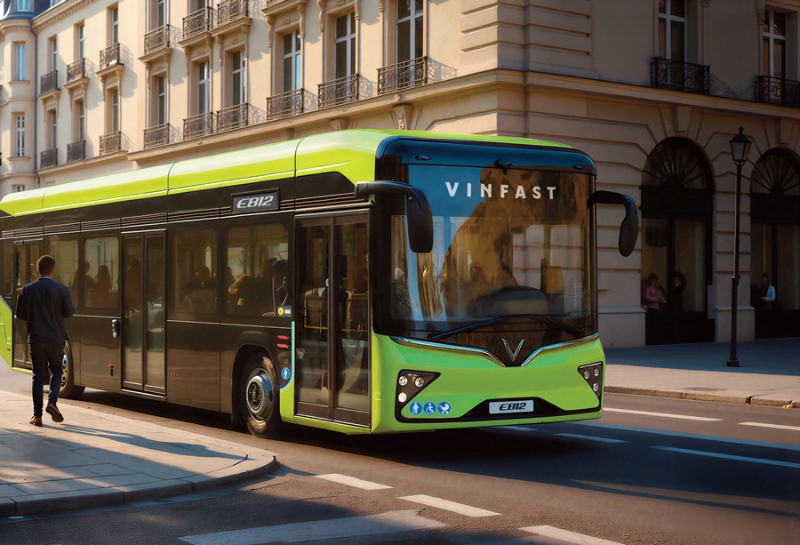
Transport has long been seen as a backbone of connectivity and economic expansion, but at the same time has also hit various stress points: rising energy demand, higher emissions, and increasingly costly operations. Amid environmental constraints, requirements in economic efficiency, and international commitments, the transport sector is being pushed into a deeper phase of transformation. The question is no longer whether to go green, but how to go about it.
Pressure to change
Air pollution and volatile transport costs are forcing the sector to adapt. Recent geopolitical developments have driven sharp fluctuations in domestic fuel prices, leading to immediate shifts in travel behavior. According to Mr. Le Bang An, CEO of Hanoi Metro, ridership on the Cat Linh - Ha Dong metro line rose by nearly 5 per cent following a fuel price adjustment, while the Nhon - Hanoi Station line saw an increase of more than 13 per cent. These figures suggest that when costs rise, commuters are willing to switch, provided viable alternatives exist.
However, transport experts argue that price is not the decisive factor. The key lies in overall convenience. People will only shift to public transport when journeys are seamless and efficient. When metro lines, bus networks, and feeder services are effectively integrated, modal shifts occur naturally rather than through administrative measures.
Experts have noted that the green transition is a multi-stage process. On one hand, emissions intensity from existing vehicles must be reduced, while on the other the adoption of new-energy transport must accelerate. At the same time, building a multimodal ecosystem, which means integrating different transport modes into a unified system, is seen as critical. This holistic approach underscores that transformation is not about isolated substitution, but about restructuring the system across multiple layers.
International experience shows there is no one-size-fits-all solution. Japan and Germany have pursued selective modernization, avoiding mass electrification to prevent disruption to domestic industrial chains. Singapore, meanwhile, prioritizes smart infrastructure to manage transport demand rather than simply limiting vehicle numbers. These approaches highlight that technical solutions must align with economic conditions and policy frameworks to deliver meaningful results.
Fragmented system
Over the past two decades, Vietnam’s transport infrastructure has expanded rapidly, strengthening regional connectivity and economic integration. However, this growth has largely been quantitative. Links between different transport modes have lagged behind. As a result, logistics costs remain high, energy consumption is significant, and emissions continue to rise, exposing the limits of a growth model based solely on infrastructure expansion.
Innovation is emerging across subsectors, but has yet to create systemic impact. In rail, companies are beginning to transition locomotive and rolling stock energy systems. Vietnam Railways has outlined a roadmap to gradually replace diesel locomotives with electric or cleaner alternatives, starting at the pilot scale. This signals a shift away from traditional operations toward lower-emission models.
Urban rail networks in Hanoi and Ho Chi Minh City are also increasingly positioned as the backbone of urban mobility. Mr. Khuat Viet Hung, Chairman of Hanoi Metro, believes a fully-operational metro network could cut hundreds of thousands of tons of CO₂ annually. However, these gains depend on integration with bus networks and feeder services. Without such connectivity, their broader impact remains limited.
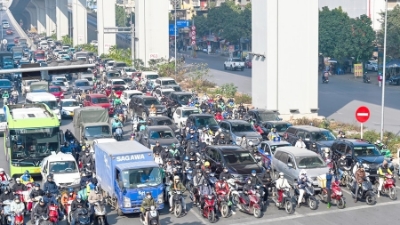
On the roads, the biggest challenge lies in scale and usage patterns. With around 7 million cars and nearly 80 million motorbikes, Vietnam faces a vast and highly fragmented base of private vehicles. Electric buses, taxis, and motorbikes are emerging, but high upfront costs, long charging times, and battery replacement expenses remain major barriers, according to transport operators. In the short term, electric vehicles are unlikely to fully replace conventional vehicles.
In logistics, structural challenges are even more pronounced. Logistics costs account for around 16-20 per cent of GDP; significantly above the global average. The main cause is a lack of integration across transport networks, forcing goods through multiple intermediaries, extending transit times, and increasing both costs and emissions. Some firms have experimented with coastal shipping, reporting emission reductions of up to 75 per cent compared with road transport, alongside notable cost savings.
At the same time, multimodal logistics projects are gradually taking shape, linking road, rail, seaports, and aviation within unified systems. This marks a shift from fragmented infrastructure development toward network-based thinking, where efficiency depends on overall connectivity rather than individual components.
The aviation sector faces its own transition challenges. With high emissions intensity per unit transported and limited electrification potential, aviation relies primarily on operational optimization, fleet modernization, and research into sustainable aviation fuel. Many major airports have deployed electric ground equipment and smart energy management systems. The sector’s capacity for deep emissions cuts, however, remains constrained.
Overall, innovation is visible across infrastructure, technology, and operations. Yet without a strong overarching design to connect these elements, the system remains fragmented. This lack of integration not only undermines investment efficiency but also limits the broader impact of green transition efforts across the economy.
Structural challenges
Recent developments underscore the limits of piecemeal greening. Replacing vehicles, while necessary, cannot drive transformation on its own if infrastructure and operational models remain unchanged. Without structural reform, even advanced technologies can only play a supporting role, with limited system-wide impact.
On the policy front, Vietnam has established a framework for green transport through laws, decrees, and strategies on emission reductions and sustainable development. However, according to the Ministry of Construction, the main challenge lies not in direction but in implementation. Gaps between institutions, technology, and public awareness are creating a disconnect between policy goals and real-world outcomes.
Addressing this requires restructuring the transport network toward a multimodal model. When road, rail, inland waterways, and aviation are effectively integrated, transport costs fall, and emissions can be better controlled across the entire chain. This forms the foundation for an optimized system, replacing today’s fragmented links.
Financing remains a decisive factor for large-scale infrastructure projects. Green infrastructure requires substantial upfront capital, long payback periods, and carries high risk, making investment mobilization difficult. Public-private partnerships and green finance are expected to play a key role, but attracting long-term capital will require clear risk-sharing mechanisms and a stable investment environment.
For businesses, green transition goes beyond fleet upgrades to encompass full business model transformation. Industry representatives emphasize the need for strong early-stage support policies, from tax incentives to credit tools, to ease investment burdens and enable adaptation. Without such support, private sector engagement will remain limited.
Technology continues to play an important enabling role, though it is not the ultimate determinant. AI, big data, and smart coordination platforms can optimize operations, reduce energy consumption, and improve efficiency. However, their effectiveness depends on being deployed within a well-structured, integrated transport system.
Ultimately, user behavior remains central. Reliance on private vehicles, particularly motorbikes, still dominates mobility patterns in major cities. A shift toward greener options will only occur when alternatives are convenient, accessible, and capable of meeting daily travel needs.
In this context, green transport is no longer about individual projects or standalone technologies. It is about reorganizing the entire transport system, where changes in infrastructure, logistics, and policy reshape how the broader economy functions.




 Google translate