


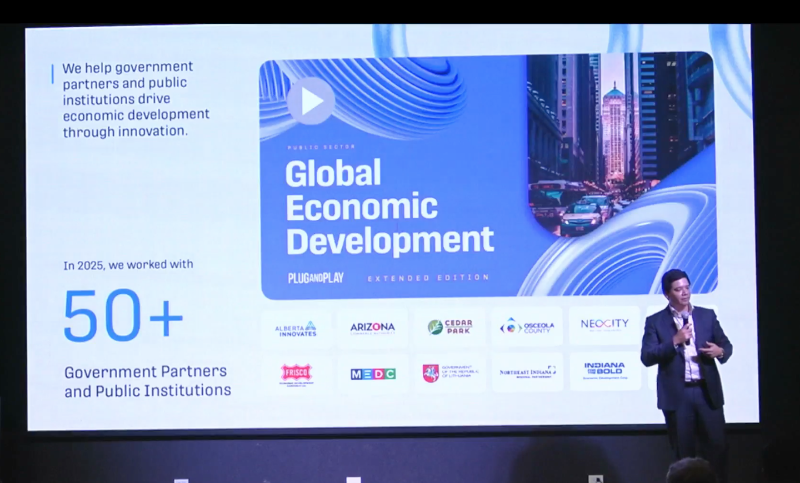
A delegation from Plug and Play Tech Center (Plug and Play) attended the conference “The New Wave of Growth: Innovation Ecosystems in the AI Era” hosted by the Ho Chi Minh City Department of Science and Technology on May 27 at the Startup and Innovation Hub of Ho Chi Minh City.
Speaking at the event, Mr. Le Thanh Minh, Deputy Director of the Ho Chi Minh City Department of Science and Technology, said that amid emerging growth models and digital transformation becoming global trends, the city has identified science and technology, innovation, and digital transformation as strategic drivers for economic growth and long-term competitiveness.
Mr. Minh said that Resolution No. 57-NQ/TW of the Politburo has introduced important directions to promote digital transformation, artificial intelligence (AI), and strategic technology sectors. The city is also implementing multiple initiatives aimed at creating a favorable environment where businesses, research institutes, universities, investors, and the public sector can collaborate to drive innovation.
In particular, public-private partnership models designed to connect enterprises, universities, research institutes, investors, and government agencies are expected to facilitate knowledge sharing, foster breakthrough technologies, expand market access, and attract investment flows.
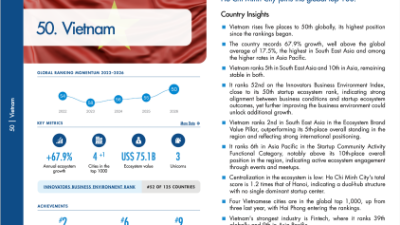
Mr. Minh also highlighted recent positive developments within the city's innovation startup ecosystem. Ho Chi Minh City climbed 12 positions to rank 98th globally, becoming one of the world's top 100 startup ecosystems for the first time (According to the StartupBlink Global Startup Ecosystem Index 2026). The city currently ranks 5th in Southeast Asia and 7th in the Asia-Pacific for startup community activity, reinforcing its role as one of the region’s emerging innovation hubs.
Meanwhile, Mr. Jojo Flores, Co-founder of Plug and Play Tech Center, said the platform hopes Ho Chi Minh City will become part of its global network. He noted that Plug and Play began in a small Silicon Valley building, often called the “lucky building,” which helped launch companies such as Google, PayPal, Logitech and Danger.
The Plug and Play ecosystem has supported or connected numerous startups that later grew into technology unicorns. “From a single small building, we have now expanded to more than 70 cities across 20 countries worldwide. Personally, I truly hope Ho Chi Minh City will become one of those locations,” Mr. Flores said.
Plug and Play currently operates through three core pillars: venture capital investment, open innovation platforms, and startup acceleration programs. On the investment side, the platform completes approximately 200–250 deals annually and currently manages a portfolio of around 2,700 companies, including more than 35 technology unicorns. In parallel, Plug and Play works with nearly 600 major corporations across 25 sectors to identify and develop technologies expected to become dominant trends over the next 10–20 years, ranging from AI and electric vehicles to autonomous technologies and smart connectivity.
Each year, the platform reviews around 20,000 startups globally and selects approximately 2,500–3,000 companies for three-month acceleration programs that provide direct connections with major corporations, opportunities to test business models, and potential collaboration projects.
Mr. Flores emphasized that Vietnam still has significant untapped potential within the global innovation network. “Although Vietnam currently has around 3,000–4,000 startups, our Southeast Asia team engaged with only around 70 Vietnamese companies last year. That suggests there is still substantial room for growth,” he said.
He expressed hope that Vietnam would eventually become an official hub within Plug and Play’s global network and that more Southeast Asian technology companies would emerge with the capability to expand internationally.
From a workforce development perspective, Mr. Mike Maseda, Vice President of Plug and Play, said the organization currently collaborates with more than 50 universities worldwide through entrepreneurship programs, business-investor-startup networks, and innovation ecosystem initiatives within academic environments.
“Approximately half of the more than 35 unicorn companies in Plug and Play’s portfolio originated from university-related investments,” he said. Plug and Play also operates internship, training, startup acceleration, technology transfer, and research commercialization programs.
Regarding the AI Center of Excellence model, Plug and Play is strengthening collaboration among enterprises, universities, investors, regulators, and startup communities to develop sector-specific AI applications. “We see tremendous opportunities in Vietnam, not only in AI applications on personal devices but also in advanced manufacturing, robotics, logistics, energy, and industrial technology,” he said.
In a broader context, Mr. Maseda said the platform aims to build a pathway and pipeline that can help create opportunities for Vietnam’s next generation of technology giants. He noted that while startups can grow into unicorns by serving the domestic market alone, access to global markets could significantly expand their potential.
“Rather than becoming a market leader in a country of more than 100 million people, the opportunity becomes much greater if technologies can reach markets of billions,” Mr. Maseda said.
Mr. Maseda stressed that this is closely linked to broader economic development goals, arguing that successful innovation ecosystems should go beyond producing startups for “interesting case studies” and instead foster businesses capable of creating jobs, attracting foreign direct investment (FDI), attracting capital, and generating long-term economic value.
Citing an example, he recalled earlier discussions between Plug and Play and Vietnam's Vingroup before the launch of the latter's VinFast, noting that within less than a decade, the company had grown into a business with a market capitalization of approximately $8.5–10 billion. He said governments increasingly seek models for building innovation ecosystems that can support the emergence of scalable and globally competitive enterprises.


 Google translate