


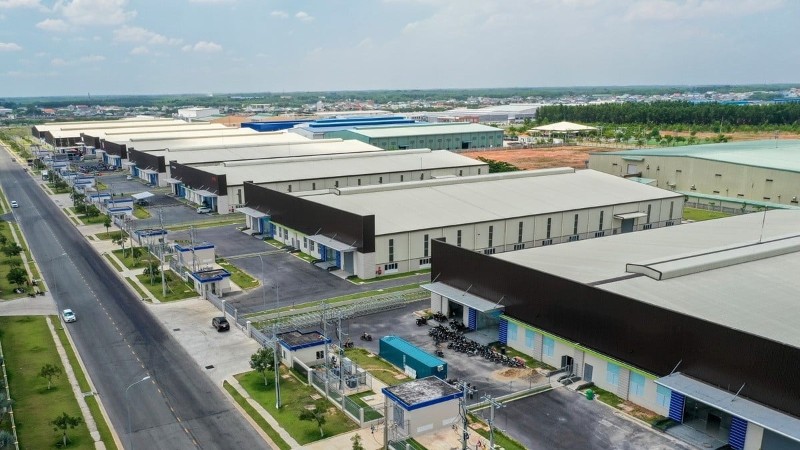
Ho Chi Minh City is studying dedicated mechanisms and support policies to transition its existing industrial zones into eco-industrial and circular models, amid continued strong foreign and domestic investment inflows into its network of export processing and industrial zones.
On September 24, the Ho Chi Minh City Export Processing and Industrial Zones Authority (HEPZA) held a consultative conference to gather feedback on draft municipal People’s Council resolutions guiding the implementation of the Law on Urban Development across the city.
Under the Law on Urban Development, the City People’s Council holds the authority to issue criteria, roadmaps, and incentive policies for eco-industrial park development. HEPZA has beeen assigned to draft two resolutions to put these mandates into practice.
The objective is to accelerate the transition of existing export processing zones (EPZs) and industrial parks (IPs) toward green, high-tech, and circular operations. Under this framework, infrastructure, technology, resource efficiency, and inter-firm linkages are integrated into a single cohesive development structure.
This approach departs from merely building additional greenfield industrial zones. The city has already laid preparatory groundwork for this direction: the municipal Green Growth Action Plan for 2024–2030 mandates reviewing and refining eco-industrial park policies, applying circular economy principles to the construction, operation, and management of EPZs and IPs, and fostering industrial symbiosis among tenants within the same zone, across different parks, and between industrial parks and adjacent urban areas.
The city has also outlined a pilot project to convert five export processing zones and industrial parks by 2030, with a vision toward 2050.
Upgrading IPs to attract higher-quality capital
Statistics show that in the first nine months of 2026, total investment attracted into these zones surpassed $5.57 billion—reaching 131.15% of the annual target and rising 29.13% year on year. Foreign direct investment (FDI) accounted for over $4.2 billion, a 62.22% surge. HEPZA granted investment licenses to 100 new FDI projects capitalized at $3.14 billion, while 120 operational projects expanded capital by a combined $1.12 billion.
For the 2026–2030 period, HEPZA aims to attract an aggregate investment volume of $20 billion to $21 billion, targeting an average investment density of $8 million to $10 million per hectare and a disbursement rate exceeding 70% of registered capital.
These figures illustrate that industrial land requirements extend well beyond the simple capacity to absorb additional projects. As the city's investment promotion shifts toward high technology, substantial value addition, innovation, and green growth, the quality of infrastructure and the production ecosystem within industrial parks have become decisive components of the overall investment climate.
At the September 24 conference, a representative of Becamex IDC recommended that the municipal administration benchmark eco-industrial park criteria against international standards. The developer also proposed exploring partnerships with multilateral organizations such as the International Finance Corporation (IFC) to evaluate and certify eco-industrial parks internationally. Aligning with global standards would enable tenant manufacturers within these parks to fulfill stringent requirements across demanding export markets.
Under the master plan for the city’s export processing and industrial zones for 2021–2030, with a vision toward 2050, the southern hub encompasses 105 export processing and industrial zones covering a combined planned area of over 50,288 ha.
 Google translate