


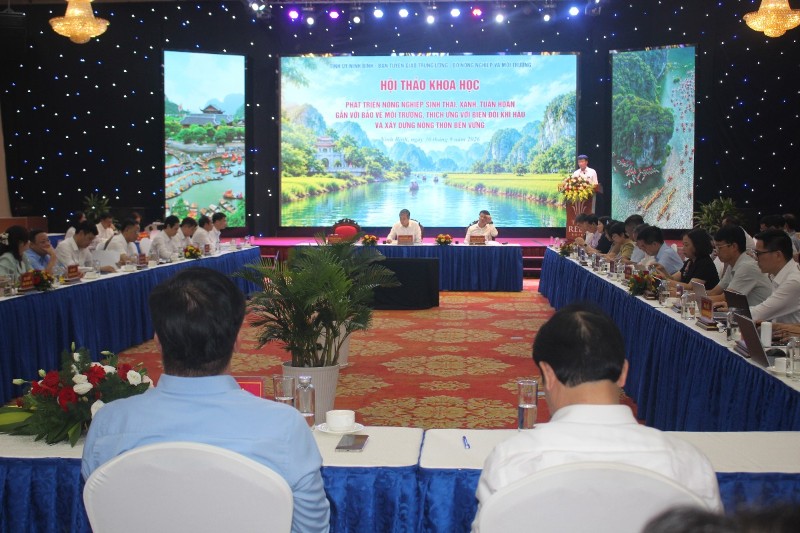
At a scientific workshop held on September 30 by the Party Committee of the northern Ninh Binh province, the Party Central Committee's Commission for Information and Education, and the Ministry of Agriculture and Environment, discussions focused on strategies to develop ecological agriculture alongside environmental protection, climate adaptation, and sustainable rural development in the Red River Delta province.
Speaking at the event, Mr. Ngo Dong Hai, Deputy Head of the Party Central Committee's Commission for Information and Education, emphasized that modern agriculture must look beyond basic food security to build ecological farming, modern rural areas, and civilized farming communities. He noted that changing environmental dynamics require a decisive shift toward green, circular, and low-carbon growth capable of generating sustainable added value.
Following administrative merger since July 2025, Ninh Binh spans nearly 4,000 square kilometers with a population exceeding 4.4 million. The province features a diverse ecosystem ranging from plains and semi-mountainous regions to limestone karst, coastal wetlands, special-use forests, and mangroves.
Mr. Tran Huy Tuan, Secretary of the Ninh Binh Provincial Party Committee, stated that agricultural performance can no longer be measured purely by volume. Production must simultaneously boost economic value, protect soil and water resources, preserve biodiversity, reduce emissions, and secure rural livelihoods.
Under the Resolution of the 1st Provincial Party Congress for the 2025-2030 tenure, Ninh Binh aims to become a centrally run city by 2030, balancing heritage preservation and environmental protection with economic growth, green transformation, and digital adoption. The province targets agricultural, forestry, and fishery production values to reach at least VND220 million ($8,472) per hectare by 2030.
To realize these goals, Ninh Binh is executing its agricultural restructuring scheme for 2026-2030. Since 2024, the province has collaborated with the Vietnam Academy of Agriculture and Japanese partners to implement water-saving, low-emission rice farming aimed at generating carbon credits. The initiative has expanded to over 8,800 hectares across 21 communes, with plans to exceed 15,000 hectares by the Spring 2027 crop.
In aquaculture, the ASC-certified clam farming area in Kim Dong Commune covers 1,205 hectares, providing a foundation for sustainable seafood production tied to environmental management, product traceability, and export markets.
Overall, Ninh Binh currently hosts over 400 agricultural enterprises, 1,074 agricultural cooperatives, more than 120 production-to-consumption supply chains, and 279 certified growing area codes spanning over 7,500 hectares.
Despite progress, structural bottlenecks remain. Addressing the workshop, Dr. Nguyen Sy Linh from the Institute of Strategy and Policy on Agriculture and Environment, under the Ministry of Agriculture and Environment, identified key challenges, including project-dependent mindsets, sectoral policy fragmentation, asymmetric value distribution for eco-conscious farmers, lack of impact measurement frameworks, weak market demand for eco-products, and limited local administrative capacity.
To resolve these constraints, Dr. Linh proposed five fundamental transitions: optimizing total economic value rather than maximizing yield, shifting from isolated households to regional eco-zones, transitioning from basic products to full value chains, managing outcomes rather than inputs, and moving from single-model subsidies to systemic capacity investment.





 Google translate