


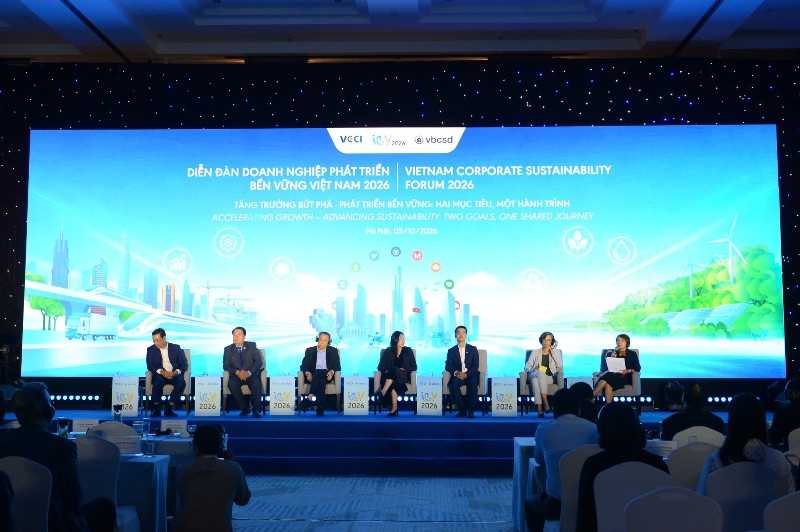
This strategic shift formed the focal point of discussions at the Vietnam Corporate Sustainable Forum 2026 (VCSF 2026), which was co-organized on October 5 by the Vietnam Chamber of Commerce and Industry (VCCI) and the Vietnam Business Council for Sustainable Development (VBCSD), with the theme “Accelerating Growth – Advancing Sustainability: Two Goals, One Shared Journey.”
Delegates emphasized the pressing need to construct a collaborative ecosystem bridging state agencies, commercial enterprises, smallholders, and research institutes.
Speaking at the forum, Mr. Ho Sy Hung, Chairman of the Vietnam Chamber of Commerce and Industry (VCCI), stressed that Vietnam is entering a growth stage where competitive advantages depend on technology, data, artificial intelligence, and automation.
He added enterprises must generate higher value from labor and raw materials, accelerating economic growth while dampening environmental pressure. Green transformation should be viewed as a primary source of market edge. Emission reduction, product traceability, and sustainable governance are becoming mandatory baseline requirements for Vietnamese goods to enter international markets.
However, small and medium-sized enterprises (SMEs) face operational hurdles executing full-scale green transitions independently. Mr. Hung highlighted the necessity of constructing comprehensive value chains connecting large corporations, SMEs, universities, financial institutions, and government bodies, transitioning from a mindset where enterprises simply execute policies to one where the state and business community co-create development frameworks.
From an international perspective, Mr. Bui Minh Giap, Principal Economist, Asian Development Bank - Vietnam, noted that the nation must shift decisively from capital- and labor-driven expansion toward productivity- and innovation-led growth. Amid population aging, rising wage costs, and intensifying regional competition, productivity must serve as the primary metric for economic progress. Innovation should extend beyond high-tech investments to encompass practical, incremental improvements in manufacturing processes, corporate governance, and energy efficiency.
Foreign direct investment (FDI) attraction should similarly prioritize technology transfer, local business integration, and workforce training over mere capital volume.
Enterprise updates demonstrate that sustainable practices are embedding deeper into domestic supply networks. Mr. Binu Jacob, Managing Director of Nestlé Vietnam and Co-Chair of the Vietnam Business Council for Sustainable Development (VBCSD), pointed to local deep processing over yield expansion as key to driving coffee industry value under land and water constraints.
Partnering with 23,000 Central Highlands farming households, the company supports regenerative agriculture, water efficiency, and international compliance. Maximizing commodity value, Mr. Jacob noted, requires structured coordination across government, business, smallholders, and research entities.
Mr. James Crampton, Corporate Affairs Director at Heineken Vietnam and VBCSD representative, emphasized the role of FDI enterprises in generating economic value through responsible business practices. Beyond internal production targets, Heineken builds satellite vendor ecosystems, supporting local distributors in boosting capacity, resource conservation, recycling, and water use efficiency.
Among domestic corporations, Mr. Le Hoang Minh, Executive Director of Production at Vinamilk, shared strategies for embedding sustainability into manufacturing while extending social impacts. Vinamilk focuses on energy transition, circular economy models, and greenhouse gas inventories. The firm utilizes renewable energy, processes livestock waste into biogas and organic fertilizer, and optimizes water recirculation.
The company has extended sustainability metrics across its supply chain by partnering with 4,000 dairy farming households, providing technical guidance, and incorporating ESG criteria into supplier evaluations. These initiatives illustrate that green transformation must extend beyond factory walls to encompass producers, suppliers, and end consumers.
Addressing regional implementation, Mr. Le Van Anh, Vice Chairman of the People’s Committee of Quang Ninh Province, aaffirmed that breakthrough growth and sustainability must proceed in tandem as the province transitions from a “brown” to a “green” economy centered on high-tech manufacturing, marine economics, green tourism, and digital trade.
To accelerate this shift, he advocated granting local authorities greater autonomy to pilot circular economy models, carbon credit markets, and clean energy projects through formal public-private collaboration.
Insights from the forum confirmed that sustainable development is evolving from an isolated corporate compliance requirement into a macroeconomic imperative. When FDI corporations link with local suppliers, major enterprises support agricultural smallholders, and the state provides supportive regulatory environments, green transformation yields sustainable commercial value.
This integrated strategy provides the framework for Vietnam to enhance productivity, elevate product quality, meet stringent international standards, and advance its position across global value chains.

 Google translate