


The Hanoi Party Committee has issued
Under a plan to implement the Politburo's Resolution No. 70-NQ/TW on ensuring national energy security by 2030, with a vision towards 2045, Hanoi targets a commercial electricity output of 52,178,000 kWh, with an average consumption of approximately 5,721 kWh per person annually, and the peak capacity expected to reach 9,400 MW, by 2030.
The plan was recently issued by the Hanoi Party Committee, aiming to enhance the capital's electricity supply capacity and reserve power in the coming years, in order to meet economic growth demands.
Hanoi is steering towards a renewable energy share of at least 5 per cent in the total primary energy supply and aims to develop a total solar power capacity of about 1,500 MW by 2030.
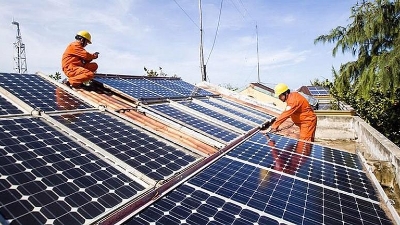
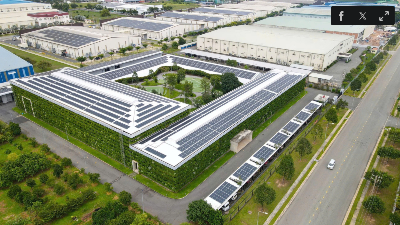
To that end, the city will invest heavily in centralized solar power projects and install rooftop solar systems in industrial parks, high-tech zones, industrial clusters, government offices, apartment buildings, high-rises, and commercial-service-residential complexes.
Accordingly, 50 per cent of public buildings will utilize rooftop solar power systems under a self-production and self-consumption model, without selling surplus electricity to the national grid. Additionally, the city aims to increase waste-to-energy capacity to approximately 280 MW by 2030.
The plan also sets a target to save 8-10 per cent of the city's total energy consumption.
Furthermore, Hanoi aims to develop liquefied natural gas (LNG) import facilities to meet the needs of gas-fired power plants and other sectors, and establish centralized LNG energy centers in a harmonious and synchronized manner.
Environmentally, Hanoi strives to reduce greenhouse gas emissions from energy consumption by 15-35 per cent, compared to the business-as-usual scenario, aligning with an economic growth target of 11 per cent or more in 2026 and subsequent years.
The city is also building a smart, efficient power grid capable of safe regional connectivity.
Looking towards 2045, Hanoi aims to ensure robust national energy security, develop a competitive, transparent, and efficient energy and electricity market, and foster a sustainable, resource-efficient energy sector that reduces greenhouse gas emissions and adapts to climate change.






 Google translate