


The Ho Chi Minh City Department of Science and Technology has begun issuing high-tech enterprise certificates under a new decentralized mechanism. This move is designed to help businesses access support policies, promote innovation, and master core technologies.
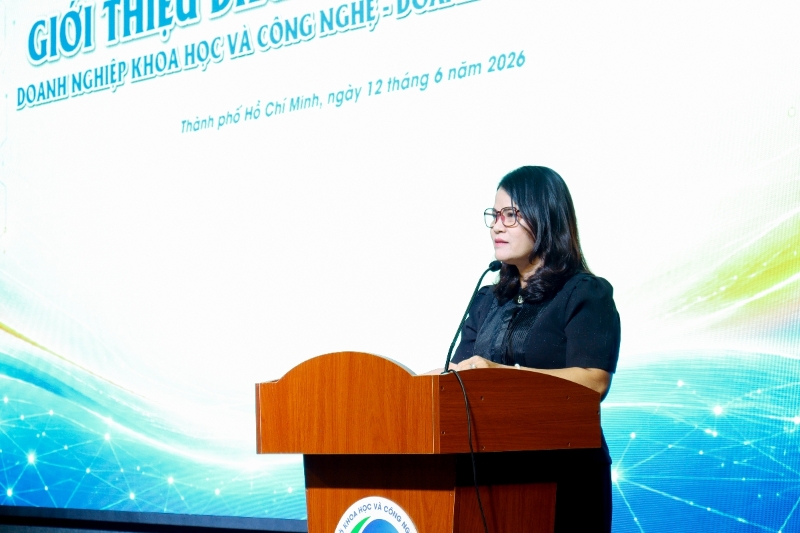
On June 12, the department organized a conference to introduce certification conditions for science, technology, and high-Tech enterprises.
Speaking at the event, Ms. Nguyen Hoang Bao Tran, Deputy Director of the department, stated that science, technology, innovation, and digital transformation are identified as vital drivers for socio-economic development in the new era.
According to Ms. Tran, this direction has been institutionalized in the Politburo’s Resolution No. 57-NQ/TW. The goal is to transform science and technology into a direct productive force, fostering Vietnamese enterprises capable of mastering technology and participating more deeply in global value chains.
In the context of a rapidly growing knowledge economy, a company’s competitive advantage no longer depends primarily on capital or cheap labor. Instead, it is increasingly determined by technology, data, and intellectual property (IP). Enterprises that own core technologies, patents, and robust R&D capabilities are expected to maintain a more sustainable competitive edge.
During the session, Deputy Head of the department's Technology Management Division Phan Quoc Tuan introduced the specific criteria and procedures for certification.
To qualify as a science and technology enterprise, a firm must have products derived from scientific research, technological development, or innovation. The research results used for certification can include patents, utility solutions, industrial designs, copyrighted software, or officially recognized research findings.
A key criterion is that the enterprise must maintain R&D and innovation spending of at least 2% of its average net revenue during the review period. Additionally, it must meet specific requirements regarding R&D personnel and revenue generated from science and technology products.
Despite having strong products and stable markets, many businesses still face difficulties in the certification process. These challenges often stem from a lack of structured R&D systems or a failure to prioritize the establishment of intellectual property rights.






 Google translate