


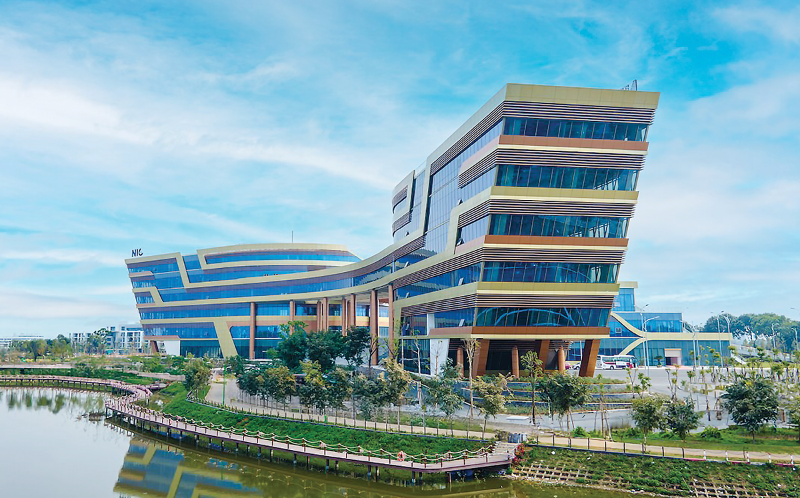
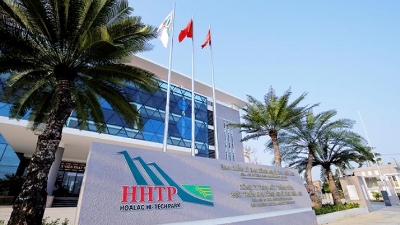
Almost three decades ago, Hoa Lac Hi-Tech Park was envisioned as a research and innovation center modeled on some of the world’s most successful technology parks. While it has since developed the foundations of a science and technology ecosystem, Hanoi leaders believe the Park must now evolve beyond the traditional high-tech park model into a modern science and technology city to support the capital’s next phase of development.
A series of policies and strategic decisions being issued recently signals a strong commitment from both the Party leadership and the Hanoi administration to transform Hoa Lac into the nucleus of the capital’s innovation ecosystem and a new growth engine for the knowledge economy.
Current developments
Since its establishment under Decision No. 198/1998/QD-TTg, dated October 12, 1998, Hoa Lac Hi-Tech Park has attracted 113 projects with total registered investment of around $5 billion. The Park is home to major domestic and international technology companies, including Viettel, FPT, and VNPT from Vietnam, South Korea’s Hanwha, and Japan’s Nidec, alongside research institutions such as the Vietnam-Korea Institute of Science and Technology (VKIST), the Vietnam National Space Center, Vietnam National University, Hanoi, FPT University, and several other higher education institutions. Together, these organizations are gradually creating an ecosystem that connects education, scientific research, technology development, and manufacturing.
Under Hanoi’s higher education development strategy outlined in the Capital Master Plan with a 100-year vision, Hoa Lac University Town will be expanded by approximately 1,500 ha, bringing its total area to 2,500 ha. The expanded zone will bring together universities, research institutes, R&D centers, technology companies, and innovation support institutions to create a complete ecosystem where knowledge is transformed into technology and technology is commercialized into high-value products.
Despite this progress, a recent report from the Hanoi High-Tech and Industrial Park Management Board (HHTIP) showed that only about 42 per cent of Hoa Lac’s commercial land has been occupied. Technical infrastructure, science and technology infrastructure, digital infrastructure, and social infrastructure also remain incomplete. The figures point to substantial room for growth, but they also highlight persistent bottlenecks that must be addressed if Hoa Lac is to become both Hanoi’s technology growth pole and one of Vietnam’s leading innovation centers.
Speaking at a recent working session with the HHTIP, Vice Chairman of the Hanoi People’s Committee Truong Viet Dung said the greatest obstacle is no longer infrastructure but development thinking. He argued that sustainable high-tech parks are built around a “1+1” ecosystem model that combines advanced technology with a modern urban environment. Such a model creates not only a center for research and innovation but also a hub capable of generating economic value and driving the capital’s innovation ecosystem.
Hoa Lac’s current development model has reached its limits, he believes. The Park therefore needs a new development mindset, stronger governance, greater management autonomy, and a more selective approach to attracting investors in strategic high-tech industries. At the same time, commercial services, education, healthcare, housing, and urban amenities must be developed in parallel to complete the ecosystem.
The ultimate goal is to transform Hoa Lac into a modern science and technology city and the nation’s leading center for research, education, innovation, and technology transfer, creating a new growth engine for western Hanoi.
Mr. Nguyen Van Phong, Vice Secretary of the Hanoi Party Committee shared the same view, saying the biggest limitation has been treating Hoa Lac as a standalone high-tech park. Around the world, he noted, successful innovation ecosystems emerge only when technology parks are integrated with universities, research institutes, modern urban areas, transport infrastructure, healthcare, education, and business support services.
Under current master plans, Hanoi and Ho Chi Minh City will need to mobilize an estimated $214 billion to $241 billion to develop more than 2,000 km of metro lines. The greatest challenge, however, is not simply securing sufficient capital, but designing a financing framework that enables the system to continue attracting investment, operate efficiently, and maintain long-term fiscal sustainability.
The timing is especially significant, he continued, as Hanoi revises its master plan and prepares to launch a series of major investment projects. In the years to come, the city should implement a development roadmap with clear priorities, focusing on planning, infrastructure, innovation ecosystem development, and the targeted attraction of strategic investors.
New incentives
Hanoi’s leaders believe Hoa Lac has strong potential to attract leading global technology investors if it succeeds in building a complete innovation ecosystem. That means developing not only technology infrastructure but also skilled human resources, university networks, electricity and transport systems, cultural facilities, healthcare, education, housing for experts and workers, and a business environment that supports long-term investment.
Politburo Resolution No. 57-NQ/TW on breakthroughs in science, technology, innovation, and national digital transformation identifies Hanoi as a pioneer in implementing new development models. The Resolution is expected to create fresh opportunities to attract investment into strategic technology industries while reinforcing Hoa Lac’s role as the capital’s science and technology hub.
At the same time, Politburo Resolution No. 02/2026/NQ-TW on the development of Hanoi sets the objective of turning the capital into a center for innovation, digital technology, and high-value services via breakthrough policies that strengthen its national leadership role and enhance its regional and international competitiveness.
Under the Resolution, Hoa Lac Hi-Tech Park will serve as the country’s core R&D center, piloting new policies, technologies, business models, and regulatory sandbox mechanisms while promoting research commercialization, startup development, and high-quality workforce training.
However, city leaders argue that granting special development mechanisms alone will not be enough. The criteria used to measure Hoa Lac’s performance must also change. Instead of focusing primarily on land occupancy rates or the number of investment projects, they say success should be measured by innovation outcomes, including patent registrations, the number of science and technology enterprises established, revenue generated from core technologies, startups securing investment, research commercialization, and the share of value-added created within Hoa Lac itself. These indicators, they argue, provide a far more accurate measure of the vitality of a modern science and technology city.
Hoa Lac Hi-Tech Park is now at a pivotal stage in its development. The convergence of strong political commitment through recent Party resolutions, the special mechanisms introduced under the revised Capital Law, and Hanoi’s new development strategy presents a rare opportunity to transform the park into a modern science and technology city.


 Google translate